Forum | Point/Counterpoint
Point: Reality TV is more than a “guilty pleasure”
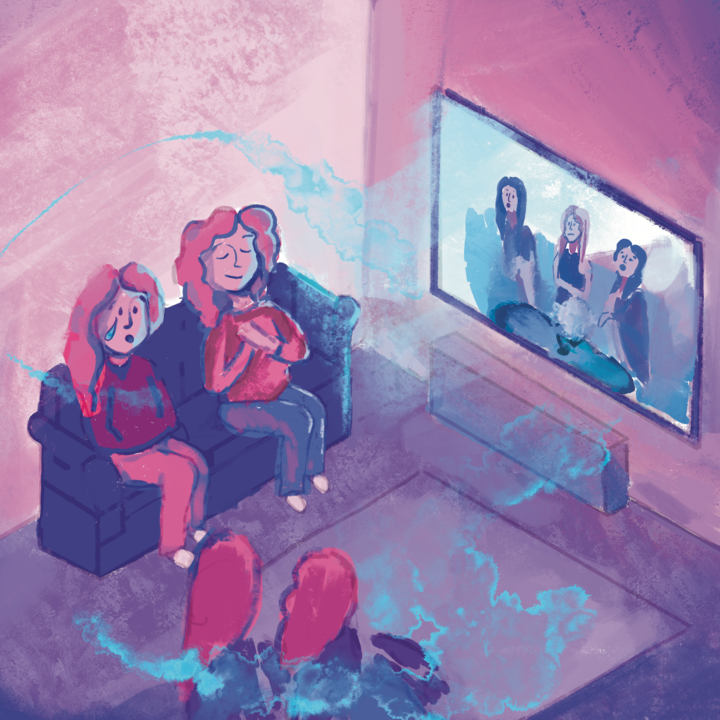
Tillie Szwartz | Contributing Illustrator
Whenever I talk about my interest in reality television, someone (usually a guy) without fail will chime in to tell me how stupid and shallow they think it is. People often dismiss the consumption of reality TV as a “guilty pleasure” and regard it as lowbrow, but I feel no embarrassment about my love for it. Beneath the chaos and confessionals, there is something that is worth taking seriously. Unlike scripted media, these shows offer an unfiltered glimpse into the social circles of men and women who live very different lives than ours.
Reality TV shows tackle a wide array of topics, both trivial and serious, like relationships, running a business, addiction, marriage, and mental health. What’s more interesting, though, is that we get to see how everyone in the show reacts to these issues as they come up. We see how Lisa from “The Real Housewives of Salt Lake City” comforts Meredith through her marital issues and how Kyle from “The Real Housewives of Beverly Hills” approaches Adrienne about the rumors that she’s selling stories to the press. We see how Kim makes amends with her family after struggling with addiction for years and how Taylor learns to live after the passing of her husband.
While it may be hard to see past all the drama-filled clips posted online or the heated moments you see while walking past your sister’s room, the cast of these shows demonstrates true vulnerability.
Writing off interactions between castmates as “trash” is harmful and represents something deeper about our society. Reality TV is one of the few spaces in the entertainment industry where women are present in large numbers, not only as cast members, but as producers (with female producers making up 41.5% for unscripted television) and audiences. The dismissal of these shows reflects a broader condescension of women’s social spaces. Whether it’s boy bands, romance novels, or beauty influencers, the interests of women are often deemed shallow and not worth analyzing, while traditionally “male” hobbies and interests (sports, video games, movies by male directors, etc.) are given respect.
Two big criticisms of reality television are that these shows are “scripted and fake” and that the cast is being exploited by producers.
Yes, producers do meddle in the affairs of cast members to create drama that favors a television screen, but to say that the entirety of these shows is scripted simply isn’t true. The castmates of these shows aren’t actors; they are businesswomen, mothers, friends, and rivals, all consenting to sharing their lives with us. While the drama we see on the show is amplified by producers, it isn’t created from nothing.
As for exploitation, this is an industry issue that is not exclusive to this genre. Instead of dismissing the entire medium, we should push for accountability among producers and protection for participants, while also acknowledging the cultural value of these shows.
Reality TV shows the unfiltered, messy, mistake-ridden lives of human beings (which is perhaps why critics may feel uncomfortable with it). This showcase of love, ambition, and struggle enriches the lives of many when they come home from work or school. It allows them to relate to people who are seemingly nothing like them. So before you make fun of your sister or girlfriend for watching a reality TV show, sit down and watch an episode or two with her. Maybe after actually watching, you will be able to take the stories of these individuals seriously.
Stay in Touch!
Get the latest and top news from StudentLife delivered to your inbox