Forum
AI can make art, but is it really art?
Kevin Kan | Illustration Editor
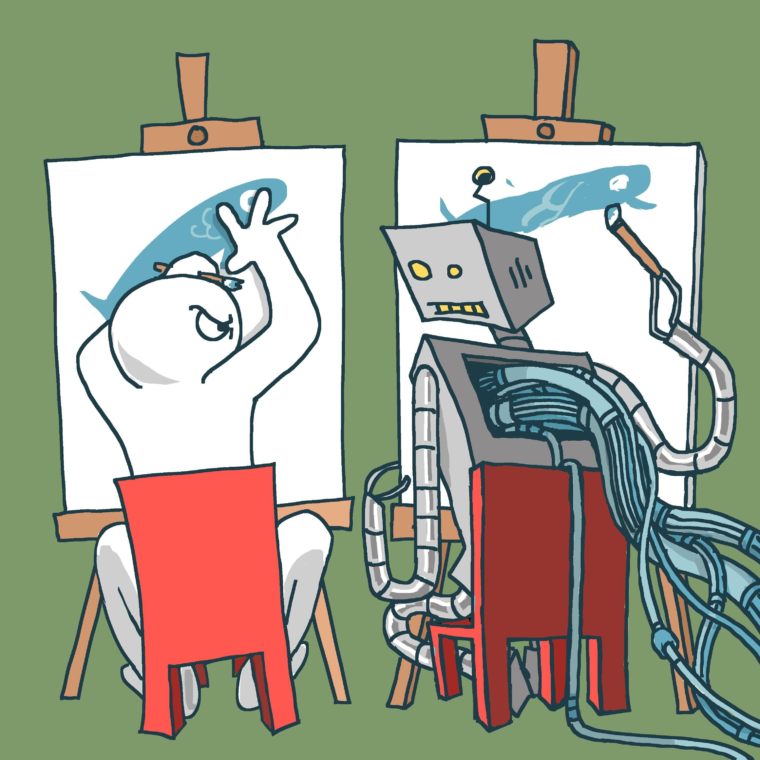
It’s the hottest question in college philosophy debates, a question that is boiling the blood of many creatives and instilling a subtle but growing fear that the very core of what makes us human is being slowly usurped and nullified by machines: Can artificial intelligence make art? It seems that AI has done a pretty good job of convincing us that it can create works comparable to those of the great masters — sometimes doing it better.
As an art history minor, this question used to enrage me. I gained a love for the masterworks I studied, and the insinuation that AI could simply “replicate” amazing art seemed like an erasure of everything I had learned. Yet the minor also gave me the tools to critically assess current arguments surrounding AI art, a debate which quickly expands into the endless controversy of what constitutes “art” at all.
Yet my experience didn’t involve having discussions about AI art in art history classes, nor did I have the philosophical groundwork necessary to critically assess what makes AI art so complex compared to human art. I decided to talk to students from Professor Megan Entwistle’s “Philosophy of Mind” class about the issue. AI art is a topic frequently mulled over in their class, as students draft papers about anything they find “philosophically engaging.” Many students are crafting arguments that focus on AI and its likeness to human minds.
“Just because machines can produce the same output that humans can — a computer can pass the Turing test, it can write in a way that is human — doesn’t mean the process behind it is the same,” said Clara Beth Lee, a sophomore writing a paper on whether machines can think. “If we’re only looking at the output, which, in this case, is the image AI produces, and you think that’s all that matters, then sure, that could be art. But a lot of human artists would say that’s not really how it works. It takes hours and hours of work to create magnificent pieces of art. … It takes years of study, of observing the world and having feelings about it — an artist would tell you that’s the part that matters more.”
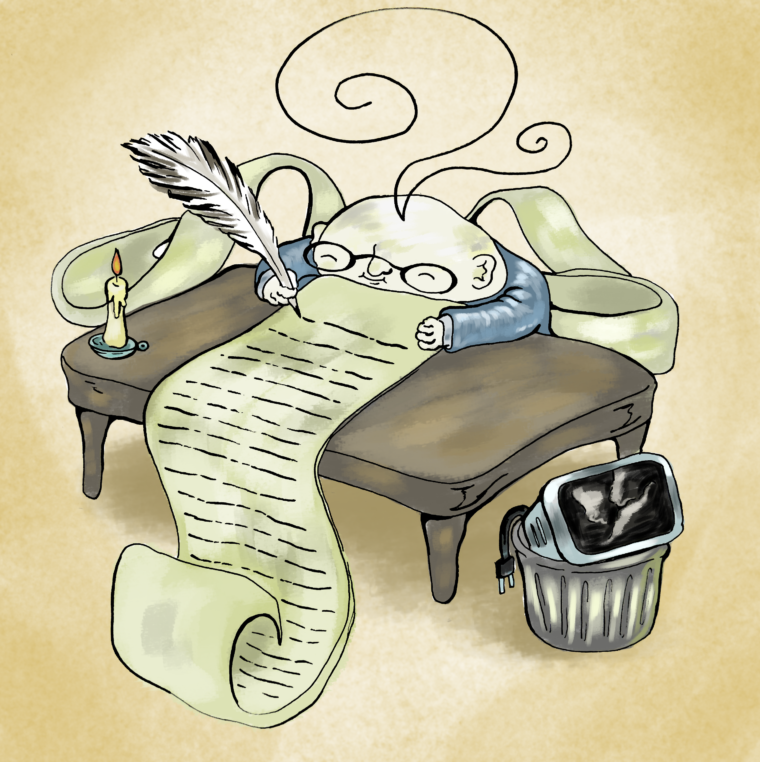
Lee makes a good point: a machine’s effortless automatic processing seems far less impressive than a human artist’s lifetime dedication to mastering the craft, overcoming endless trial and error to achieve perfection.
But not all art is created equally. In fact, some of the most groundbreaking art ever made took no time at all. Take Marcel Duchamp’s “L.H.O.O.Q.,” a piece far more obscure than his famous “Fountain” but just as controversial. It is, in essence, a postcard of the Mona Lisa which he purchased, drew a mustache on with a pen, and wrote the letters “LHOOQ” at the bottom. Or consider the famous duct-taped banana, called “Comedian,” by artist Maurizio Cattelan. Both pieces probably took around five minutes. Both also directly challenged what “art” could mean, stripping away previous markers of “real” art, like originality, skill, and authenticity — qualifications which continue to be challenged by AI art. Many art critics did not, and still do not, believe these pieces to be works of art.
Yet both works have been featured in museums, sold at auctions, and studied in art history classes, including here at WashU. My art history class on Dada and Surrealism taught this conceptual art-making process as a form of “transubstantiation”; the objects become art, without physically changing, by way of ritual (the art-making process) and perception (we think it’s art, so it is). In this sense, one could see how AI “art” could be perceived as capital-A Art. By whatever process, the machine is creating art. It doesn’t matter how long it takes or what techniques it has or hasn’t mastered. And, if we decide it’s art, then it has to be.
Many other students agree with Lee, arguing that the intention of an artist matters significantly in discerning “real” art. Cassandra Leo, a junior in the “Philosophy of Mind” class, remarked that “art should have functionality and intention behind it, which AI doesn’t have, because it’s being told by a person what to do in the first place.”
The same argument is often used when explaining why animals can’t make “real” art. For instance, Pigcasso, the famous “painting pig,” was given plenty of instructions and treats before he began putting paintbrushes to canvas. Any “artworks” he produced were, unfortunately for his fans, directed by his trainer. Even when Pigcasso would take to the canvas at his own volition, it was for the singular purpose of gaining a reward. In that case, should we think of AI “artists” in the same way we think of animal “artists”: vectors of human intention, neither being in full control of what (or when) they can create?
To further complicate the matter, artists have also begun using AI’s generative abilities as a tool to create their own artworks. In the case of artist and WashU Chair of MFA in Visual Art Tiffany Calvert, using AI in art is an important aspect of critiquing our society’s growing reliance on it. Unlike corporate-owned generative AI programs, however, Calvert’s unique program used the help of researchers at the McKelvey School of Engineering to create a model that exclusively uses her own collected dataset of 16th century Flemish and Dutch artworks.
“My current works are very thick abstract paintings on top of reproductions of machine-generated imagery,” Calvert said. In these works, Calvert paints colorful, abstract brushstrokes over and out of the AI artwork, an important part of her process, which, as she puts it, “pits human against digital. This contrast, together with the uncanny and irresolvable nature of the paintings are intended to demonstrate or act out the failures, biases, and dangers of AI.”
Her ingenious meshing of man and machine produces groundbreaking masterpieces, which prompt audiences to question the ways we use this powerful technology. For Calvert, this has always been an essential role of the artist, to expose the different and subversive ways that knowledge can be used.
“Artists have always adopted new technologies early on and used those technologies in sometimes unconventional or even ‘incorrect’ ways. … They are asking us not to take new technologies for granted, but to literally turn them inside out or see them through a different lens in order to consider how those technologies are changing us and the world,” Calvert said. In Calvert’s case, it seems, AI’s generative tech can expand human art rather than limit it.
But there comes another crucial viewpoint when considering the difference between human art and AI “art.” Ada Sensoy, a junior, puts it best: “AI can’t create happy accidents.” It seems, then, that art does not rely completely on intention, but may rather hinge on the unintentional: mistakes that only humans can make, which, in some cases, become a crucial part of the artwork itself. Another great example from Duchamp is “The Bride Stripped Bare by her Bachelors, Even,” also known as “The Large Glass.” It is — you guessed it — two large slabs of glass, inlaid with abstract forms. You can imagine, then, the “happy accident” that occurred while the 9-foot piece was transported from the Brooklyn Museum. Duchamp, a lover of the unintentional in art, decided to leave the shattered piece as it was: broken, yet more complete than ever. Often, it is these “mistakes” by famous artists which solidify their names in the canon, and Calvert agrees.
“It doesn’t occur to me to worry about AI replacing artistic creativity or painting specifically — the most interesting paintings are full of human error and quirkiness,” she said.
AI also can make “mistakes,” much like any artist, but it can’t “defy its commissioner,” so to speak, the way Michelangelo directly disobeyed Pope Julius II endless times during the process of painting the Sistine Chapel. AI has to follow our instructions… for now.
It seems that, until the day AI inevitably achieves self-control and decides to create art at will, we can’t conclusively say that these hyperintelligent machines are capable of “making art,” at least by our current definition. Human art can defy; it can mess up; it can disobey. It can be made with the greatest of all intentions or with the simple intention of having no intention. But this process of “defining” art, of boxing it in and categorizing it for our own comfort, limits its greatest purpose: to express an aspect of the human experience, which has infinite interpretations. This, of course, is the great failure of AI art: It cannot create as a reaction to the bewildering experience of being alive. For a software so focused on achieving perfection, it has ironically revealed how much we as a society actually appreciate the flaws of art, imperfections which, when noticed, reflect back to us our own humanity.
Stay in Touch!
Get the latest and top news from StudentLife delivered to your inbox