Forum
Rings of Power: How metal bands symbolize strength, creativity, and status
 Erica Shi | Staff Illustrator
 The squeal “Let me see, let me see!” erupted from the doorstep before the bride-to-be had even opened the heavy-set door. A gaggle of 20-something girls pounced eagerly on a bony French-manicured hand. There, glistening on her left hand, fourth finger, was the engagement ring. Not just any ring — a 3.2-carat emerald-cut diamond, sourced from the world-renowned Argyle Diamond Mine in Australia, graded D, a 3.0 on the GIA scale, set in a custom-made white-gold band, channel-set with 48 pave diamonds, each cut to exacting standards. “Restroom,” one mousy-haired girl choked as she clicked away from the squealing mob, already pulling out her phone. Leaning heavily against the door frame, she determined this 3.2-carat monstrosity landed at a modest $48,750. After washing her tear-streaked face, our young heroine plunged into the frenzy, sliding her left hand easily into her back pocket — the rock on her own engagement ring was small enough that it wouldn’t get caught.
The experience shared by this young girl and the other 12 or so women waiting outside the bathroom to perform the same price-search is not unprecedented. Indeed, while rings have long symbolized personal strength, self-expression, and love, these symbols of love have increasingly been overshadowed by their stature as status symbols, distorting their original meaning.
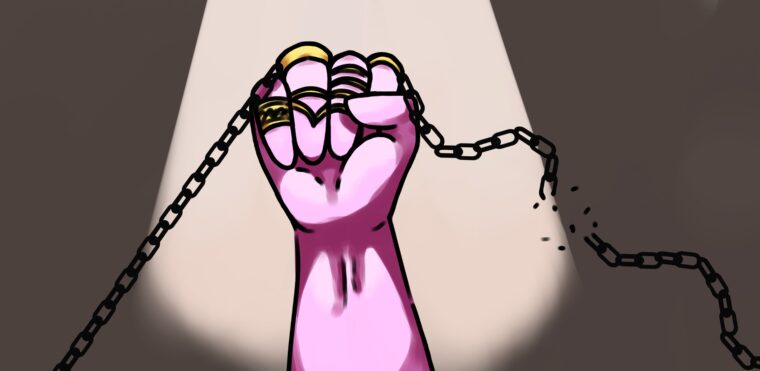
Rings have long served as symbols of power, providing their wearer an additional layer of armor. While I do not know if this capability is solely reserved for rings — after all, the right pair of earrings can feel pretty damn empowering — it’s certainly a notable strength.
I am continually puzzled when my friends pair sweatpants or athleisure with five or more rings. It always struck me as terribly mismatched — aren’t rings meant to accessorize more formal ensembles? Just as someone may look at me strangely for not wearing rings with a cocktail dress, I might do the same when they wear 10 rings to the gym. What I have come to realize is that clothing and jewelry are not mutually exclusive. As the seasonal depression begins to creep in, I’ve come to understand that it’s about what makes you feel strong — what you need to wear to get through these dark and dreary months.
Isabella Giordano, a social media personality well-known for her accessorized lifestyle, embodies this idea. She routinely encourages her viewers to “get stacked” with her, while she adorns herself with roughly eight necklaces, 12 bracelets per arm, and two rings per finger. For Isabella, who suffers from a chronic autoimmune illness, wearing jewelry goes beyond mere decoration. She explains, “I’m really sick, and [wearing jewelry] makes me feel so powerful every single day. When I put all my jewelry on, it’s armor — it makes me feel better.” Now, as the founder of The Sick and Stacked Society, Giordano is a sparkling (quite literally) example of the strength that jewelry — especially rings — can represent.
In a similar vein, researchers in Japan conducted a study to see if wearing rings could improve behavioral and psychological symptoms in female dementia patients. The researchers focused on how wearing rings could reinforce patients’ sense of attractiveness, fostering internal validation. The rings also prompted positive compliments from caregivers, further enhancing patients’ self-esteem. The results were overwhelmingly positive, underscoring the important role played by these “rings of power.”
Beyond serving as powerful symbols, rings also inspire creativity and foster personal expression. This is hardly a new concept: One of the earliest birthplaces of rings, Ancient Greece, celebrated decoration, with its citizens failing to rest until their extremities were fully dressed in gold and silver. In stark contrast to Ancient Greece, I attended an all-girls school in middle school with a strict dress code: Skirts had to stay below the knee, shoulders were to remain covered, logos were forbidden, and only gray was permitted — personality was, well, nonexistent. The only thing not regulated was jewelry. No nose rings, sure. Besides that, you had your pick of the metallic mecca.
In many restrictive environments like my all-girls school — professional workplaces, the airline and hospitality industry, and the military — rings offer a rare opportunity to infuse creativity and personality into one’s appearance. Not to mention that rings have evolved, breaking their typical norms: You’ll now find pinky rings, intricate ring stacks, signet rings, and the occasional toe ring (although, I must admit, I don’t know if I can support that choice).
While rings have made their way south to toes, one placement remains the most symbolic — the fourth finger of the left hand, after which it is named. Whether inspired by Eros, the Greek god of love; the Egyptian belief in the “Vena Amoris” (a vein of love running from the finger to the heart); or Roman “fede” rings depicting two hands clasped in love, a circular ring has symbolized eternal love since its inception. While the ring’s shape and materials have evolved — such as the 17th-century Irish claddagh ring with its heart, crown, and hands, or the introduction of diamonds during the Renaissance — its meaning has remained unchanged. From engagement rings to promise rings, these small circles represent a bond between two people. They also serve as powerful reminders of fidelity, loyalty, and the deep familial connections and heritage passed down through generations.
Unfortunately, however, all that glistens isn’t gold. While rings do serve as symbols of love and devotion, the fourth finger on the left is now burdened by social pressures and expectations — the weight and size of the ring perhaps being the heaviest of them all. The once-symbolic gesture of presenting an engagement ring has been distorted by social media and the obsessive comparison culture that permeates the minds of current millennials and new generations. In many ways, an engagement ring has become transactional: The newly adorned bride-to-be dashes away from her fiance’s outstretched arms in search of her phone. Snap-snap. There it is, plastered all over Instagram.
As a result of the social pressures to snatch the biggest diamond, many individuals feel that they must spend the equivalent of six months’ salary on an engagement ring. In the reality TV show “Selling Sunset,” one gentleman, Romain Bonnet, identified an economic solution: He bought his fiancee, Mary, a moissanite ring. Moissanite is a laboratory-grown mineral that mirrors mine-derived diamonds at a fraction of the price. As demonstrated by a hateful colleague, Davina Potratz, this practical and rational choice does not fool the hawks whose freshly manicured nails are ready to scratch.
No other piece of jewelry seems to invite comparison in the same way. Sure, you may think so-and-so has a nicer necklace than you, but it doesn’t lead to questions about your own social standing. The difference lies in the cultural significance of rings, their visibility, the perceived status they confer, and most significantly, their role in the social media spotlight.
Since the time of the Greeks, Egyptians, and Romans, rings have symbolized power, creativity, and eternal love. However, the rise of social media has distorted this symbol of love, turning engagement rings into tools of status. This shift should serve as a wake-up call to our generation, urging us to reconnect with the historical significance of rings and recognize the harmful cycle they’ve fallen into. Without awareness and change, this torturing cycle, much like the ring itself, will be eternal.
Stay in Touch!
Get the latest and top news from StudentLife delivered to your inbox