Forum
A land acknowledgment isn’t enough for WashU’s dwindling Indigenous population
Washington University’s campus was built on stolen land. St. Louis resides on the traditional land of the Osage tribe, the Illinois Confederacy, the Miami, the Otoe-Missouria, the Quapaw, and many other tribes. However, an online land acknowledgement stating these facts isn’t enough, as WashU is failing both to create a welcoming community for Indigenous students and to support its current ones.
As of 2023, only 0.1% of WashU students are Indigenous, and that number has decreased compared to previous years. The Kathryn M. Buder Center for American Indian Studies at the Brown School attempts to provide scholarships for Indigenous students, but the number of students in the Buder program has significantly decreased in recent years, as it doesn’t do enough to incentivize Indigenous students to come to WashU.
“We used to probably have ten new students a year. However, since COVID, that has dropped to the best we’ve had is four new students, and last year, I was the only new student in the program,” said Brown School student Ashlyn Newcomb. “A lot of us died or had family members die due to our lack of healthcare. So a lot of them don’t want to leave unless you give them a good reason to leave.”
Additionally, there are no Indian Health Services (IHS) clinics nearby, and students are required to pay $2,500 upfront for insurance through the university. “I was told I wouldn’t have to pay for [the university insurance] here, but when I got here I was very mistaken,” Newcomb said.
These costs that are unassociated with tuition and thus not covered by scholarships make universities like WashU inaccessible to Native students. Furthermore, if students like Newcomb end up paying for costs that they were assured would be taken care of, it’s natural that they may feel deceived rather than supported by WashU’s administration — hence the need for WashU to offer greater financial assistance, scholarships, and health services to improve the number of Native students.
The Buder Foundation is the only program strictly providing money for Indigenous students.
“I will say the Buder Program already pays for our scholarships. It pays for our way to go here, and they also pay for a living stipend, but it’s not enough — it’s $1,000. However, I don’t feel like they should be the ones putting up all the money for this,” Newcomb said.
In turn, this apathy has created alienating feelings in Native American students. “Everyone has money here. You’re very much reminded of what you don’t have when you come to a university like this,” Newcomb said.
Another student at the Brown School feels as though Indigenous people at WashU are treated “like they don’t exist” and that there’s a strong sense of “invisible racism.” The lack of Native representation at WashU leads to Native voices not being heard or recognized outside their community.
“I do think that it needs to be acknowledged that we’re not invisible. I think that there needs to be more focus on histories of Natives,” alumni of the Buder program and current PhD student at WashU, Kelly McCall, said.
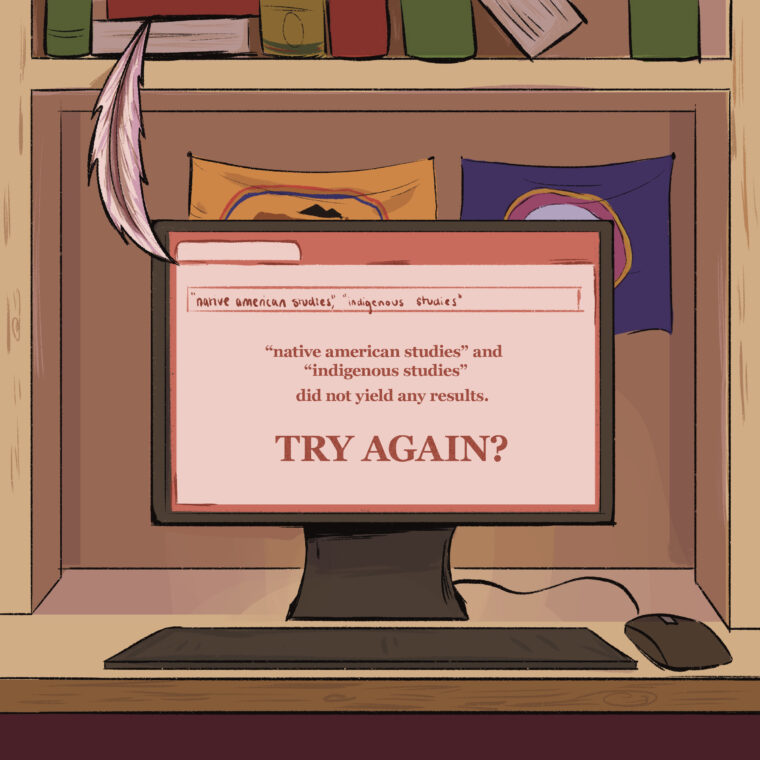
This feeling of invisibility is furthered by a widespread lack of knowledge on Indigenous history. One Brown School student claimed that “most people don’t know American history,” and McCall, along with many other Indigenous students at WashU, also believes that “there needs to be more of a focus on Indigenous studies here.”
WashU lacks sufficient Native American representation in its faculty.
“Definitely hire more Indigenous professors that have experience in academia,” McCall said. “Not just clinicians and masters but actual, experienced, educators, PhDs, that have knowledge in American Indian Alaska Native studies.”
McCall discussed her experiences accessing advising in her studies of American Indian/Alaska Native populations compared to other disciplines.
“For me, as a PhD student, I don’t have that type of mentorship. I definitely have great mentorship in my other areas of interest but when it comes to American Indian Alaskan Native, there’s not a lot, so I have to go outside WashU,” McCall said.
WashU needs to increase its focus in Indigenous studies. As there is a limited number of present professors in this field, it is imperative that attention be given to this dying discipline before it completely vanishes.
Even within the Indigenous community, however, it is difficult to find support with such few numbers.
“What used to be twenty students in our program is now five, so it’s very very small. When there’s more people I feel like it’s easier for us to hang out with one other person, but when they’re only four or five of us, usually someone has something going on,” Newcomb said.
Not only is it difficult for Indigenous students to support one another in such small numbers, but it becomes difficult for them to honor their culture on campus. WashU hosts an annual Powwow, and while this may seem to be a genuine celebration of Indigenous culture, some Indigenous students feel that it is merely performative.
“Indigenous students here are supposed to be more like a show,” one student in the Buder program noted. Last year, fewer than ten students in the American Indian Student Association (AISA) were expected to raise $3,000 on their own in order to pay for the event. In past years, that money has typically been donated; however, the AISA doesn’t think it should be their sole responsibility to fundraise.
WashU funds many clubs and activities for students, and their unwillingness to fund the annual Powwow shows that celebrating Indigenous culture simply isn’t a priority for them. Not only is there very little funding for the AISA, but there’s very little awareness of the club and its events.
“Getting out announcements about AISA events throughout the university rather than just the Brown School would be helpful,” McCall said.
In order to make change, WashU’s Native American divisions must work together to address the lack of representation head-on.
“We do have a Native American law program, but we’re not a part of them. I wish there was more collaboration with them, but … it’s very divided based on what you study,” Newcomb said. This separation leads to a lack of structured community, as the AISA isn’t enough to create an integrated community amongst Native students across WashU.
Without higher numbers of Native students, it’s unlikely that the Native community at WashU will grow much tighter, but unless WashU changes how they support their current Indigenous students, the numbers of Native students at WashU will continue to decrease.
“My hope is that the number of Native students grows. That’s why I’m doing what I’m doing: to encourage more Indigenous students to continue their education, not just going to undergrad but even pass that and try to make sure that we have the resources and the funding and the knowledge to make that happen,” McCall said.
Stay in Touch!
Get the latest and top news from StudentLife delivered to your inbox