News
‘It highlighted the holes in our system’: WashU study examines St. Louis disaster preparedness post-tornado
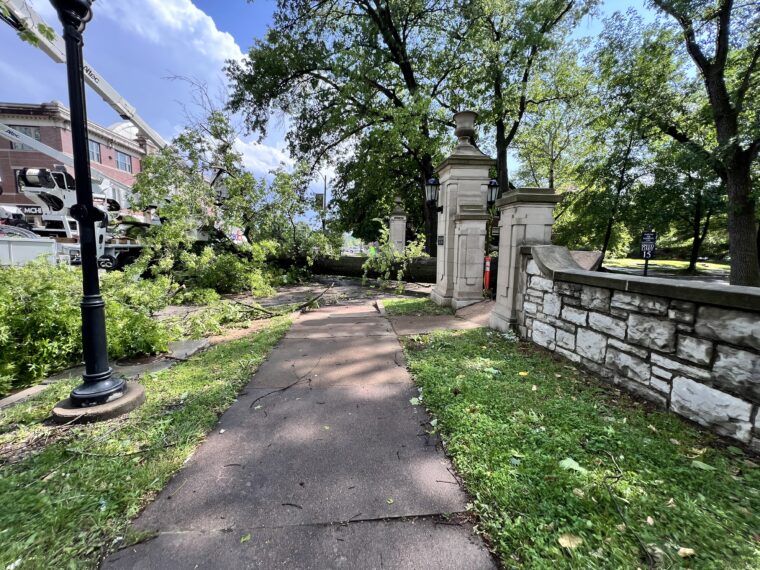
In 2025, a tornado caused damage throughout much of St. Louis. (Photo courtesy of Wilson Hou)
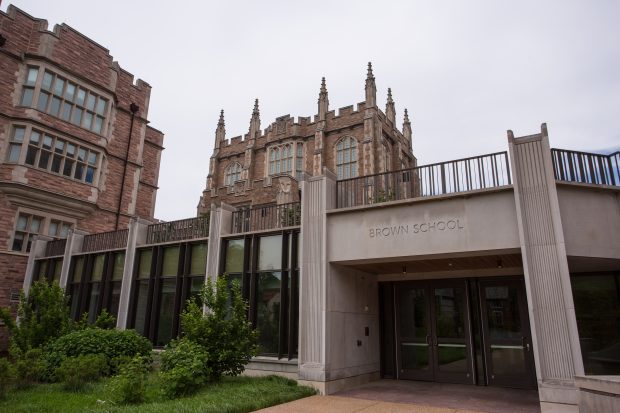
A study from WashU’s Brown School has identified gaps in St. Louis’ emergency preparedness and response, including a lack of funding and a disconnect between community organizers and government.
The study was put together by graduate students at the Brown School before the tornado on May 16, 2025, but it was updated after the disaster caused widespread destruction in St. Louis. The study examined St. Louis’ response to emergencies through a social work lens, highlighting the important role that community organizations, which are often without resources from the city government, play in disaster recovery.
The study pointed out multiple interlocking issues that caused St. Louis to respond ineffectively to the tornado.
“Infrastructure fragmentation, outdated emergency plans, and disjointed agency coordination,” the authors wrote, “further limit the city’s ability to respond effectively [to disasters].”
One former Brown School student who worked on the study, Sara Mendiola, said the report took on new significance after the EF3 tornado hit St. Louis last May.
“I think the tornado ended up acting in a way that highlighted the holes in our system,” Mendiola said. “When you have something so extreme and so quick happen like that, there’s no chance to scramble and patch up the holes really quickly.”
Victoria Anders, another former student who worked on the report, said the tornado called attention to a gap between the city’s resources and the work being done by community organizations.
“What became so clear was that the immediate response to community needs was not being filled by the city,” Anders said. “Largely, it was being filled by community organizations and by the community itself, like people stepping up and giving donations and providing their time and energy to help with clean up.”
The study called for St. Louis to incorporate grassroots community organizations and social work principles into its disaster response.
“Coordination between government agencies and community-based organizations is often ad hoc, siloed, and reactive rather than strategic,” the authors wrote. “By elevating the role of social work and leveraging the strengths of grassroots organizations, the city can build a more connected, resilient, safe, and just future.”
Mendiola said that the region has a divide between the responses of community members and the city government.
“We need to connect the dots between … the people on the ground who are giving [and] talking to people affected by the emergencies and the people at the top who are making up the rules on how to decide what we’re supposed to do in an emergency,” Mediola said.
This divide exists not just between the city government and community groups, but also between governments, according to the study. The report examined the effects of the divide between St. Louis City and St. Louis County, as well as between different county municipalities, on disaster preparedness.
“Instead of combining resources to create a stronger impact, local organizations must often rely exclusively on their own, siloed resources and infrastructure,” the authors wrote.
These fragmented layers of government can create confusion around who is supposed to respond to which event, according to the study.
“St. Louis City and surrounding counties operate with inconsistent emergency plans, infrastructure, and protocols, leading to confusion and inefficiencies, particularly during emergencies that span multiple jurisdictions,” the authors wrote.
Mendiola said that the effect of these inconsistencies across governments can be serious for residents after a disaster happens.
“I still pass by buildings where I can see the inside of the second floor, where there’s an exposed internal staircase,” Mendiola said. “That’s very telling to me that something is wrong there.”
Anders said that a necessary step to improving the city’s disaster preparedness is more communication across entities.
“We really need to come together and have a coordinated strategy to make this city resilient ahead of the next disaster,” Anders said. “That’s what is needed.”
Molly Metzger, a professor in the Brown School’s Master of Social Work program, taught the course in which the students wrote the study. After the tornado hit, she noticed that her students were volunteering without waiting for instructions from the city.
“It was really amazing … and it was evident from the beginning that it was completely divorced from the city infrastructure and that there was just a disconnect there,” Metzger said.
Metzger said she was concerned that the city’s insufficient capacity to respond to emergencies comes simply from a lack of resources.
“We need more infrastructure within the city. The place where most of that lives is the City Emergency Management Agency. They had just finished processing all of the payments and everything from the 2022 flood in St. Louis when the tornado hit,” Metzger said. “They need more capacity to do all the things we’re expecting.”
Mendiola, who works in state budget policy, agreed that a natural disaster or emergency can place strain on already scarce city resources.
“Budgets are stretched, and money is a tight thing, even on the government level,” Mendiola said. “At the same time, if you don’t do that preparedness, then the response and recovery are more expensive.”
While the report’s analysis of disaster preparedness focused mostly on a community-building and social work lens, other news outlets have written about what the report calls the “hard infrastructure” of disasters. Notable examples of this have included delayed sirens when the tornado hit and an issue with the Federal Emergency Management Agency’s money disbursement.
A press release from FEMA on Jan. 29 of this year announced that an additional $23 million in funds has been approved for St. Louis’ tornado recovery efforts. This money will be added to over $100 million dollars that has been allocated to the city in the seven months since the tornado, none of which had been disbursed as of Jan. 15.
While Mendiola said that social work can’t solve every problem, she said that integrating more social workers into emergency preparedness is still a good recommendation.
“I’m not saying social work could have fixed the tornado siren, but there’s something about communicating hard things that I think social workers are trained and prepared to do that can be useful in those scenarios,” Mendiola said.
The report ultimately recommended four pillars for change: “preparedness, engagement, collaboration, and representation.”
Mendiola said that repairing the divides across the fragmented region, both between governments and between community organizations, would create the most impact.
“What we’re really calling for is an effort to try and connect the dots across county lines and across city lines,” Mendiola said. “Between government and nonprofit, and between community organizations.”
Stay in Touch!
Get the latest and top news from StudentLife delivered to your inbox