Forum
Op-ed: It’s OK that liberals don’t feel welcome (in our business school)
As we emerge from another well-received State of the Union address from our principled and handsome president, it seems appropriate to reflect on the young members of the ideological movement that despise him. Across the country at business schools like ours, college left-wingers say they face social isolation because of their beliefs.
Some liberal students at Olin Business School feel this way. After the recent collapse of Venezuela, many liberal students have reported negative social ramifications for their Marxist ideas. They feel like their naive utopian ideals do not get the same recognition as the pragmatic capitalism of their peers. And I’d like to say: That’s fine.
I’m not alone in this belief. Many on Twitter have responded by correctly saying that still being angry at the 2016 presidential election doesn’t make you an oppressed group. But I think it’s important to go beyond the observation that they’re not oppressed. To say that liberal students somehow deserve special consideration is to misunderstand what a business school is supposed to be. Rather than stifling debate, dismissing unproductive liberal ideas can open up opportunities for meaningful discussion (and profit).
It’s a logistical fact of living in human society that not every idea is fit for the public forum. We only have so many hours in the day. However, in general, it’s taken for granted that freedom of speech is necessary and essential in serious discourse, and that’s especially important in an academic environment.
A highly-regarded medical school isn’t highly-regarded because of its openness to using leeches to treat disease. This is true of political philosophies, too: Few serious people advocate absolute monarchy, and I think we’re all perfectly fine with that. We don’t feel the need to carve out a special space for Bourbon restorationists in our political science classes. Similarly, there’s no reason to actively accommodate liberals—especially fans of Xi Jinping—because their ideas add little value to our discourse.
Liberal ideas do not deserve the consideration afforded to conservative ideas, because liberal ideas do not make sense in the real world. There is no legitimate argument for supporting Nancy Pelosi and her allies, at least not one that holds up in any academic community worth its salt. Advocating for inefficiency, gridlock, sensationalist outrage and anything else Nancy Pelosi represents is not a productive in a space meant to contribute ideas to the world.
Instead of propping up radical ideas out of some sense of “bipartisan” openness, we should embrace the fact that so many Olin students are business-loving conservatives.
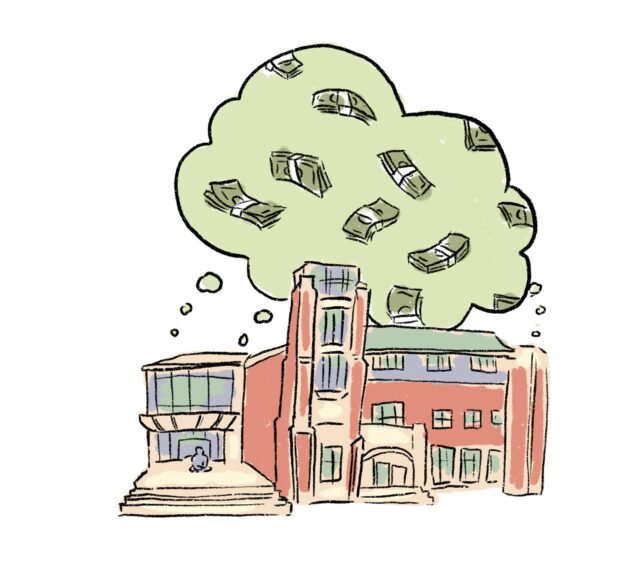
We’ve already reached tacit agreement on this. We’re overwhelmingly in the pockets of corporate business—73 percent of b-schoolers in a study of LinkedIn identified as “strongly” or “somewhat sold out to Wall Street conservatism”, compared with only 8 percent who reported any degree of “liberal”. Instead of propping up fringe ideas out of some twisted sense of “empathy and understanding for views other than our own”, we should embrace the fact that so many of our students are conservative. Instead of wasting time and energy on some left-wing argument no one really believes, we should be having meaningful conversations. What’s the best way to ensure lower corporate tax rates? How can we guarantee every student an investment banking internship at Goldman Sachs? How can we make sure that every b-schooler has a Canada Goose, a thing we all agree is necessary?
There is only so much discourse to go around, and we shouldn’t squander any of it having a balanced discussion on “Should people get money just because they asked for it nicely?”
Of course, we can—we must—allow liberals to have their liberal clubs and discuss liberal ideas. It’s also fine that righties have leftie friends—people shouldn’t discriminate based on someone’s dominant hand. But we shouldn’t create an impulse among the student body to pretend, out of politeness, that there’s anything valuable in the Democratic policy agenda. The Democratic party primarily exists to empower corrupt union leaders and the Sierra Club, and does so quasi-democratically by convincing people the world will end if they don’t buy a Prius. Call me crazy, but I don’t think that’s a party or an ideological flank that I’d like to offer a whole bunch of special treatment to.
Stay in Touch!
Get the latest and top news from StudentLife delivered to your inbox