Forum
For future reference, we should set aside our political apathy and go vote
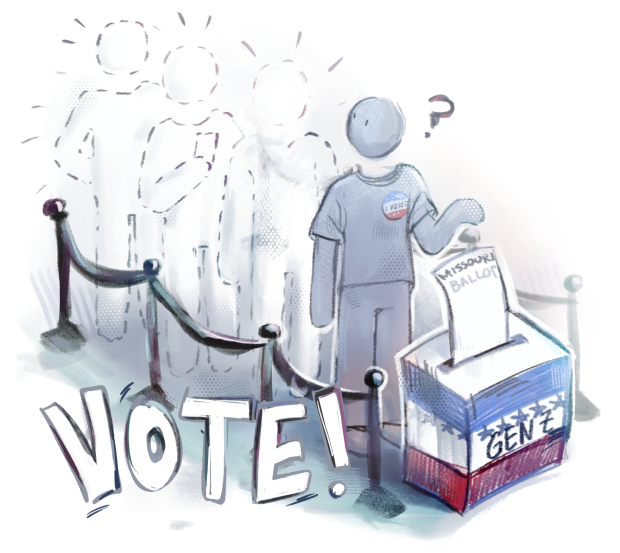
Maggie Xu | Staff Illustrator
This past midterm election was one that made history. There were several “first” titles distributed among race winners, such as Georgia electing the first Black woman governor in U.S. history and Minnesota electing the first Indigenous senator.
While young voters helped Democrats win big across the country, only 11% of electorate voters were aged 18-29. In St. Louis County, 61% of registered voters showed up to the polls during midterms. Only 10% of those voters were aged 18-29. While this statistic could be attributed to the distribution of voters’ ages, which is information that is not public online, it is alarming that voter turnout among our age group has dropped by roughly 16% since the 2022 midterm elections. Our political apathy does not serve us, but instead creates an environment where lawmakers can attempt to take advantage and deprive us of basic rights.
Voting is a way for you to advocate for yourself and others in your community. Missouri politicians have a tendency to not play fair, and this year’s midterm ballot was a testament to that fact. Missouri voters had already chosen in 2024 to keep abortions protected under state law before Missouri Republicans proposed this cycle’s Amendment 3. Missouri Secretary of State Denny Hoskins and other Republicans tried to enforce their red-leaning gerrymandered map, listed as Proposition A on the midterm ballot, three times. Exercising your right to vote is a powerful way to take a stance against politicians that refuse to listen to their constituents.
Oftentimes young people take a stance of apathy toward voting, declaring that “their vote means nothing,” but people tend to underestimate the power of a single vote. It’s not uncommon for a candidate to win an election by only a handful of votes. As it pertains to this year’s midterm, in Mississippi’s race for senator, Scott Collum (D) won by only 5,000 votes. A similarly close race is happening in Alaska. In North Carolina’s 5th district, Chuck Hubbard (D) beat the incumbent Rep. Virginia Foxx (R) by less than 100 votes. In such slim races, your vote indeed carries significant weight.
Amendment 3 in Missouri is a recent example of one of these close calls in terms of legislation. We must reckon with the fact that every missed vote meant that another vote in favor of Amendment 3 was left uncontested. Even in temporary residency, the elected officials in charge of where we call home make decisions that can change the trajectory of our lives. And even if these issues don’t seem to affect you currently, voting is not an individualistic practice — the collective good is what’s at stake.
Aside from apathy or hesitance about our system, privilege can also be a stumbling block when it comes to voting. It is no secret that students at WashU can come from privileged backgrounds, with around 22% of students from the top 1%. This privilege can downplay the sense of urgency when it comes to voting. But this is where basic empathy comes into play. Though there may be some issues that don’t affect you, those same issues affect thousands of other people in the state alone.
A study from the Center of Information & Research on Civic Learning and Engagement (CIRCLE) at Tufts University found that young people are more likely to be deterred by busy schedules and registration issues when it comes to voting. We understand that students at WashU have similar concerns, which is why we should take advantage of the resources on campus that are dedicated to making voting accessible for all eligible WashU students. The Gephardt Institute for Civic and Community Engagement and WashU Votes list numerous resources on their website for those that wish to vote in Missouri or absentee in another state. They also offer materials needed for mail-in ballots, such as an envelope and stamp, that you can pick up at Gephardt’s office. These resources are here to alleviate the stress that often comes with the voting process, and it’s best that we students accept that helping hand.
A common misconception is that you must vote on every issue in order for your ballot to be valid, but that’s not the case. Leaving a ballot box blank, or undervoting, won’t disqualify or cancel your vote. There are some situations where undervoting can affect ballot measure results, such as when certain measures require a specific percentage of total ballot votes cast. The fact of the matter is that you don’t have to be educated on every issue on the ballot. Thorough education on political matters is the goal, but it’s still important to exercise your right to vote as a way to reach that ultimate goal.
Our political system can make us feel hopeless and like there are no opportunities for true change within the system. But it is important to remember that a) dismissing the power of voting strips your ability to advocate for yourself and others in your community and b) political change is urgent for all of us. We cannot allow politicians to pass detrimental legislation without our say. We can begin to take control of our own political futures with our votes, so let’s use them.
Stay in Touch!
Get the latest and top news from StudentLife delivered to your inbox