Forum | op-ed Submission
‘Esse espirito de solidariedade perdura’: An invitation for WashU students to study Brazil
It does not take an expert observer to notice the Brazilian soccer shirts around campus. Despite being from Chicago, it was here in Missouri where I first connected with Brazilians and Brazilian Americans, along with their cultures. I have come to watch the Brazilian funk performance in Carnaval, learned samba from Professor John Mundell in my class Survey of Brazilian Cultures, and eaten homemade pastries at the Brazil Market in St. Charles County as part of a field trip in Professor Mark Dowell’s Portuguese 1610 language course. It was only last week when I heard my Brazilian American classmate, Lucas Neres, perform a samba beat on his guitar in our Portuguese 2000 class. These professors and courses, however, are relatively unknown to the student body. Mundell, a professor jointly appointed by the Latin American studies program and the Department of African and African American Studies, has a contract set to expire in May of next year. We cannot let our study of Brazil fade.
WashU students clearly appreciate the Brazilian arts and culture, and there’s no better way for us students to enhance our appreciation of Brazil than to take more courses on it and for our administration to invest in and expand the study of the Brazilian peoples. This “opinion submission” is, in reality, a friendly invitation to strengthen our espirito de solidariedade (spirit of solidarity) with Brazil, because we can benefit from learning of that republic just as WashU’s first Brazilian student, Archimedes Pereira Guimarães, did when he studied our country.
When the First World War broke out and Brazilian President Venceslau Brás declared war on the Central Powers, the need to industrialize his country grew more urgent. On May 18, 1918, Brás issued a decree to send a group of students to study science and industry in the United States and have them return with skills that would develop Brazil’s industries.
Guimarães was one of the Brazilian students who arrived in New York on Nov. 18, 1918.
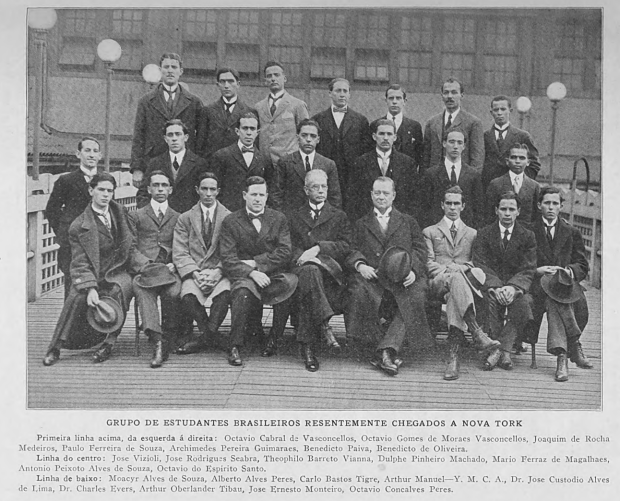
Photo of “A group of Brazilian students recently arrived in New York” provided by Francisco Perez.
Close-up of Archimedes Pereira Guimarães, provided by Francisco Perez.
The students wrote about their experiences in El Estudiante Latino-Americano, an international journal for Latin American students studying in the United States. While other students wrote articles on their journeys and amazement of New York, Guimarães wrote of his nation’s future. Sensing a change in world politics, he wrote of “embarking on an era almost finished with the world war against Germanism. … Even if we are dispersed across diverse states of the American Union, that espirito de solidariedade prevails.” Even with his optimistic writing, Guimarães knew the task at hand was not going to be easy: “If we encounter difficulties we will not complain … for we constitute the first wave of degreed students.” Guimarães would carry his “spirit of solidarity” and vigor to the WashU campus and lead an international community of Brazilian students from here.
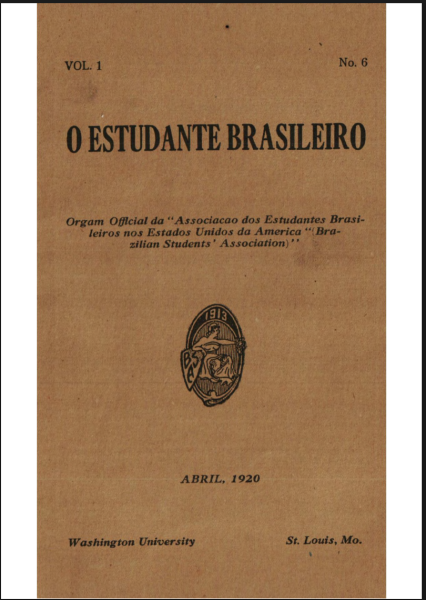
Cover of El Estudiante Latino-Americano, provided by Francisco Perez.
“BRAZILIAN IS STUDENT AT WASHINGTON UNIVERSITY,” wrote the St. Louis Globe-Democrat on Sept. 13, 1919. Guimarães was reported to arrive with Francisco Vieira, a Brazilian doctor and scholar of public health studying the city’s sewage systems. In a headline titled “W.U. Brazilian Edits Paper for Compatriots,” Guimarães was highlighted as “a Brazilian scholar” studying chemistry and writing for O Estudante Brasileiro, an international journal published by the Brazilian Students Association. Only a year later, in 1920, would Guimarães assume the presidency of the association and its journal. He published an issue in St. Louis, bearing WashU’s name, with articles written by Brazilian students across the nation discussing American industry, linguistic pride, postwar migration, and the future of their homeland. The journal also reported the achievements, whereabouts, deaths, and suicides of Brazilian students across the nation. Let’s keep in mind all of this was coordinated through letters and telegrams. It was here in WashU that Guimarães led an international community of Brazilian students.
Guimarães would later return to Brazil and make significant contributions to the development of Brazilian academia in the 20th century. He would pioneer the study of chemistry in Brazil, write on energy, improve college-level pedagogy, and earn a reputation for being an “active academic.” Vieira would later eradicate yellow fever in Rio de Janeiro’s waterways and form Brazil’s first scientific journals on public health in São Paulo.
Guimarães’ story shows us that there is a benefit to learning from one another’s countries and cultures. Let’s follow Guimarães’ example and strengthen that “spirit of solidarity” by taking Portuguese with Dowell along with Mundell’s course Afro-Latin on Camera and Hello, Hello Brazil! Popular Culture, Media, and the Making of a Nation this spring semester. As for the board of trustees, I invite them to explore possibilities of expanding faculty and courses on Portuguese and Brazil. To once again invoke the words of Archimedes Pereira Guimarães: “We hope this lesson serves everyone and our dear colleagues, parts of the future classes, and accept our unpretentious advice and suggestions.”
Stay in Touch!
Get the latest and top news from StudentLife delivered to your inbox