Scene
Film and Media Studies debuts interactive archive
Jun Ru Chen | Staff Photographer
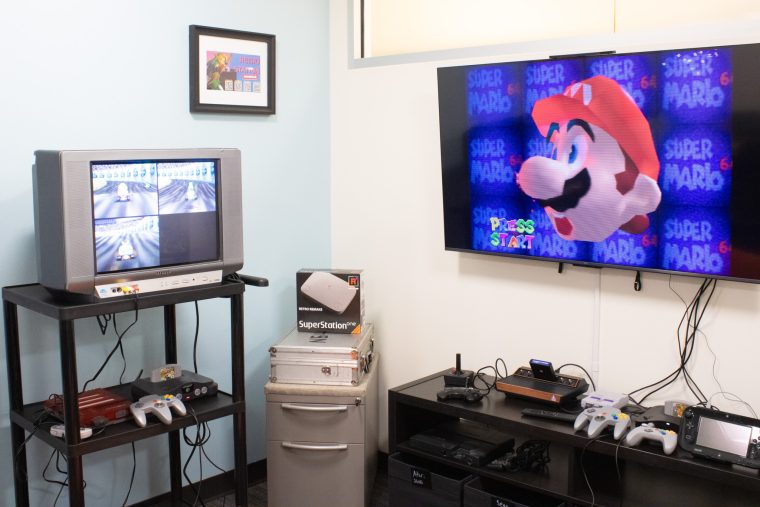
On a Friday afternoon, faint sounds of clicking and the effervescent beeping of video games can be heard in the otherwise quiet hallways of Seigle Hall’s fourth floor. Past a wall of movie posters and around a series of corridors, the sounds lead to the Film and Media Studies (FMS) Interactive Archive, a new space dedicated to the study and play of video games.
Featuring several televisions, computers, consoles, and games spanning multiple eras, the Interactive Archive functions as a gameplay lab for the program’s expanding selection of game studies courses. The archive is expected to play a key role in the development of a video game studies minor, which the department hopes to propose over the next year. Currently open to students in FMS courses, the archive is organized into four stations: modern, retro, computer, and research, each offering a different way to explore the history of gaming. Instructors can bring students into the space or borrow equipment for classroom demonstrations. Students can also visit the archive outside class to play games for assignments and consult research materials, including hundreds of books and older magazines. In the spring, the archive will be opened for all students on a sign-up basis.
“Games are a creative and entertainment medium like any other, no greater, no lesser, no better, no worse,” said director of Film and Media Studies Colin Burnett. “What we do here is cut between all those distinctions and study them for what they do, their effect. All of us play games in [some] form.”
James Fleury, senior lecturer in Film and Media Studies, received a grant through the College of Arts & Sciences Teaching Innovation Award for the 2026-2027 academic year to establish the archive. While the majority of the archive was made possible through the grant, some FMS professors have also contributed items from their personal collections. One donation to the archive is an original Atari system from Ian Bogost, a professor of Film and Media studies at WashU. The archive pairs the vintage console with a newer iteration, allowing students to compare the two systems and experience older games on a traditional tube television next to their modern equivalent on a flat screen.
The initiative follows several years of faculty hiring in video game studies and design alongside growing student interest in courses covering topics such as retro game design, global game industries, and more.
“We’ve got the faculty here, we’ve got the student interest,” Burnett said. “Let’s put this all together and create a formal program of study.”
The proposed minor is part of a broader effort to expand Film and Media Studies beyond its current emphasis on film. The department is planning a curriculum redesign that will introduce more courses in digital media studies, including the history of computing and interactive media.
Burnett also pointed to the Archive as a way to address a gap in the resources traditionally available to students. While students can access books and films through the University library, there are fewer opportunities to access games and the hardware needed to experience them.
Marceline Lee | Illustration Editor
“I’ve envisioned this space for a long time [as a place] where students could do gameplay as well as conduct research,” Fleury said. “Video game history is fascinating because it’s not that old of an art form. It’s not that old of an industry.”
Although experiments with video games date to the 1940s, the commercial gaming industry did not emerge until the early 1970s. Because many people involved in the industry’s early development are still alive, Fleury sees opportunity for students to learn directly from those who have helped shape it.
“We wanted students here at WashU to have very rigorous study, hands-on study of all of our media, whether it’s film, television, or gaming,” Fleury said.
As video games increasingly intersect with movies, television, and other areas of entertainment, Fleury believes there is growing value in examining them as part of the larger media landscape.
“Video games are becoming such a larger part of American and global culture,” Fleury said.
With its combination of playable consoles and historical resources, the Interactive Archive will give students a place to explore video game culture directly. The project positions video games as an evolving medium with histories, industries, and communities worthy of academic study today.
Stay in Touch!
Get the latest and top news from StudentLife delivered to your inbox