News
The result of Amendment 3 in today’s election will determine access to reproductive healthcare for WashU community and fellow Missourians
As the first state to ban abortion after Roe v. Wade was overturned in 2022, Missouri also made history as the first state to repeal the ban in 2024. Tomorrow, it could be the first in the nation to reinstate the abortion ban and codify the ban on gender-affirming care for transgender minors in the state constitution with the passage of Amendment 3.
The legislatively referred constitutional amendment, formally titled “Prohibit Abortion and Gender Transition Procedures for Minors Amendment,” will appear on the ballot as Amendment 3. It shares the same name as the 2024 amendment but will have the opposite effect if passed.
“It’s the opposite of what we passed two years ago,” said Evia Della Valle, senior and president of WashU Planned Parenthood Generation Action (PPGA). “Two years ago, the whole campaign was ‘yes’ on 3, and now it’s ‘no’ on 3.”
A “no” vote on Amendment 3 supports leaving the 2024 amendment in place, keeping abortion legal.
A “yes” vote on Amendment 3 supports repealing the constitutional “right to reproductive freedom,” which protected abortion up to fetal viability. It would only allow abortion in cases of medical emergencies, fetal anomalies, and rape or incest before 12 weeks. It would permit the legislature to regulate abortion providers and facilities and require parental consent for minors. Additionally, the amendment includes a provision that would formally add the existing ban on gender-affirming care for minors into the state constitution.
Now, a provision in Amendment 3 that would allow the legislature to regulate abortion providers and facilities may open the door to similar regulations being placed back into effect. Notably, the proposed amendment does not ensure the legality of birth control.
“Potentially, if this amendment is passed, maybe students wouldn’t be able to go to the pharmacy and pick up their birth control pills, or go to Habif and be able to get an IUD. We don’t know, but we do know that [the 2024] Amendment 3 protects those rights, and so it’s not just about abortion, but it’s also about reproductive freedom as a whole for everyone,” said Paulina Steinman, junior and PPGA communications chair.
Professor of Law Susan Frelich Appleton agreed, expressing concern about state restrictions designed to limit access to abortion prior to the Dobbs v. Jackson Women’s Health Organization decision.
“I think we would expect to see the same restrictions we saw before, which are the waiting periods and the so-called TRAP laws, targeted regulation of abortion providers, which — in order to make abortion inaccessible — pretend that it is the most hazardous medical procedure ever, when in fact it’s quite a bit safer than actually carrying a pregnancy to term,” Appleton, said.
Currently, gender-affirming care for minors is already illegal in Missouri. In 2023, the legislature passed the Missouri Save Adolescents from Experimentation (SAFE) Act, which banned gender-affirming surgery, puberty-blocking drugs, and hormone therapy for minors. The subsection of the act limiting puberty-blocking drugs and hormone therapy is set to expire on August 28, 2027, unless the subsection is extended or Amendment 3 passes.
If Amendment 3 doesn’t pass, gender-affirming surgeries will still be banned in Missouri, Appleton emphasized. A specialist in family law and feminist legal theory, she argues that lawmakers deliberately added an already-banned practice to make an abortion ban more attractive to voters.
“Do I think that it was designed to attract voters? Yes, absolutely. I think it is pure ballot candy. Such care is already banned in Missouri. It’s totally unnecessary,” Appleton said.
The inclusion of the provision drew legal challenge under Missouri’s single-subject rule, which limits a ballot measure to one subject. An appeals court rejected that argument, ruling that abortion and gender transition procedures for minors are sufficiently related.
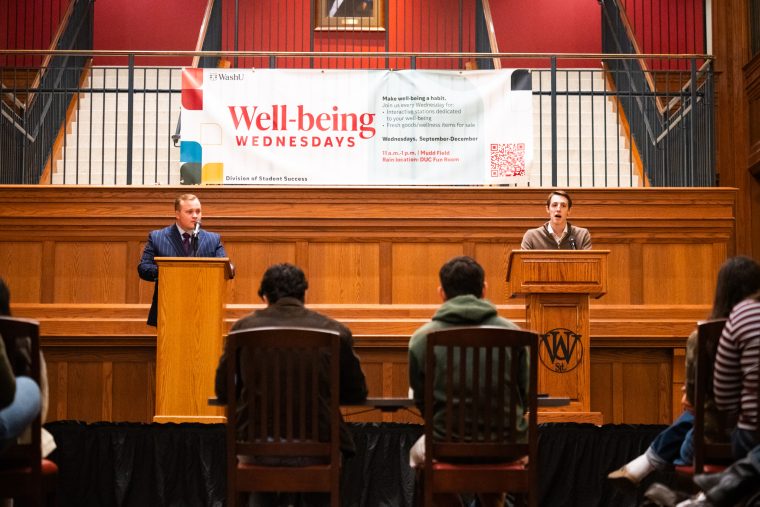
During the Campus Crossfire event on Oct. 19, junior and WashU College Republicans President Tom McGowan expressed his support for the two issues being on the same ballot.
“I don’t think it is as much of a reproductive health issue as it is a protecting newborns issue,” McGowan said. “I think both of these issues, however, happen to be correct, which is why I’m OK with it being in the same bill.”
While St. Louis is in close proximity to Illinois, which makes crossing state lines to access reproductive healthcare easier, residents in rural parts of Missouri may not have the same option.
“It also impacts people who have much less privilege than WashU students, who might not have the money to travel to Illinois or to another state, their home state, for example, to get an abortion or be able to miss school or work to get an abortion, like many WashU students would be able to do,” Steinman said.
Regardless of political ideology, Della Valle stressed the importance of simply voting.
“In a time like this, we can all come together to try to make whatever difference we can. Especially in such a close race and in the climate that we’re in, I think everything matters.”
Stay in Touch!
Get the latest and top news from StudentLife delivered to your inbox