News
What we know about WashU’s trustees

The WashU board of trustees (Courtesy WashU website)
Most WashU students will never attend a meeting of the board of trustees — or ever meet a trustee for that matter — but this body impacts students’ lives in a way few other groups do.
The board of trustees serves as “the chief governing body” of WashU. The 44-member group’s powers include appointing the chancellor, approving annual budgets and major projects, awarding tenure to professors, and directing other University policies.
“Since 1853, the Board of Trustees has exercised fiduciary responsibility and provided strategic oversight to ensure the university’s resources are effectively stewarded for the benefit of future generations,” the board’s website reads.
The board’s current chair, Penny Pennington, is the managing partner of Edward Jones, an investment firm based in St. Louis. She is not a WashU alumna and is the first woman to lead WashU’s board.
Nominated and selected by a committee, trustees meet five times a year and serve on committees. According to WashU’s tax filings, trustees do not receive financial compensation.
The board of trustees also has four non-voting student delegates, consisting of two undergraduate students and two graduate students.
Student Life conducted an analysis of who sits on the board, including disclosed political contributions reported to the Federal Election Commission (FEC) since 1979. Here are some of the key findings:
Many trustees do not live in St. Louis.
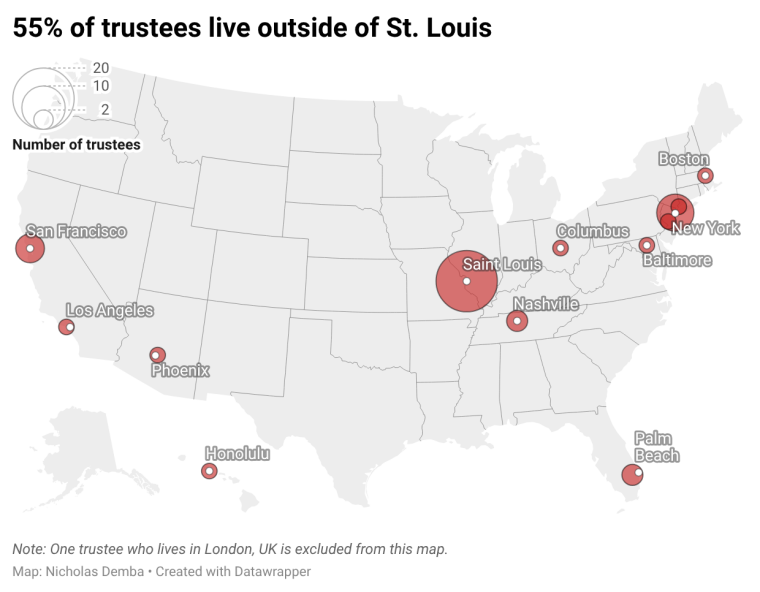
Twenty of the board’s 44 trustees live in the St. Louis area, while the other 24 live elsewhere, with some living as far away as Honolulu and London.
The board is predominantly white, male, and alumni.
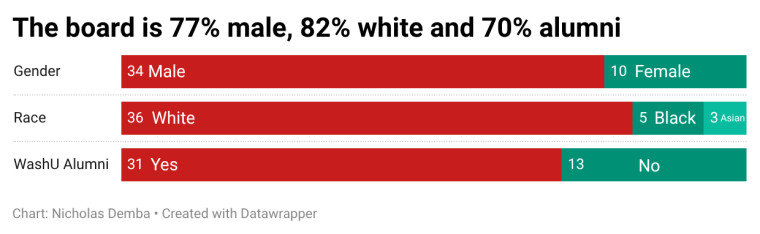
By comparison, about 36% of WashU students are white, and men make up 47% of the student body.
Alumni status is not required to be a member of the board, though about 70% of trustees are WashU graduates.
The board’s website says that its nominating committee plans for an “emphasis to be placed on diversity in long-term recruitment.”
Republicans have received most trustee donations this election.
With less than a week until the midterm elections, trustee donations have largely gone to Republican candidates, as of the most recent filings.
Senator Susan Collins of Maine, a moderate Republican who chairs the influential Appropriations Committee and visited WashU’s Medical Campus last semester, received the most donations from the most trustees.

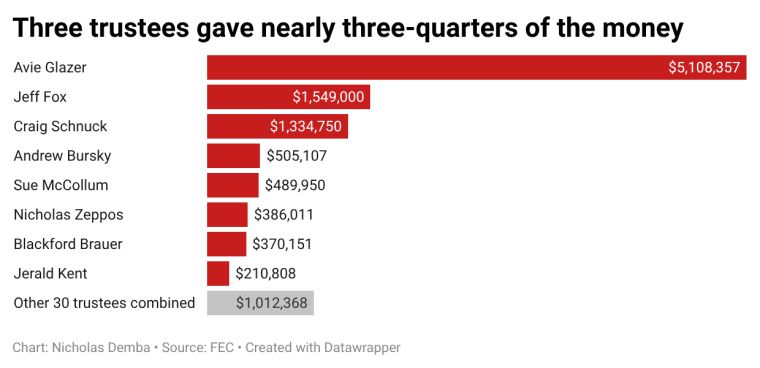
Trustees have given nearly $11 million to federal campaigns.
Thirty-eight of the 44 trustees have federal contributions to political campaigns on record, totaling about $10.97 million going back to 1980. The median trustee gave about $35,000, but three trustees account for most of the money.
Most trustees give mainly to one party.
Among the 37 trustees with publicly reported donations to candidates, 21 donated more to Democrats and 16 gave more to Republicans. Most trustees gave over 60% of the money to one party. The two notable exceptions are Pennington and Bursky.
Bursky serves on the governing board of the centrist political group No Labels, and his public contributions are roughly evenly split between the two parties.
Glazer’s spending went almost entirely to Democrats. Meanwhile, Schnuck and Fox gave a combined total of $2.9 million, mostly to Republicans.

Few trustees have publicly contributed to Donald Trump’s campaigns.
Democratic presidential nominees Hillary Clinton, Barack Obama, Joe Biden, and Kamala Harris had the most trustees who made a contribution to their campaigns. Recent Republican nominees George W. Bush, John McCain, and Mitt Romney follow.
President Donald Trump is an exception. Only three trustees have given directly to his campaigns, totaling about $6,000. By comparison, five trustees gave more than $500,000 to his 2024 primary opponent Nikki Haley and a super PAC supporting her.

One trustee has given an outsized amount of money to Democrats.
In terms of raw dollars, trustees’ political contributions skew heavily toward Democratic candidates and committees. However, this is largely thanks to Avram “Avie” Glazer, who holds a BSBA from WashU.
Glazer is the co-chairman of Manchester United and an owner of the Tampa Bay Buccaneers. Forbes estimates his net worth at $2 billion. Without Glazer’s contributions, the board’s total contributions skew Republican. Many of Glazer’s family members also attended WashU.

Missouri politicians also drew broad support; former Senators Roy Blunt, Kit Bond, and Claire McCaskill, as well as St. Louis area congresswoman Ann Wagner, had an outsized number of trustees who donated to them.
Most trustees work in business.
Most of the trustees come from backgrounds in business. They include current or former executives at companies like Bristol Myers Squibb, Carnival Corporation, Emerson Electric, and Schnuck Markets.
Some also hail from academia. Nicholas Zeppos, the former chancellor of Vanderbilt University, sits on the board, as does WashU Chancellor Andrew D. Martin.
The board includes major donors to the University.
WashU students may recognize many trustees’ names from buildings and institutions on campus.
Andrew Bursky, a former board chair and current trustee, made a record-breaking $200 million contribution to the School of Public Health that is now named in his honor.
Jim McKelvey, a co-founder of Square, also sits on the board. In 2019, the School of Engineering was renamed after he donated an undisclosed amount to the school. McKelvey Hall on the East End was also named in honor of his father, James M. McKelvey Sr., who served as dean of the School of Engineering.
Craig Schnuck, a former chairman of Schnuck Markets, has been a trustee since 1996. The Schnuck Pavilion is named for him and his wife, Nancy.
Michael Riney, a trustee, and his wife Quirsis pledged a gift for the new Arts & Sciences building on Mudd Field that was to be named for them. Construction was halted indefinitely in 2025 amid financial uncertainty.
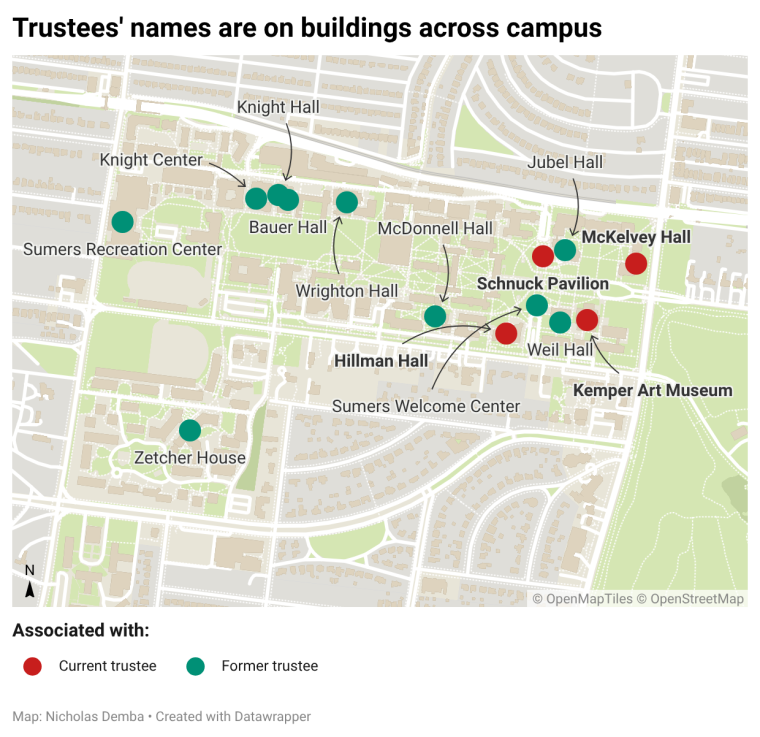
Some trustees also carry relations to notable WashU figures and buildings.
The School of Design & Visual Arts carries the name of trustee Jeff Fox’s late father Sam, a St. Louis philanthropist and WashU alumnus.
The Mildred Lane Kemper Art Museum on campus is named for former board chair David Kemper’s mother, and his family’s foundation pledged $5 million to fund its expansion in 2016.
WashU’s Associate Vice Chancellor for University Communications Kedra Tolson declined to comment for this story.
Stay in Touch!
Get the latest and top news from StudentLife delivered to your inbox