News
College Democrats and Republicans debate the state of politics before midterms
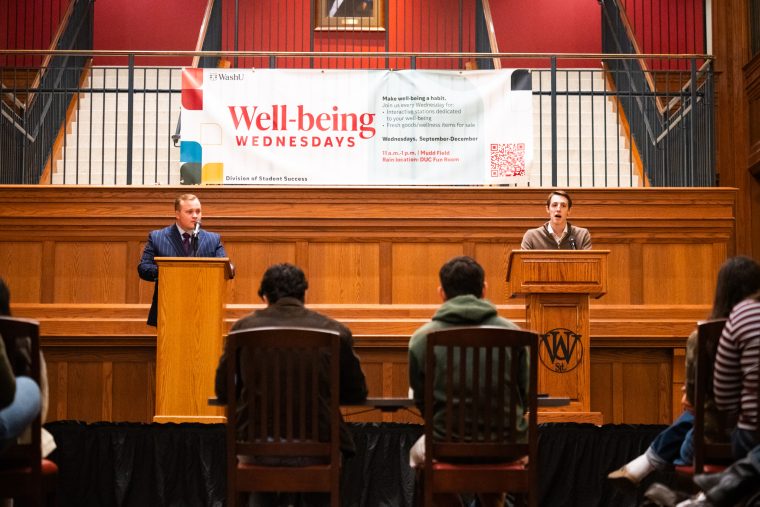
College Democrats and Republicans debate at Campus Crossfire (Eran Fann | Photo Editor)
With the midterm elections just two weeks away, the WashU College Democrats and WashU College Republicans (WUCR) took to Tisch Commons to debate federal and local issues before a 50-person audience.
The hour-long debate, moderated by Student Life, featured questions about the Trump administration’s policy decisions, or lack thereof, on artificial intelligence, affordability, international disputes, and international students at universities nationwide. Other questions discussed items on Missouri’s ballot, such as Proposition A, which seeks to redistrict Missouri’s congressional map, and an amendment to roll back abortion rights and add a ban on gender-affirming care for minors to the state constitution, known as Amendment 3.
McGowan, who represented WUCR at the debate, said that while some of his political ideologies fall in line with the Trump administration, he deviates from the administration’s approach to international students.
“Just because he is a Republican president does not mean that I think he’s not a moron sometimes, or a lot of times depending on what you think of it,” McGowan said.
The College Democrats’ representative, junior and club president Trey Jackson, said it is necessary for people to push back on their political party.
“I support people breaking with Donald Trump,” Jackson said during the debate. “I support people having this type of conversation, and here’s the thing, here is what is most detrimental to our country in the long run: It’s when you have Republicans that aren’t willing to stand up to Donald Trump.”
The Trump administration has proposed several policies attempting to limit international students’ stays in the U.S., including a cap on international student visas and substantive fees for Optional Practical Training, among others. McGowan sees limiting international students’ stays as detrimental to the nation.
“They should have to stay in the United States after the fact. They shouldn’t be allowed to come and get an education here and then go back and benefit their own home country,” he said.
For Jackson, international students should be able to make that choice for themselves.
“I believe that every person should be able to pursue higher education regardless of whether they go somewhere else or whether they stay in America,” he said. “It’s American to say that I deserve an education as does everyone else, and that they should be able to pursue their own ends as it is laid out in the Constitution.”
Jackson said that the Trump administration’s approach to international policy stems from xenophobia, with the president banning immigrants from select nations during his first and second term.
“There is a moral deficiency in the man who tries to enact those policies, and that’s what we’re seeing. We’re seeing him hijack the education system to produce results that he just wants to see.”
Moving to international disputes, McGowan commended Trump’s removal of former Venezuelan President Maduro from power, which McGowan views as a way to protect Americans from substances coming in from the U.S.-Mexico border, and U.S. involvement in Iran. He also fully supported Trump’s immigration policy, including mass deportations, as a way to correct for the “droves” of people who came into the U.S. during the Biden era.
To McGowan, international policy is a matter of national safety.
“I don’t think letting people get smuggled into the country is a good thing. I don’t think drugs coming into the country is a good thing overall,” McGowan said. “They need to get out.”
Jackson said the Trump administration’s approach to international disputes intends to distract from the lack of affordability in the U.S.
“Every opportunity that we have to make life more affordable for people is an opportunity that we should take,” he said. “It’s not one that the Trump administration seems to care about.”
Jackson said that the safety of the American people is important, but he argued that gun control is more relevant to American safety than border policy.
“I can’t be 100% on board when a woman is shot in a car in Minneapolis. I can’t be on board when an American is shot in front of his child in New York. I’m not on board with those things, but I am on board with keeping Americans safe,” Jackson said. “There are policies that we can [use to] do it.”
For McGowan, protecting guns is imperative for protecting women.
“I have a friend of mine who’s a cheerleader, 90 pounds [and] 4’11’’. Any man in the United States, if they wanted to physically intimidate her, could, and no one could stop him,” he said. “Give that same woman training and a gun, and now magically, she can go toe to toe with 350-pound linebackers for the Cleveland Browns, right? I think as a feminist, it’s also a very important issue to me as well.”
The representatives also discussed Amendment 3, which, if passed, will undo Missouri’s 2024 amendment that reinstated abortion access in the state. McGowan said he views abortion as a matter of protecting newborns more so than a reproductive health issue.
Amendment 3 also groups together abortion and gender-affirming care, which Jackson expressed concern over. While McGowan supports the single-subject rule, he did not take particular issue with these two items being grouped together. To McGowan, this decision falls in line with how he sees the issue.
“Obviously, gender-affirming care and getting an abortion are two radically different and separate procedures, right?” he said. “I just view them under the same umbrella of it’s all medicine.”
Jackson sees Amendment 3 as a tactic to overturn voter-approved legislation.
“This is the second attempt by the legislature to reverse what the people have already decided,” Jackson said. “You know your party and your government is wrong when the people have to legislate themselves twice.”
While Campus Crossfire has been hosted in years past, it has not been a regular part of political programming on campus. Both parties hope that this debate will become a semesterly occurrence.
“When we stop talking, that’s when bad things happen,” said Tom McGowan, junior and president of WUCR.
Stay in Touch!
Get the latest and top news from StudentLife delivered to your inbox