News
SU and dining workers’ union pushes back on Ibby’s tipping cap
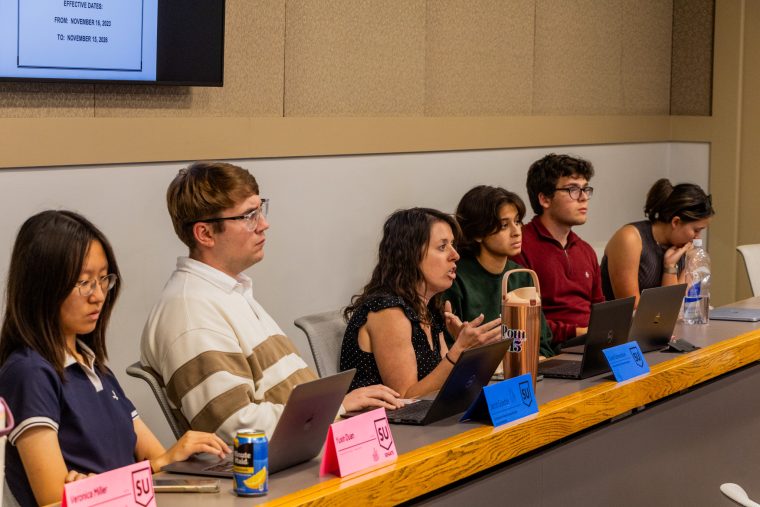
Student Union debates resolution calling for Sodexo to no longer cap tips at Ibby’s (Eran Fann | Photo Editor)
Ibby’s Bistro’s new cap on meal point tips for servers at 25% is now the subject of union arbitration and a Student Union Senate resolution, both challenging a policy the SU Senate says was implemented without public notice or explanation to those affected. The dining workers union says this violates the collective bargaining agreement.
Since Ibby’s opened for the semester on Sept. 8, students paying with meal points have only had the option to tip servers 15%, 20%, or 25% of the bill on top of the included 18% gratuity.
Union Representative Ben Lagorio said the cap was put in place without the union’s involvement, which violates their collective bargaining agreement. The Collective Bargaining Agreement is between SDH Education East, a subsidiary and operating entity of Sodexo at WashU, and United Food and Commercial Workers (UFCW) Local 655, which is the union representing dining and food service staff on campus. A collective bargaining agreement is a labor contract between an employer and a union that governs the terms and conditions of employment, including wages.
“We were not asked to be a part of those talks. We were just kind of left out in the cold,” Lagorio said.
In an email to Student Life, Raven Lumpkins, the director of strategic initiatives and communications for Dining Services, declined to say if union representatives were present for or consulted during deliberations before the policy was implemented. Lumpkins described the cap as “an operational change to Ibby’s service structure” and Ibby’s staff were informed directly ahead of the fall 2026 semester.
Both the SU resolution and the union say the reasoning behind the cap’s implementation was never properly articulated to the workers, the union, or the broader WashU community.
“It’s not just that we think what they did violates our contract. We don’t even really have a comprehensive understanding of why they decided to do this in the first place,” Emily Perez, UFCW’s general council, said.
Tipped wait staff at Ibby’s make $7.90 an hour in base pay, which is below the minimum wage of $15 per hour in Missouri, and they rely on tips to make up the difference. WashU food service workers, including cashiers and hosts, make $15.95 per hour base pay.
“Comparing the tipped workers to the non-tipped workers is like comparing apples to oranges,” Perez said. “The structure is already fair because their base wage reflects the fact that they get more income in tips than non-tipped workers.”
Lagorio said that servers estimated capping tips would decrease workers’ salaries by around 60%.
“These people, they count on those tips, and that being taken away for an unknown reason is not acceptable,” Lagorio said.
Ibby’s is one of 45 campus locations where students can spend meal points, and the only sit-down restaurant with servers who customarily receive tips. Students are required to buy a meal plan whether living on or off campus, and for the last 18 years, students have been able to tip servers using meal points at their discretion.
Students often capitalized on the limitless tipping option, especially those with higher meal plans. Sophomore Sophia Schuchart dined at Ibby’s nearly every other week last year and estimated she tipped between $60 to $100 each time.
“I was on a platinum meal plan,” Schubert said. “So I wanted to help them as much as I could because if I didn’t need the meal points, I might as well give it to someone who actually needs it for their livelihood instead of having it just be erased at the end of the year.”
The resolution, passed on Oct. 13, calls on Dining Services and Sodexo to lift the cap, arguing it cuts servers’ income and restricts how students can use the meal points. Although SU has no formal authority over Sodexo, many previous resolutions have addressed dining issues before.
“We demand that Sodexo and dining by proxy be transparent with us when making changes that are this impactful on the student body,” chairperson and resolution sponsor Alandee Patil said.
According to the Senate’s resolution, Dining Services told senators in a Sept. 22 meeting that tips left using a credit card are not limited, but the Senate and servers say no system exists for tipping beyond the predetermined values. Speaker of the Senate Casey Preis, the resolution’s cosponsor, said another gratuity option is important to implement.
“Sometimes I don’t think the 18 plus 25% gratuity is going to reflect how much effort they’re putting in to making sure our food comes out on time, talking with us, making us laugh, making us feel at home,” Preis said. “It’s frustrating not to be able to pay them in the way that I believe I should be able to as a student.”
Stay in Touch!
Get the latest and top news from StudentLife delivered to your inbox