Forum
St. Louis, slogans, and slander: How well does WashU embody its slogan?
Ella Skye Heisel | Staff Illustrator
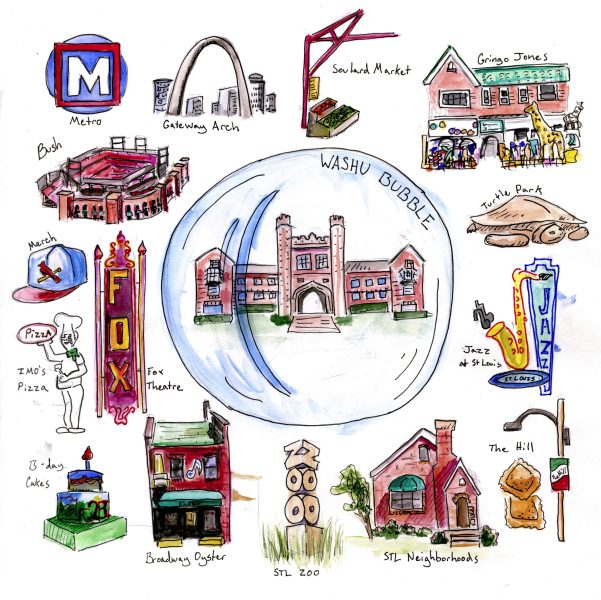
For a school with its city in its name, WashU students sure do reject St. Louis often. It’s odd that this perspective co-exists with the school’s slogan of “In St. Louis, For St. Louis.” Indeed, WashU cannot truly embody this slogan if it does not encourage and empower its students to immerse themselves in the city and provide fair, well-compensated jobs at all position levels that it employs.
Many members of WashU’s student body have a habit of complaining about St. Louis. I can’t go a day without hearing somebody say that there’s nothing to do in here, or that WashU would be perfect if it was in a bigger city. During my freshman year welcome week, most students didn’t even sign up for WashU’s “In the Lou” tour experiences, seemingly having no interest whatsoever in familiarizing themselves with the city.
This is reflected in WashU students’ lists of pros and cons of attending the school submitted to this College Confidential forum. Student lack of interest in St. Louis and the “WashU bubble” appear repeatedly as cons. A Reddit post states that “[a]t WashU, it seems like people don’t really leave campus, and when they do, they just go to the [Delmar] Loop. It also seems like the Loop is the only place there is to go off campus.” This exemplifies the commonplace rejection of St. Louis, and the equally commonplace audacity to complain about the city while refusing to experience it by not venturing beyond campus and the Delmar Loop.
One common reason listed in the forum for not exploring the city more is its car-dependent infrastructure. While complaints about the city being car-dependent are absolutely valid, the metro is an accessible option that many reject because of fears of public transportation. This is definitely a more complicated topic, but the vast majority of the time the metro is clean, safe, and reliable. St. Louis’s metro has a rate of 5 people experiencing crime per 100,000 people boarding, whereas certain stops on Chicago’s metro system reach over 16 crimes per 100,000 people boarding.
Beyond its student body, WashU can’t be for St. Louis if its employees who live in the city, specifically hourly-rate service sector workers, deal with unreasonable expectations and inadequate compensation. Janitorial and dining positions are two occupations at WashU that directly impact student well-being, but are also two of the lowest-paid full-time positions.
In 2019, WashU switched dining providers, risking heavy employee layoffs. Rather than learning from that experience, in 2024, WashU changed its dining provider again, making shift hours and allocations a bidding system and negatively impacting dining hall employees. This cycle seems pretty repetitive.
Apps like Sidechat and YikYak have become a medium for when students notice employee mistreatment. Students have relayed seeing the stressed employees in the Mallinckrodt Subway. Other students tried advocating for Bear’s Den workers after their chairs got removed, despite health concerns among the employees. While all avenues of student advocacy are important, the fact that serious complaints about working conditions are finding recourse by students on informal, anonymous collegiate chatboard platforms indicates that the University isn’t paying close enough attention to the experiences of its employees.
It is, however, true that WashU gives back to St. Louis through initiatives such as medical care, research opportunities, and general job openings. These efforts are strongly positive but they don’t cancel out the negatives. In other words, it’s not enough for WashU to provide new jobs if they don’t treat their current employees well. The effort to have a positive impact on the St. Louis community should be well-distributed at all position levels, from providing medical care to offering great jobs.
Student internships in the St. Louis area, as promoted by the Center for Career Engagement and the Gephardt Institute, offer WashU students the opportunity to integrate themselves better into St. Louis and, in doing so, benefit the community. Again, however, this positive does not cancel out other negatives. A WashU student doing important work for a St. Louis organization is admirable and impactful, but it does not compensate for the complaints of a WashU janitorial staff member after a long workday of not feeling valued or seen by the University.
As a wealthy institution with billions of dollars in endowments, WashU must do better to fairly compensate their employees, delineate more reasonable expectations, and enforce better working conditions.
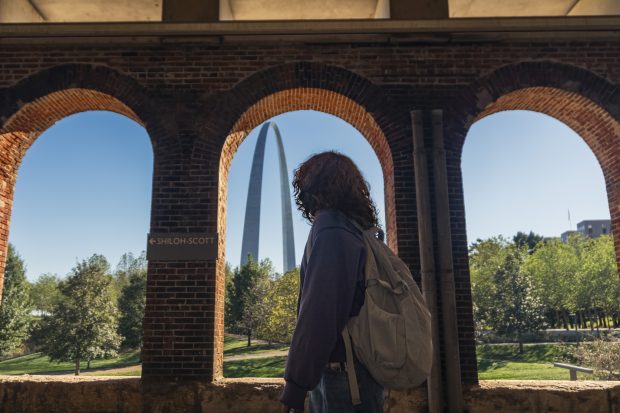
For WashU Students: go into St. Louis. Get out of Clayton and University City! Take a St. Louis-oriented class, or do some late night Wikipedia rabbit hole research about the city’s history. I promise it’s rewarding. Get into the music scene (it’s a lovely, historic city for jazz if you’re into that). Student Life’s Scene page is a great place to consult for things to do around the city.
Alex Dering | Photo Editor
Both the institution and the student body have work to do if we want WashU to truly embody its slogan, “In St. Louis, For St. Louis.” This work is definitely worth it, though. Embodying this slogan would promote better interaction between the city and WashU, creating more positive experiences among students and community members alike.
Stay in Touch!
Get the latest and top news from StudentLife delivered to your inbox