Save Me | Scene
We swapped classes for a day, and you should too
Are you really so passionate about physics that you’d camp out in Olin Library over the weekend just to get destroyed by your midterm? Do you actually love art enough to memorize when, where, and why the Mona Lisa was made? With midterm season upon us, you may be asking yourself “Do I actually want to major in this?” If you’ve found yourself tired of your own course load and intrigued by your friends’ classes, swapping places for a day might help you realize that you are, indeed, on the right path.
Leah Niebuhr | Staff Illustrator
Helen’s reflection as a Biomedical Engineering major:
If you’re a fellow first-year BME student reading this, you know exactly how strenuous the major’s course load is. Chemistry, physics, math, and … Introduction to Biomedical Engineering. A whole lot of science and math with no space in any of our schedules for a humanities class in our first year. The lack of a humanities class in my schedule is exactly what prompted my eagerness to sit in on Rivers’s classes: Introduction to Western Art History and First-Year Seminar: Arab Cinema. In doing so, I learned quite a bit about the world outside of STEM.
The first class of the day was Western Art History. Since I was sitting in on the class before the midterm, instead of the professor teaching new material, the GTAs (Graduate Teaching Assistants) were leading a review session. I have never been intrigued by how art came to be, so you can imagine my surprise when half of the words they had on the slides were ones I’d never seen before. Terms like doric, frieze, iconoclasm, and stylobate felt like I was learning a whole new language, except this one isn’t offered on Duolingo.
But it wasn’t just new terminology that surprised me. The TAs showed several examples of paintings discussed in class, and I couldn’t wrap my head around how one would memorize the name of the maker, time period it was made, and significance of the artwork for such a large volume of artwork. Compared to the wiggles and squiggles drawn in wave diagrams in Chemistry, the bronze statue of Zeus or Poseidon seemed to be considerably more difficult to remember for a midterm. I’d consider myself somewhat of a creative person, but sitting in on this class convinced me that I should keep my creative endeavors to hobbies, not a major.
After my art history horizons were broadened, I then sat in on an Arab cinema seminar class. With a grand total of eight students (only five of whom decided to show up that day), I was already feeling out of place in such a small classroom, a stark contrast to the usual 300- person lectures I’m used to. As the professor began to discuss the movie the students were assigned to watch prior to class, I found her passion for the subject to be contagious. The discussion about the themes, cinematography, acting, and history of the movie was extremely fascinating and educational. While I didn’t actively participate in the discussion, listening to the ideas being shared felt like I was exercising a completely different part of my brain than when I’m in a math lecture.
Although my day pretending to be an Arts & Sciences student was short-lived, as a BME major, it was a nice experience deviating away from the science- and math- heavy weeks I’ve been having. While I definitely couldn’t see myself majoring in anything art -related, I thoroughly enjoyed the seminar-style class, and look forward to adding one to my schedule sophomore year!
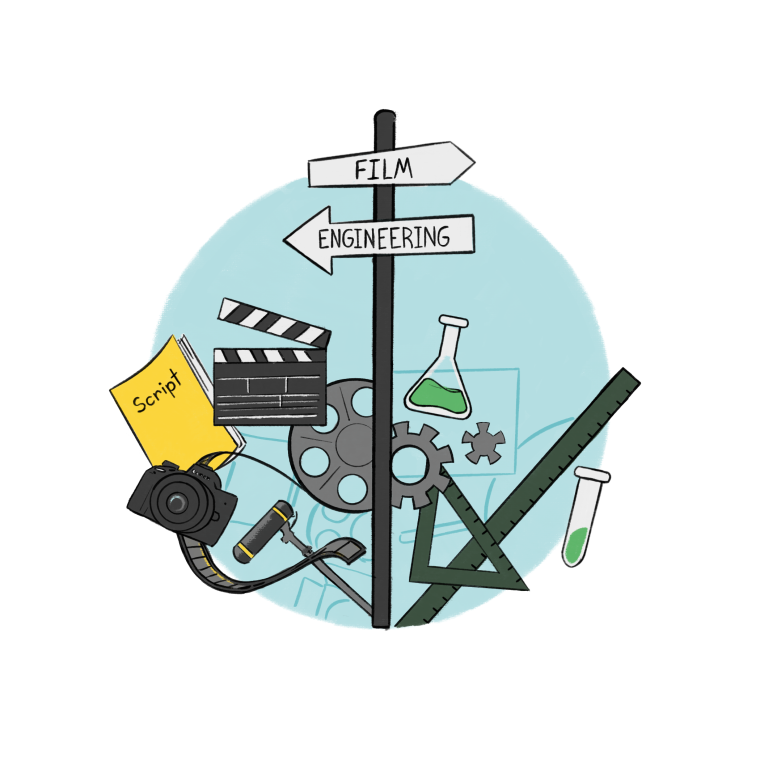
Leah Niebuhr | Staff Illustrator
Rivers’ reflection as a film and media studies major:
After spending my day attending three classes that I am not enrolled in (Differential Equations (DiffEq), General Chemistry, and Introduction to Biomedical Engineering (BME)) I can safely say that STEM is not my forte, and I will be sticking to the humanities. That being said, I have gained a deeper respect for STEM students, and I am impressed with their ability to understand and communicate in the language of mathematics and science.
Despite taking AP Calculus AB during my senior year of high school last year, almost everything that transpired in the hour-long DiffEq lecture I attended flew right over my head. How could a math problem be homogenous or non-homegenous, and how do you determine if an equilibrium solution is stable, unstable, or semi-stable? Prior to attending this lecture, this question did not concern me; now it runs circles in my mind while I lie in bed trying to sleep. I do enjoy taking difficult classes but for me personally, I like to be engrossed enough in the subject matter to make it worthwhile. Unfortunately this was not the case for me and DiffEq.
Chemistry confused me in a similar way, and if you were to ask me what the connection between the terms angular node, amplitude, and lobe is, I would not be able to give you an answer. The upside of this lecture though, was that it was taught by a charming middle-aged British man who used the phrase “bang-smack” more than once during the class, much to my delight. Truthfully, I did not expect a professor lecturing on the behavior of subatomic particles to be this lively, but it was a welcome surprise. A good professor can be the difference between whether or not you enjoy a class, even a class in a subject that you are already interested in or majoring in. Ideally, your interest in a subject should be stronger than any disinterest derived from a professor, but it is still a plus to have a professor that you click with.
Introduction to Biomedical Engineering was perhaps my favorite class of the day and one that I actually learned something in. Taught by a professor with a demeanor befitting a librarian, I learned that conductance is the inverse of resistance and that sodium and potassium switch places under some specific condition. Lacking the proper context for that information though, it means very little to me. I envy anyone who knows what the relationship between the Nernst potential and the value for a squid giant axon at rest is. The meaning of these words continues to elude and haunt me. But if the mysteries of a subject seem more exciting than daunting to you, consider learning a little bit more. There’s no downside to gaining more knowledge, and you have everything to gain.
If you’re a humanities student who is also curious about the seemingly brutal STEM student workload, try out some new classes for a day. It will definitely offer some perspective, and there’s a good chance you’ll have a little fun!
If you’re getting fatigued by the same old subjects on repeat, spice your week up a little and try a day (or more) of classes unfamiliar to you! With course registration for next semester quickly approaching, now is the perfect time to try some new classes! You never know what might pique your interest or confirm for you what you already know.
Stay in Touch!
Get the latest and top news from StudentLife delivered to your inbox