Best Of | Best Of STL 2026 | Special Issues
I rode the entire St. Louis MetroLink in one day
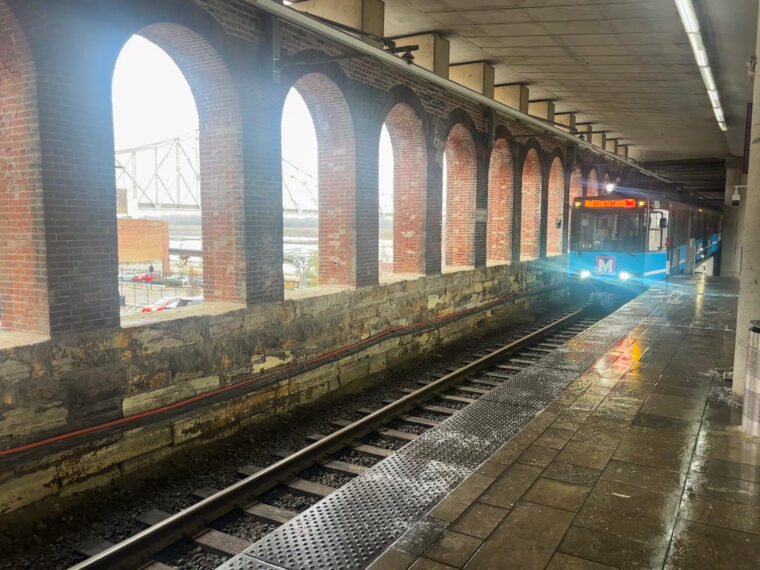
A Metrolink train arrives at the Laclede’s Landing station. (Matt Eisner | Managing Sports Editor)
The St. Louis MetroLink is this city’s most underappreciated amenity. St. Louis is unique in having a Metro system that is so expansive — in the Midwest, only Chicago and Minneapolis have higher ridership on their rapid transit systems. Still, all too often, students deride the Metro for being too dangerous, woefully unreliable, and not serving the areas of St. Louis that students want to travel to.
I have always loved public transportation, and I think the Metro is a unique perk of St. Louis that most students don’t take advantage of. So, I did what any reasonable person would do: I rode the entire dang thing. It was a fascinating experience.
My day started at University City-Big Bend station on the Blue Line. This is one of the few parts of the Metro that I was previously familiar with, having taken the train downtown for St. Louis Cardinals games, concerts, and Mardi Gras in Soulard. But instead of waiting on the familiar eastbound platform, I went west toward Shrewsbury-Lansdowne. After zipping past downtown Clayton, the Galleria, and the Brentwood Promenade, I began to notice a common theme among these stations. While they’re located in car-dependent areas, each stop has something around it that serves the St. Louis community. For example, if you don’t have a car, you could take the Metro to Brentwood and shop at Dierbergs or Target without needing to pay for a pricey Uber. This should be the goal of every transit system — to take people where they want, or need, to go.
About 15 minutes later, I made it to Shrewsbury, and my morale was very high. I waited 20 minutes before getting back on the same Blue Line train, this time heading east. I passed the WashU Medical Campus and the familiar slog through the downtown railyards before alighting at Laclede’s Landing. This stop, the last one in Missouri, is located inside the Eads Bridge and has a beautiful view of the Gateway Arch. I used this stop as my opportunity to switch from the Blue Line to the Red Line. This also marked the one hour point of my journey.
I crossed the Mississippi River into Illinois, and immediately, things changed. The infrastructure and stations were less built up, and my morale decreased. St. Louis has a defined urban core, but the Metro East region of Illinois is sprawling and lacks a major population center. We pulled into the 5th and Missouri station, the “downtown” stop in East St. Louis, and only one person got on the train. The only busy stop on the Illinois side was Emerson Park, which is where the Blue Line terminated that day.
The stations across the river just do not serve the places where people live, instead relying on commuters to take the Metro into St. Louis. And as fewer people work downtown, fewer people take the train. Take the Memorial Hospital station for example, which is located more than a mile away from Belleville Memorial Hospital. Since the station is located in a forest on an old freight railway, and notably not in the neighborhood which it claims to serve, the Memorial Hospital station is functionally useless if you don’t have a car.
I continued on the Red Line through the Illinois suburbs and toward Scott Air Force Base, the terminus of the system. As we passed Belleville, the most populous city in the Metro East region, the dense suburban landscape gave way to farmland and back roads. I arrived at the Shiloh-Scott station almost two hours into the trip and 25 miles away from WashU. I exited the train to see a parking lot, an empty Air Force base on a dreary Sunday morning, and fields of corn. Amazingly, later this year, the Metro will extend beyond Shiloh-Scott towards the MidAmerica St. Louis Airport, a minor airport which served over 300,000 people in 2024 — paling in comparison to the 16 million people who flew through Lambert Airport in the same year.
I sighed and got back on the line toward St. Louis. I drifted in and out of sleep as we went through Illinois, back across the Mississippi River, and made it through the last few stops. After 3 hours, 7 minutes, and 35 seconds of sitting on the St. Louis Metro, I got off at my final station.
Would I recommend that you do this trip? No. In fact, when my friends asked me if I enjoyed this side quest, I responded that it was a massive waste of time. I did notice, however, a stark difference between riding the system in the city of St. Louis versus in its suburbs. The Metro is really good in the places where there are amenities surrounding stations and really bad in places that are strictly suburban or rural. Transit only works when there are people nearby to use it and the stations are near the locations that people want to travel to.
Let this pointless journey be a plea to city leaders, developers, and transit executives that the St. Louis MetroLink has boundless potential. That potential can only be realized through investment in transit-oriented development and further expansion into underserved areas like North City, South Grand, and Tower Grove. City leaders are still debating whether to build a new transit corridor from Cass Avenue in North City down Grand Avenue, before ending at Chippewa Street in South City. This new line would provide a crucial link to areas that receive woefully unreliable public transit today, and whether it is bus rapid transit or light rail, it must be built.
And if you’re a student considering taking an Uber to a Cardinals game or pleading with your friend for a ride to your Medical Campus lab, consider the Metro. Get your free U-Pass, time your trip with the train schedule, and you might be surprised with how much you liked the experience.
Stay in Touch!
Get the latest and top news from StudentLife delivered to your inbox