Scene
Carolina Caycedo returns to the Kemper Art Museum with ‘Growing Deep Roots’
Tamiah Woodfork | Staff Photographer
On Sept. 9, the Mildred Lane Kemper Art Museum opened “Carolina Caycedo: Growing Deep Roots.” The exhibition is a collaboration between LA-based Colombian artist Carolina Caycedo and Kemper Senior Curator Meredith Malone. The two collaborated last year on a related exhibition, “Seeds: Containers of a World to Come,” a group show.
After “Seeds,” Malone offered Caycedo a solo exhibition at Kemper set to open at the same time as Counterpublic, a triennial St. Louis-wide public art show in which Caycedo is also showing work.
Caycedo works in several forms of media, and “Growing Deep Roots” is reflective of this. Caycedo tends to create works in series, and the works in this exhibition are pulled from various projects, including several that are ongoing. The media include sculpture, video, prints, drawings, and even satellite images.
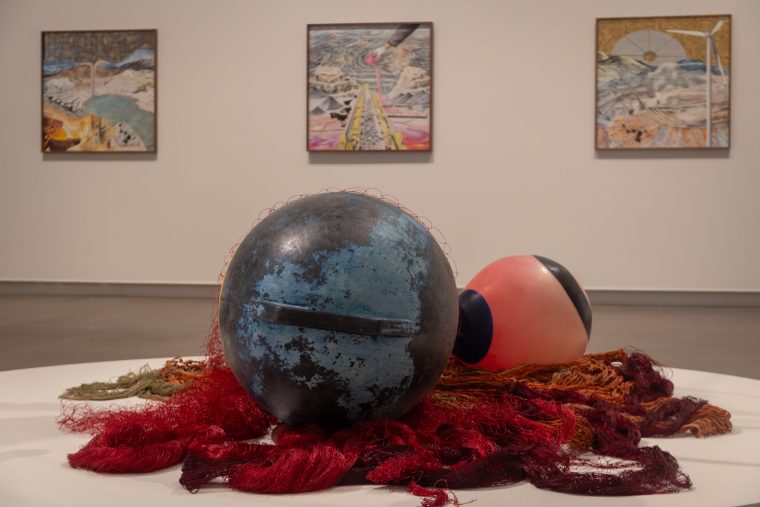
The centerpiece of the exhibition is a hanging sculpture that is part of a series called “Cosmotarrayas,” which features various hanging sculptures formed from artisanal or recovered fishing nets. This particular work, called “Celestial Autonomy, the Dance of Big Dipper and North Star,” was made in Alaska and constructed from recovered dipping nets and buoys.
“[The Big Dipper and North Star] are very visible in Alaska and used by native peoples there to locate themselves and to navigate geographically their lands and their waters, their oceans. So I’m talking about that kind of knowledge that exists in our relationship with stars,” Caycedo said.
The exhibition features works from three of Caycedo’s other collections, each telling a different but still interconnected story.
Three of the featured works are from the series “Root Portraits,” from which the exhibition’s name is drawn. While two of the works are unconnected colored pencil drawings of roots — one showing the intertwined roots of two Kernza plants, a type of perennial grain — the rightmost work is a three-part relief depicting root systems of six prairie plants, all native to the Midwest.
“Prairie plants have very deep roots. Many of them have roots up to 15 feet deep. They absorb water. They absorb carbon. They’re perennial, so they come back every year. And I wanted to highlight this because these are things that we can’t see because all this is happening underneath our feet, under the soil,” Caycedo said.
Intriguingly, this three-part portrait is drawn to scale, with the roots stretching to accurate anatomical lengths. Tap roots, which are typically around nine feet long, take up nine feet vertically on Kemper’s gallery walls. Caycedo explained that she kept the actual root lengths because she wanted to depict the complexity of what is happening beneath our feet while taking creative liberties with color and texture. She chose to create this particular portrait, depicting only plants native to the Midwest, to connect the exhibition to the individuals who visit it.
“We are responding to things that are important in St. Louis, that are things that experts, citizens, scientists, tribal members are proposing, so we can live together in a rapidly changing earth,” Caycedo said.
Another series represented in the exhibition is “Mineral Intensives,” which consists of vibrant collages done in colored pencil. These drawings piece together various vignettes of mining sites, labor, and processes. Caycedo contrasts natural forms, such as mountains, waterfalls, and lakes, with hazmat suits and harsh metal machines. Some of the landscapes are even based on the shape of mining sites or common uses of the mineral.
The four minerals featured in this exhibition — lead, indium, neodymium, and molybdenum — are all used in clean energy technology, a dichotomy starkly shown in the drawings. Indium is essential in modern electronics, touchscreens, and crucially, solar panels. In “Indium Intensive,” Caycedo sketches an electronics graveyard, filled with cracked computers and broken phones, lit by solar-powered street lamps. The foreground is gray and somber, a sharp contrast to the vibrantly multi-colored background. However, the cracks spiderweb through the colorful backdrop, revealing black beneath.
Other works in the exhibition include two videos, one in the main gallery and one downstairs. There is also a mural covering a full wall, composed of overlapping and collaged satellite images, called “Elwha’s Healing.” Finally, there are two works from a series called “Plant Portraits,” which shares many similarities with “Root Portraits.”
In addition to presenting her own work, Caycedo also curated an exhibition in the room next to “Growing Deep Roots,” titled “Our Feminine Lineage.” This display is composed exclusively of artwork created by or depicting female and nonbinary artists. The works are all drawn from Kemper’s permanent collection, except Caycedo’s own contribution to the exhibition, a printed banner displaying over 140 female environmental activists from around the globe. Two display cases rest in the center of the gallery, containing six plant samples from the Missouri Botanical Garden’s Herbarium; one case contains native prairie grasses, while the other presents plants named by or for women.
Caycedo hopes that people who visit the exhibition walk away wondering how they can give back to the natural world.
“I hope that they can re-question or re-think their relationship to nature and to natural systems, to understanding not as resources that are there for humanity to exploit until depletion, but instead think about other ways to relate, more reciprocal ways to relate to plants, to water, to minerals,” Caycedo said.
Both exhibitions are open to the public from 11 a.m. to 5 p.m. every day except Tuesday until Jan. 4, 2027.
Stay in Touch!
Get the latest and top news from StudentLife delivered to your inbox