Scene
One senior’s project to build community and preserve memories
Courtesy of Judy Li
As a line of students stretched through the second floor of Seigle Hall, the building buzzed with excitement. Seniors talked to one another about their post-graduation plans, complained about finals, and stressed about filing taxes. Closer to the front of the line, people fixed their hair, adjusted their clothes, and asked friends, “Should I smile with teeth or without?”
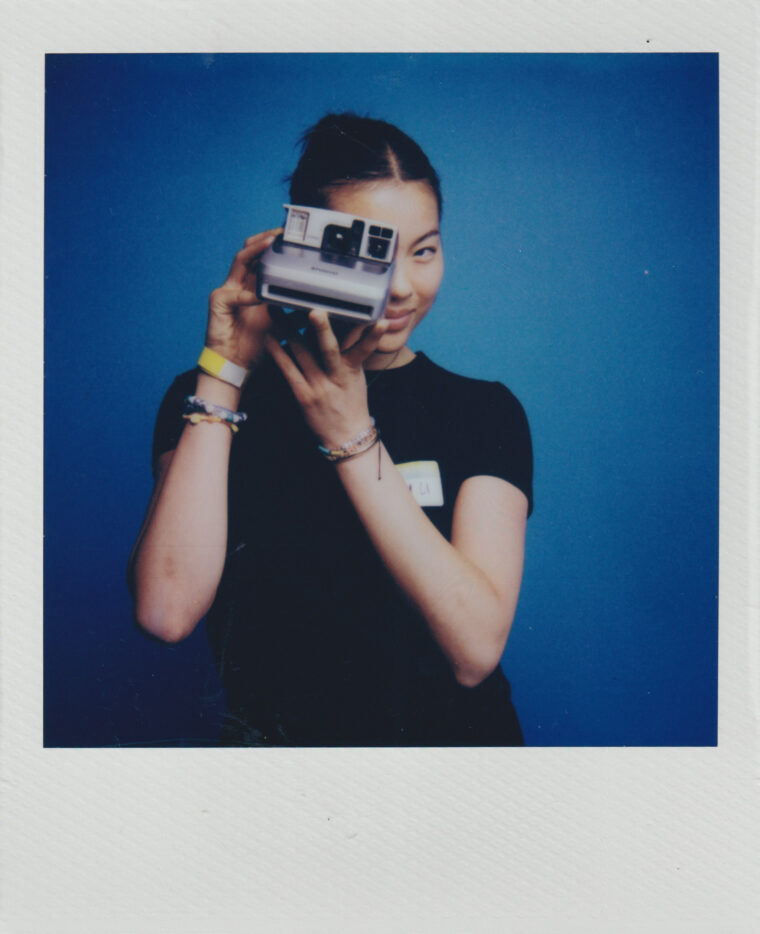
Ultimately, the long line led to senior Judy Li. Equipped with her camera, she greeted each person with an enthusiastic “Hi, how are you?” and a smile. She snapped their picture, handed them the developing Polaroid to sign, then added each photo to the growing stack that would eventually become the senior Class of 2026 yearbook.
Li’s initial vision of the yearbook began last year as small, handmade zines she planned to give to just her graduating friends. After a conversation with then-senior April Springer, who had told her about WashU’s former yearbook, “The Hatchet,” Li’s project expanded into something more formal and extensive. She compiled photos and quotes from over 200 seniors in the Class of 2025 and created her own yearbook titled “The Washed of WashU.”
“I think what struck me the most about her yearbook project was that this wasn’t even her year that she started it,” Springer said. “She decided to undertake this very massive project to create yearbooks for a community that wasn’t really even necessarily her own.”
After publishing her first edition, Li returned to this year’s “The Washed of WashU: Volume II” with a clearer vision and redesigned multiple aspects of the yearbook. Her 2026 yearbook will include a new layout that features multiple students per page, seniors’ signatures on each photo, and a hardcover format so the book can lay flat. These changes reflect not only an attention to design, but also to how people will experience and interact with the yearbook. Like the project itself, the updates to the yearbook demonstrate Li’s thoughtfulness, care, and commitment towards her community.
On the surface, the project seems like a one-woman show. Li handles almost everything herself: photographing students, coordinating with a publishing company, and designing the yearbook. However, Li views this yearbook as more of a collective project.
“I couldn’t have done it without people showing up and being curious enough and bold enough to show up to this random yearbook project,” Li said.
Senior Madeleine Pira was one of the curious and bold seniors to participate in Li’s yearbook. She endured the long and winding line of students just to have her picture taken. What made the process worth it for her was the sense of connection the yearbook created.
“I just think it’s important to be part of community in both big and small ways,” said Pira. “I felt like this was a way to do that.”
She noted that the community building began while waiting to get her photo taken as she was “talking to [my friends] while waiting in line and seeing people that I maybe wouldn’t normally see around campus.”
At the center of this project is Li’s Polaroid One600 Classic, which she has owned since high school. For Li, the choice of medium is intentional.
“What I love about the Polaroid is that it’s so instant,” she said. “You can just hand [photos] to them … It’s like a physical memoir, which I love because we’re in such a digital age right now.”
Li’s appreciation for print media connects directly to the project’s archival significance. A copy of “The Washed of WashU” lives next to volumes of “The Hatchet” in Olin Library’s WashU Archives. Since the last edition of “The Hatchet” was published in 2011, Li’s yearbook fills a void that had been left empty for over a decade. The overwhelming turnout and excitement for the project signaled a desire for this sort of work within the student body.
“It’s something that people are missing. People want a yearbook,” Li said.
Springer sees Li’s yearbook as part of a broader responsibility to preserve WashU’s unique student culture.
“I feel like it’s a little bit incumbent upon us to retain what we know, as future generations will continue going to WashU and will be interested in that history,” Springer said.
Stay in Touch!
Get the latest and top news from StudentLife delivered to your inbox