Scene
From script to set: On production with WashU Film Club
Sara Gelrud | Senior Scene Editor
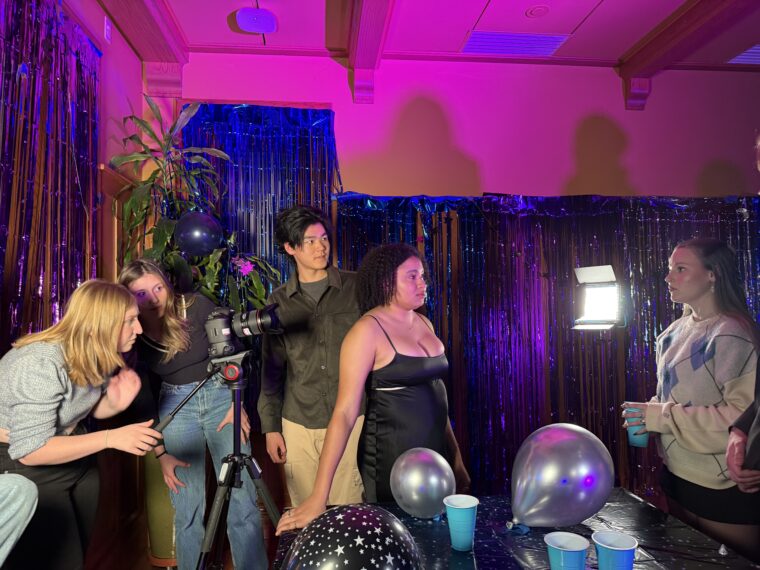
It is 10:30 p.m. on a Sunday, and the Danforth University Center looks empty. But upstairs, a crowd of actors and extras are chatting to pass the time. Purple and blue light floods their faces, and the wall behind them is lined with silver streamers.
Suddenly, the director yells out: “Quiet on set!”
A hush falls over the room. Nobody makes a sound.
“Camera rolling.”
“Rolling!”
“Sound speeding.”
“Sound speeding!”
“Slate in… and action.”
The lead actress exchanges a few words of dialogue with another actor. In the background, the extras dance in silence. Then she walks off, the camera trailing behind her. The actress’ footsteps are the only sound in the room.
“Cut!”
The room relaxes.
“And that’s a wrap!”
The WashU Film Club had just finished recording for their new rom-com short film, “Meant to Be.” Although shooting began that Friday afternoon, in many ways, the making of this film began over a year before.
Junior Nicole Backal, director and writer of “Meant to Be” and PR chair of the Film Club, said that the idea for this film came to her over winter break in 2024.
“[I] was obsessing over the idea of meet-cutes and moments like that, [ones] that we romanticize,” she said.
After writing the script last spring, the film was first pitched to the members of the WashU Film Club, but it was not picked up. However, the club tries to do two productions every year, one per semester. So, Nicole Backal pitched the idea again last semester, and the club voted to make a film based on her screenplay.
Once the spring semester began, so did preproduction. According to sophomore Dania Backal, a producer for the film, preproduction requires a lot of coordination.
“We have been working on preproduction for several months, which involves scouting out locations [and] actors. We host auditions. We have been working on getting the equipment here,” Dania said.
Through auditions, the producers were able to find their lead and supporting actors. However, the process was not entirely smooth. Last-minute casting decisions and scheduling issues made it difficult to guarantee that everything and everyone would be in place once production started. Nicole Backal also said they ran into some location issues.
“Obviously, we’re on a college campus, but finding places where you can shoot is still challenging,” Nicole said.
This meant the production team had to leverage the support of Film Club members and their friends to find spaces where not only could they film, but which could also meet the aesthetic requirements of the project. For instance, the second day of production took place in a dorm that did not belong to anyone on Film Club because no one in the club had a room that met the vision of the film. The cast and crew for the production, numbering around 10, could be seen huddled around each other in the hallway of Nemerov House, adjusting sound and light equipment, giving feedback on each shot, and quieting when the cameras started to roll. Nicole Backal emphasized the importance of preproduction.
“The past two months have been spent working all day on making sure this weekend happens,” she said.
After the preproduction process has been finished, a production call notice is sent out to the members of Film Club. Here, members volunteer to assist with cinematography, sound, editing, lighting, or can fill in wherever they are needed.
First-year Kelsey Espenshade works on set as a production assistant (PA). According to her, being a PA means helping out on the set however she can.
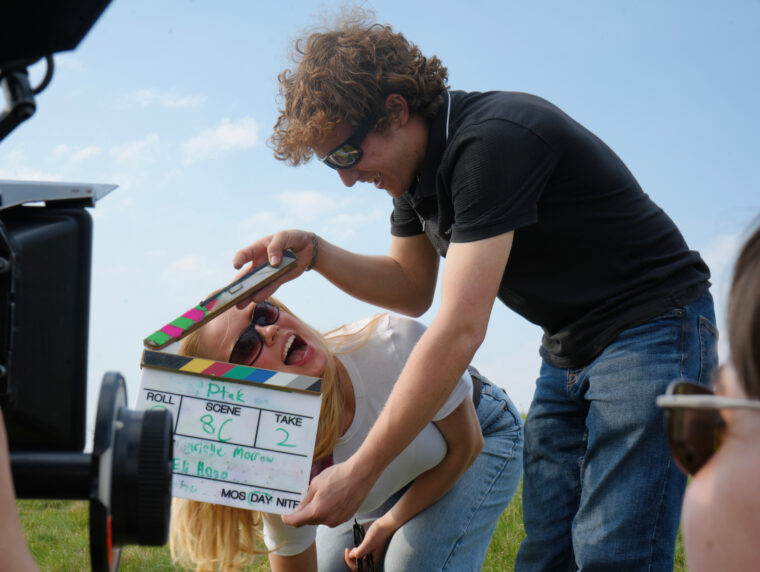
“[I’ve done] slating, the board that people have and clap down. I worked on the calendar [props] this morning; yesterday I helped on camera,” Espenshade said. “It’s kind of odd jobs all around, depending on where I’m needed.”
On production is also junior Muqing Niu, the camera operator and cinematographer. As a cinematographer, Niu has the responsibility of realizing the director’s aesthetic vision for each shot. For him, this means relying on instinct but also communicating with the director to understand what their vision for the film is.
Each job has different challenges. For Niu, the hardest part is keeping a line of communication open with the director and understanding the vision of the film. For sophomore President Abigail Brinkmeyer, who, along with her role as president, works as the supervisory editor on the project, this means being aware of how the shots will work together when editing the final cut, as well as keeping track of what shots the editing team has to work with.
“Every experience is different,” Niu said. “You always meet different people, get into different troubles, and try to fix [them].”
For the director, the challenges associated with the job are no less plentiful. As Nicole Backal explains, a key part of a director’s success is translating her screenplay and ideas, through the actors, cameras, and sets, into a finished product.
“At the end of the day, I have to tell other people what my vision for the film is and not have them guessing,” Nicole Backal said. “That includes making a shotlist, which is just an attempt at planning every single shot that is going to happen, … figuring out the casting call, when we can shoot, what we can do. Trying to make sure that we shoot every single scene this weekend.”
And even when everyone is on set, making a movie is a slow and intensive process.
“Some shots might be five seconds long but sometimes take an hour to film,” sophomore Gaurish Agrawal, a PA, said.
Despite the challenges and setbacks, Nicole Backal finds that, all things considered, the process is an incredibly rewarding one.
“When you are in that moment where you are taking a shot, and it looks good, and the actors are getting it, and the scene is perfect, and it’s everything you imagined, it is so rewarding.”
For anyone interested in realizing a project like this, Nicole Backal says that the Film Club has many opportunities to engage with film and media, from student-led film projects each semester to surprise screenings across campus.
“If you are someone who has any curiosity about the process of making a movie, join a production, be a PA, be the sound guy, even if you’re not remotely sure if you’re going to like it,” Backal said. “It is important to just do it. It’s fun, it’s low-stakes, it’s a story to tell.”
Stay in Touch!
Get the latest and top news from StudentLife delivered to your inbox