Scene
WU Turkish community reckons with natural disaster back home
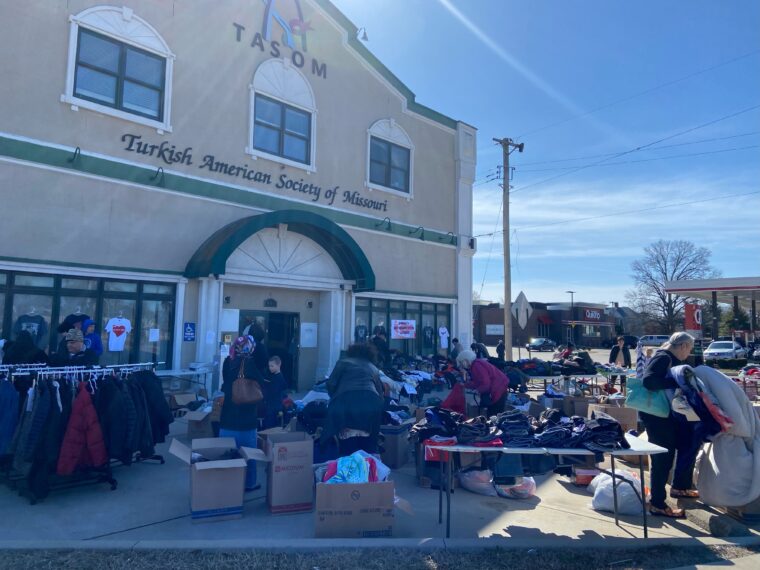
The WashU Turkish-American Students Association (TASA) helped with a fundraiser for people in Turkey impacted by the earthquake (Courtesy of TASA).
At 6 p.m. on a Tuesday night, the Village House was filled with familiar sounds. Cashiers chatted with students, the TV was playing some obscure sports game, the sizzle of the deep fryer making the (probably) hundredth half and half.
At the end of the last table furthest from the kitchen, six students were seated, speaking what they call Tring-lish, a combination of Turkish and English. They seemed relaxed, some leaning back in their chairs and others smiling and cracking jokes. Save for the Tring-lish and you wouldn’t have known that these students were all from Washington University’s Turkish-American Students Association (TASA), a club started at the beginning of this semester as an affinity group where Turkish students, or those interested in learning more about Turkish culture, could connect. The club initially met every other week just to catch up and plan events, but for these students, that would soon change.
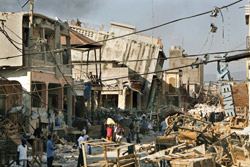
On February 6 just after 4 a.m., the ground in Gaziantep province in southeastern Turkey began to move. The first of two massive earthquakes stunned the region: homes, businesses, and livelihoods completely collapsed. According to the Turkish Interior minister, as of March 4, 45,968 people have died.
Most people who spoke to Student Life believe the real number of deaths is much higher than what is being officially reported by the Turkish Government.
Turkey is situated between Europe and the Middle East. It is a country familiar with experiencing seismic activity. Since 2000, there have been roughly 20 earthquakes in the country, and since the first quake in February that measured 7.8 on the Richter scale, there have already been three earthquakes in other regions of the country.
Members of TASA reacted immediately when the topic of the earthquake came up. Smiles turned to expressions of sadness. A sudden somberness swept over the table. It became clear that this was a group of people going through an emotional experience, both suffering and grieving.
First-year Vahdet Karatas, described scrolling on social media after the quake and seeing, “videos of dead people being taken out,” from the rubble.
Despite the added emotional burden from this event, members of TASA who were interviewed did not take time away from school. But they weren’t entirely present, either.
“I attended classes, [but] I was just physically there for the first few weeks, I really wasn’t emotionally or mentally there,” Vahdet said.
For this small group of students, the earthquake felt simultaneously personal and distant, a force that disrupted their entire lives while living halfway across the world from the impacted area.
Junior Tuğçe Iyiyol described how before the earthquake, TASA members met every other week to reconnect with each other, speak their native language, and be surrounded by other students who come from similar cultures.
“Just seeing each other gives you a motivation boost because we all know we are trying to build a life here,” Iyiyol said.
Starting on February 6, the club began meeting daily to process the news coming out of their country.
Iyiyol emphasized that even though her family has not been directly impacted by this quake, she still feels the ramifications of the event and urges people to view it as a humanitarian crisis. In 2010 during the Fukushima disaster, she remembers her “family saying hey, ‘this is not just [about] Japanese people.’” Iyiyol’s family instilled in her that when natural disasters happen, all people need to come together and provide support.
Since the quake occurred, TASA has become more connected with other college Turkish student associations around the country through social media. Iyiyol opened a Whatsapp group chat with over 30 contacts, each from a different college or university. This movement to provide aid has become something that students from around the country are involved in.
Iyiyol also pulled up a spreadsheet that the TASA’s had created to keep track of donations and money raised for Turkey. These groups are trying to “cooperate together across the United States,” she said, to raise awareness about this issue. TASA has worked with TASOM (Turkish American Society of Missouri) and held multiple clothing drives where people can drop off clothes to donate to either be sent straight to Turkey or sold to raise money for donations.
TASA also discussed mirroring a fundraising event that the Stanford Turkish Association did where they asked a local Dunkin Donuts if they would donate some donuts to the groups so that they could be sold to raise money.
Additionally, they are considering renting out a table in the DUC to sell traditional Turkish desserts and raise awareness about the earthquake. For these students, every little donation matters —every coat, dollar, and donut matters and has significance —and they are not done holding events just yet.
Iyiyol said that on March 18, the club plans on collaborating with TASOM to have another clothing drive and collect donations.
TASA is doing its best to make the most out of the situation its country is in, and it is committed to helping others who are suffering. Vahdet said that WashU’s response to the quake was “Pretty sad, to be honest.”
“It was disappointing not hearing from WashU,” senior and TASA member, Rana Karatas, said
First-year Refik Celik said that the only class that talked about the earthquake was his natural disasters course.
“[I] still hear[s] stories of people coming out from under the rubble. Somehow they have food or water next to them. So the more help we can provide the better,” Celik said.
First-year Orhan Erdoḡan said the people on his floor who knew he was Turkish reached out to him after the quake. He also said that his RA (Resident Assistant) reached out just eight hours after the earthquake and messaged him personally, asking if any of his family had been affected. For Erdoḡan it felt “comforting” when his floormates and RA messaged him. At the same time, “four out of my five professors didn’t mention anything,” he said.
Associate Professor of Middle Eastern History, Hayrettin Yücesoy, said that he wanted to hear more from the University.
“[I have] not seen a proactive response from the upper administration, [and] one would like to have that kind of solidarity and support to alleviate the emotional toll on our students and faculty from the region,” he said.
At the same time Yücesoy, “understand[s], if [WashU releases a statement] once after a disaster it will have to do so with all applicable cases.”
TASA emailed multiple administrators asking them to make a statement so that students would be aware of their fundraising efforts. At the time of writing, the University has not put out a public response about the earthquake.
Many believe that this earthquake could have resulted in far fewer deaths, had appropriate precautions been taken. Yücesoy also expressed his immense frustration at the Turkish government. According to Yücesoy, the Turkish national guard was prohibited from entering the impacted area for more than 24 hours.
As Yücesoy spoke about the earthquake and the inadequate governmental responses, he would lean forward and raise his eyebrows when trying to emphasize a specific point. He began by emphasizing how Turkey could have been more prepared to deal with this earthquake, and how the country failed to rise to the occasion when disaster ultimately struck.
“One of the areas of neglect that created this kind of disaster, and another disaster 20 years ago, and another disaster about 70 years ago, was basically [due to] the lack of enough attention to urban planning and earthquake fault lines,” Yücesoy said.
Yücesoy added that the government is not enforcing building codes. He explained that Turkish contractors work in an entirely free market economy, where everyone is trying to minimize cost in whatever way possible, including cutting corners when it comes to building safety codes.
Since the government actively participates in this economy, as one of the largest contractors in the country, this problem has only gotten worse. Even as the country is reeling from the physical and emotional aftershocks of the quake, new buildings are being constructed without building code enforcement from the government.
Karatas read online about how the government was “not abiding by building codes,” and how “Terrible government management of the earthquake [has resulted in] 40 or 50,000 deaths, [which] could have been ten thousand or maybe less,” he said.
TASA’s mission has undoubtedly changed since the club’s inception, but members remain steadfast and committed to helping others. Karatas feels both hopeful and pessimistic about the group’s current position.
“There isn’t much that we can do, because we are in America,” Karatas said.
However, he remains hopeful and urges others to “raise awareness, or go send money” because for him, every little bit counts in this disaster.
“Even if it is one dollar, [donate] because one dollar or five dollars is a lot in Turkey,” Karatas said.
Stay in Touch!
Get the latest and top news from StudentLife delivered to your inbox