Scene
From fruit scraps to lucid dreams: WU fashion seniors express their cultures and passions through one final showcase
Sam Fox’s 92nd Annual Fashion Design Show and Exhibition features the capstone collections of seven seniors pursuing BFAs in fashion design. The students were prompted to develop lines that captured their unique spirits, passions and identities, and seniors Genna Torgan, Mirai Patel and Emma Rubinson surpassed expectations. The garments—products of the arduous process of research, prototyping and design—will be available for in-person viewing from May 14–22 at the Des Lee Gallery.
Genna Torgan: “Life Cycles”
Dehydrated grapefruit, orange and lemon slices are strung like holiday garland to construct a sleeveless tunic, and any discarded peel is used for embellishment. Leaves set in vegetable glycerine become soft and malleable materials for embroidery. The natural rings on pineapples are easily repurposed as buttons, and dried flowers have limitless uses when developing a sustainable fashion line.
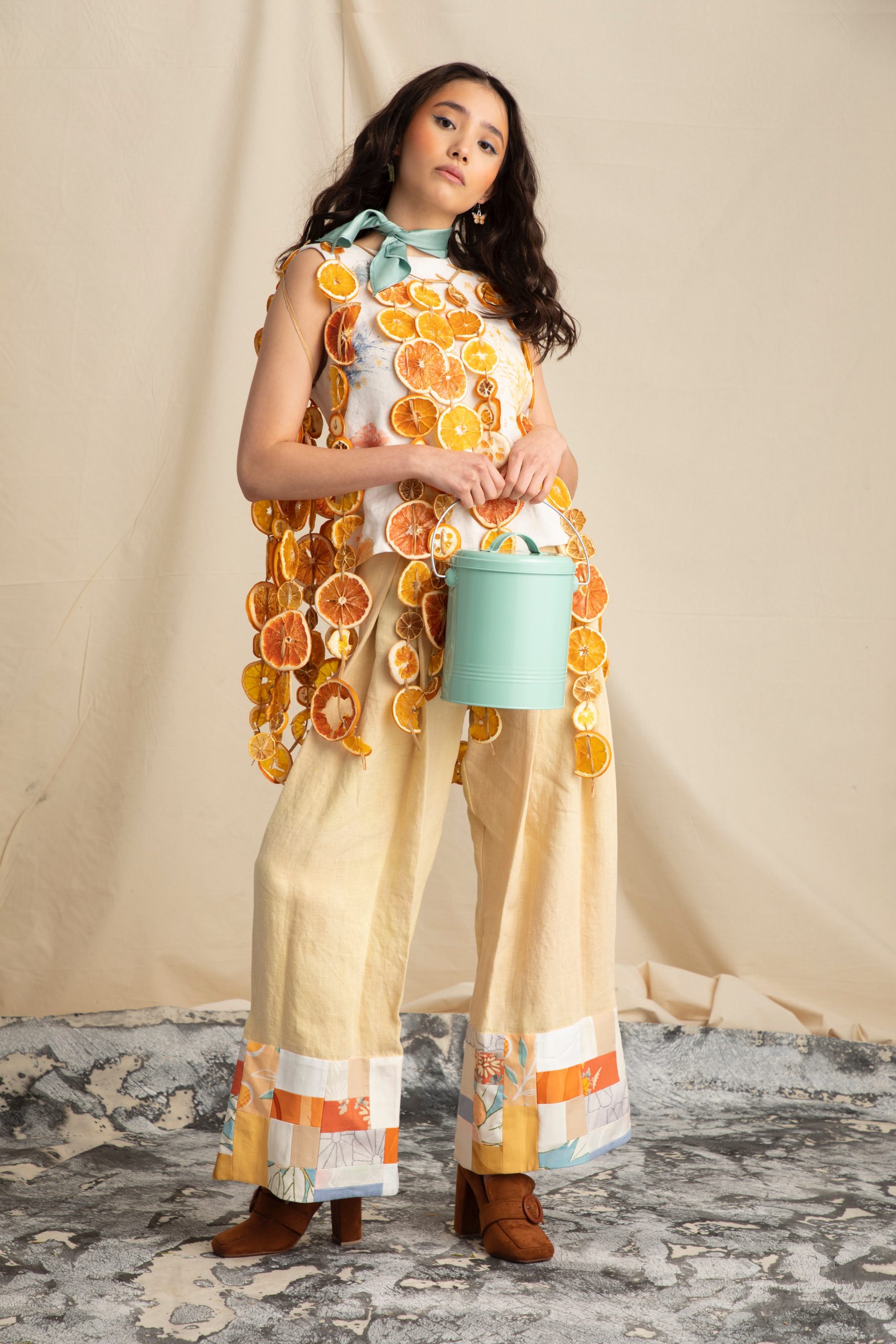
Senior Genna Torgan’s collection, which features dried fruit and recycled materials, was inspired by her passion for environmentalism and waste reduction. (Brian Cui/Student Life)
“I knew I needed to develop [a line] that spoke to my passion for the environment,” said senior Genna Torgan, a fashion design major with a minor in interdisciplinary environmental analysis. Torgan’s commitment to environmentalism has closely accompanied her along the journey toward the fashion world.
“For the capstone, we were really encouraged to go our own individual route,” Torgan explained. She set out to explore “what the future [of fashion] could really look like,” utilizing exclusively recycled and sustainable materials in her line “Life Cycles.”
Torgan’s “Life Cycles” pays homage to the natural theme of “death, birth and rebirth” and emphasizes the notion that the end of one life is simply the beginning of another.
“Life Cycles” relies on two main fibers, organic cotton and hemp, dyed using exclusively natural fruits and vegetables including “turmeric, avocados, yellow onion skins, chamomile, purple cabbage, hibiscus and madder root.” Torgan also incorporated patchwork, using leftover fabric known as deadstock, and derived faux leathers from the skins of pineapple and cacti. “You don’t necessarily have to use [harmful] fabrics and materials,” Torgan advised, saying you just need to “get creative.”
“Getting to dye the fabrics myself…I gained an appreciation for the work that goes into creating dyes and fibers,” Torgan said, noting that the process fostered an intimate relationship between creator and collection. Appreciating the brilliance of fabric leads to a reduction of waste, and Torgan incorporates this mentality in her personal fashion choices.
“I try to thrift or shop vintage…and I think it’s more fun and more interesting to have a garment with a backstory and [previous] life.”
Torgan also rarely throws away clothes when she does buy new garments. “I usually hang onto my clothes for a while,” she said. When she’s ready to part with them, Torgan will sell or donate using Poshmark and Thredup—two sites she recommends to anyone looking to extend the life cycles of their own clothing.
“Nothing ever really needs to go to the landfill,” Torgan said.
Mirai Patel: “Kenshō”
“Kenshō,” the Japanese term for understanding one’s true nature, is the encapsulating theme of senior Mirai Patel’s capstone collection. “I feel like a lot of people, including myself, switch personas depending on the environment,” Patel said.

Senior Mirai Patel’s designs feature aspects from all of her cultures—British, Indian and American. (Brian Cui/Student Life)
Patel’s background made understanding her own identity more complicated. “My mom is British and my dad is Indian…and I grew up in America,” she said. Patel’s childhood was imbued with a medley of cultural influences, and some conflicted—her parents’ interracial and non-arranged marriage proved to be a subject of contention. Born in a predominantly white neighborhood in San Diego, Patel felt removed from her background; it was only on rare family trips to India and a study-abroad visit with her English relatives that she began to feel a connection to her roots.
Patel’s line mimics her own experience with code switching, as it incorporates the psychological phenomenon of color adaptation, where colors are perceived differently depending on their background.
“A lot of my pieces are inspired by my cultural background,” Patel said, adding that they also pay homage to the cultural experiences of parents and family members. The passing of Patel’s grandfather at the end of last semester was extremely difficult, and she decided to dedicate her collection to him.
As a double major in fashion design and computer science, Patel said that she’s constantly engaging in “project-based work…with my creative side but also in analytical and technical terms.” Combining diverse backgrounds and interests to create a novel product is a “huge part of my identity,” said Patel. “I think there are some great ways for exploring the intersection of fashion and computer science.”
Patel has been in contact with one of her inspirations, Dutch designer Anouk Wipprecht, since her senior year of high school. Wipprecht combines robotics engineering with fashion, creating Lady Gaga-esque designs with functional components. Patel hopes to follow in her footsteps.
Emma Rubinson: “Liminal”
Senior Emma Rubinson has been lucid dreaming since her childhood, meaning that she has some control over the content and environment of her dreams. She sought to develop a bright and colorful collection meant to inspire people to “express their true colors,” which, for her, are most vividly expressed in dream states.
“In a lot of ways, [my dreams] are where I can be my most free self,” Rubinson said. Anything is possible in Rubinson’s dreams, and though they may be nonsensical, she believes this freedom brings forth the desires that reality represses.
“I am very into the idea of looking like a spectacle walking down the street,” she said. “I think the whole world should be brighter, [more] colorful and…more authentic than it is.”
Rubinson’s line, “Liminal,” serves as the blend between our confined reality and “what’s possible in the dream world.” It is an encouragement for outrageousness in everyday life.
“My personal style is not as bright and colorful as I’d like it to be,” Rubinson confessed. Instead, she scratches her creative itch through fashion design and collage.
Rubinson strongly values context, noting that background, hair, makeup and accessories are make-or-break elements of any line. She decided to shoot her line against the reflective mosaic produced by Kemper’s kaleidoscopic glass sculpture back in September.
All of the final capstone collections will be presented virtually on May 15 on the @wustlfashion Instagram and on YouTube.
Stay in Touch!
Get the latest and top news from StudentLife delivered to your inbox