Scene
WU-SLam hosts a riveting and vulnerable night of spoken word poetry
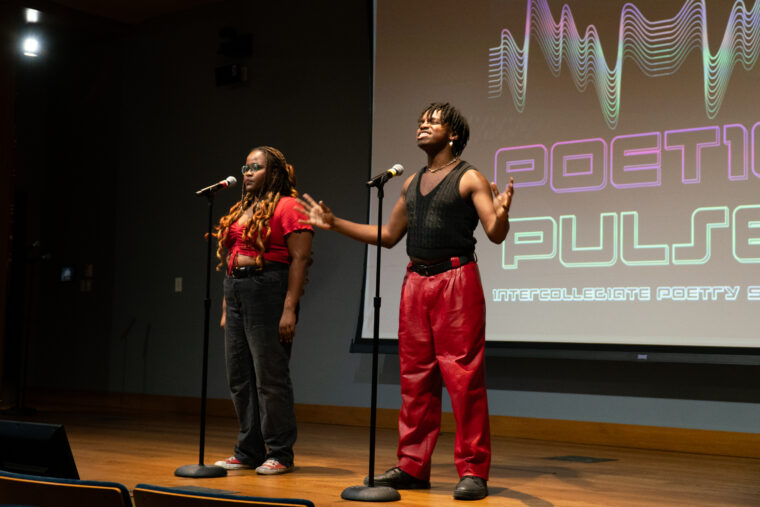
Washington University’s spoken word poetry group, WU-SLam, hosted their annual Spring Slam, an event in which seven members from their performance crew performed original poems, Feb. 8 in Graham Chapel. This three-round slam was competitive: Two poets were eliminated after the second round, and the remaining five poets competed in the final round for first, second and third place.
In a slam, or at least the one I attended, the judges are actually chosen from the audience. I was one of the judges, which was an interesting experience. All of the poets were incredibly talented, and I love watching spoken-word poetry! I’m also very indecisive; so, it was kind of hard (and stressful) to watch a performance and then have to immediately evaluate it on a numerical scale.
To start off the evening, a “sacrificial poet” performed in order to give the judges a baseline to scale the rest of our scores around. The poet performed a thought-provoking poem about the body being a home. As the first poem of the night, it was a nice reminder of how much I love poetry.
After the sacrificial poet, the poets who were competing performed their pieces one after the other. This was the first slam I’ve ever been to, and it was really inspiring to see my own peers getting on stage and sharing their work. They performed poems on a variety of topics, including a guide on how to become vegan, an ode to public bathrooms, the love story of one poets’ parents and more. The subjects of these poems may sound strange, but they were all superbly done. By the end of the poem about becoming vegan, I found myself wondering if veganism was the right choice for me. Another poet listed every public restroom she’d used on campus; I was both surprised and impressed.
My favorite poem from the first round was a poem entitled “Black Girl Magic” by first-year Zari Muhammad. She spoke about the caring and nurturing nature of Black women, but also the downsides that came with that. Black women are often so influential in successful movements, but they are rarely given credit for their success, and no one ever considers the possibility that perhaps they are just as scared as everyone else. Often, they are also trapped in boxes that are hard to escape. As an African-American woman, I deeply related to this poem. But beyond that, I was very impressed with how eloquent her words were and how composed she was while speaking on such a vulnerable topic.
Once each poet had performed a poem, the first round ended. Then scores were tallied, and the second round began. This time, the poets went in the order in which their first poems scored; the poet with the highest average score went first, and the one with the lowest went last. The second round brought more poems, and I continued to be moved by the work I was seeing.
During the second round came what I considered the highlight of the night, first-year Yohanes Mulat’s “Black Boys Don’t Break.” With captivating stage presence, Mulat performed this heart-breaking poem about how Black men are largely unable to show vulnerability, and how hard it is to be a Black male in America. Mulat spoke on these issues in much better words than I can, but it was absolutely incredible; his words were very powerful, and the gestures he incorporated added an even stronger effect to the already phenomenal poem.
After the second round, the cumulative scores were calculated again, and the two poets with the lowest averages didn’t continue onto the third round. This was a bit sad to watch because though I knew I wasn’t the only judge, I did play a hand in their elimination, even though both eliminated poets were very talented.
In the final round, the remaining five poets got onstage for the last time that night to perform one last poem. A standout of the third round was sophomore Keralyn Siebrass’ poem “Teen Girl.” It was an intriguing and thoughtful poem about the distinctiveness of teen girls, and I really enjoyed her presence onstage. Additionally, it reminded me of spoken word poet Olivia Gatwood’s “When I Say We Are All Teen Girls,” a poem that has been a favorite of mine for quite a while.
At the end of the evening, a member of the performance crew who didn’t slam announced the poets who came in first, second and third place. I imagine it must feel wonderful to win a slam, but every poet who performed truly did an amazing job. Before this event, I’d solely experienced spoken word through watching videos on YouTube, and seeing it live was a new and different experience. The energy in Graham Chapel was palpable, and there’s something special about watching artists perform their work in real time. WU-SLam is a talented ensemble of poets, and it was a treat to watch everyone perform. This may have been the first slam I attended, but one thing is certain: It won’t be the last.
Stay in Touch!
Get the latest and top news from StudentLife delivered to your inbox