Scene
STL Jewish community’s pride committee offers year-round engagement
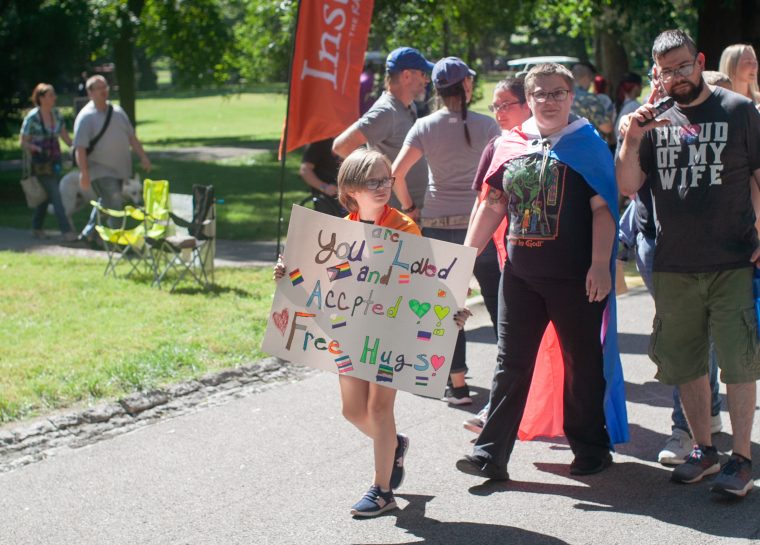
Although annual pride parades hosted in cities worldwide manage to draw larger crowds each year in celebration and support of the lesbian, gay, bisexual and transgender community, this year’s fell at particularly ideal timing for those in the U.S.—just one day after the Supreme Court legalized gay marriage. In downtown St. Louis on June 27 and 28, crowds in unprecedented numbers filled the sides of Market Street to watch this year’s impressive collection of floats, dance performances and musical acts move through the parade. PrideFest attendees may have noted one addition to the yearly lineup—this year was the first year that the St. Louis Jewish Communities Pride Committee had a float, thanks to a generous Innovation Grant from the Jewish Federation of St. Louis.
“After receiving both the Innovation Grant and donations from all of the organizations that partner with our committee, we realized this was something that could have a lasting impact,” Tasha Kaminsky, a member of the St. Louis Jewish Communities Pride Committee, said. “We were actually the largest faith-based group marching in the parade this year.”
In fact, the committee’s well-received presence at the pride parades has inspired what is now a plan for community outreach throughout the upcoming year. At PrideFest, the committee had a booth where volunteers used Polaroid cameras to take pictures of attendees, regardless of age, gender or sex, religious affiliation or sexual orientation. Guests were encouraged to pose however they wanted in the pictures, whether by themselves or in groups, and then were given the opportunity to caption the printed Polaroids with colored Sharpie markers.
“We provided guests with prompts such as ‘Why are LGBT rights important?’ or ‘Why is Judaism important?’” Kaminsky said. “Sometimes they were followed and other times, they weren’t. People also could identify themselves as much or as little as they wanted in the caption.”
The pictures have since been compiled into a travelling art exhibit, inspired by the idea of Humans of New York (HONY).
“We wanted an opportunity not only to document all of these interactions, but to share what we had experienced in a meaningful way with those who couldn’t attend,” Kaminsky said.
The exhibit will be displayed at various synagogues and other community recreation areas throughout St. Louis over the course of the upcoming year and will be accompanied by a programming packet explaining the process behind its creation. The collection of photographs reveals a range of perspectives and emotions at the festival, with some photos almost haunting or deeply sad and others much more cheerful and uplifting.
Kaminsky encourages college students to visit the St. Louis Jewish Communities website to determine where the exhibit is on display during various times throughout the year. Because of the contemporary medium of photography, the exhibit may be particularly relevant and thought-provoking, especially for those who appreciate HONY.
In addition to the art exhibit, the committee has organized two sessions of free Keshet training for May 2016. Keshet is a grassroots organization that focuses on equality for LGBT Jews in all aspects of Jewish life. While the training on May 16 is specifically for clergy and youth professionals, the one on May 15 is open to the community. Kaminsky recommends the training for college students as an opportunity to merge LGBT and Jewish identities or learn ways to incorporate inclusivity and tolerance into Jewish culture and everyday life.
Stay in Touch!
Get the latest and top news from StudentLife delivered to your inbox