Scene
Danielle’s ARTicles – ‘World War I: War of Images, Images of War’
The Mildred Lane Kemper Art Museum’s new fall exhibition, “World War I: War of Images, Images of War,” introduces an illustrative angle on this portion of history, outlining the visual cultures that were formed around the events of the war. The show was designed architecturally to create an experience that mirrored the order-to-chaos that unfolded—walking through the show was like being strapped into a time machine.
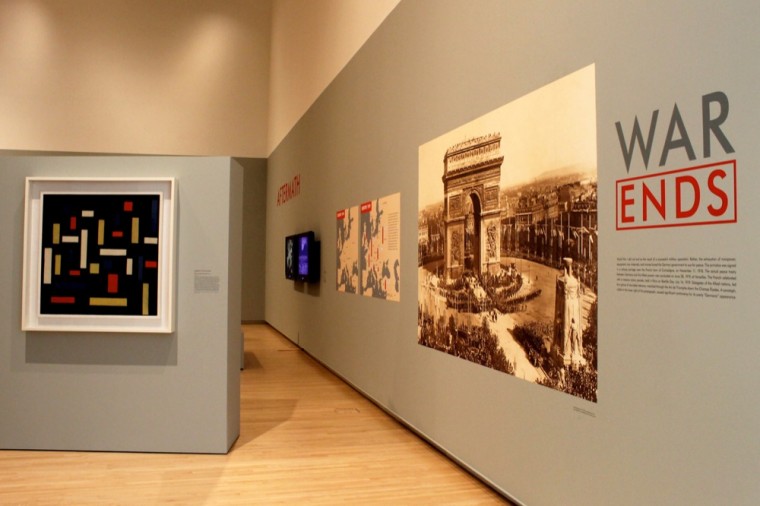
The exhibit included sectioned-off 10-foot walls that shrink in size to mimic the feeling of trenches and suffocation by the tunnel effect of Total Warfare. The viewer begins by stepping through the ordered propaganda of the “War of Images” that came from the involved countries before the outbreak of the actual war in 1914, into the winding chaos of the observed “Images of War” by modern artists who experienced the war firsthand. A display case is cryptically set on a total 45-degree angle leading from the “War of Images” to the “Images of War” section. This jarring turn in the flow of the visitor’s movement is an appropriate one; it matches the distressing turn of events that caused so much vulnerability for those in combat. From satirical, graphic propaganda to the reality of “Images of War”—trench art objects, journal entries and apocalyptic themes—the spatial decisions in this show were necessary to demonstrate the disparity between the fictional, pre-hype images and the real-life responses to destruction by new inventions like tanks, U-boats, machine guns and poison gas.
A goal of the exhibition is to point out that this war was fought between cultures—nations were concerned about the fate of the European empire in the 20th century and felt a need to push each other further out of the picture by skewing the cultural imagery to accentuate their competitors’ stereotypes while highlighting themselves positively. The propaganda that came out of this ethnocentricity is both humorous and disheartening: a checklist of visual codes. The French and Italians err on the side of “classical antiquity,” picturing the Germans as threatening “Huns”: barbaric, stout, always eating sausages and drinking beer. The German’s defensive illustrations poked fun at everyone else and viewed their belief in their “sophisticated culture.” They pictured the French as effete, often symbolizing them as an overdressed Marianne, the Russians as peasant-like bears, Italians as exceedingly suave and the British as comically innate.
Quickly shifting from the clean-cut caricatures and bold colors of propaganda, the “Images of War” section introduces the dark truth and atrocities of trench warfare. Horrifying black and white images of dead bodies and animals piled high in Henry de Groux’s etchings, the frantic ink scribbles and diary entries of Futurist artists Umberto Boccioni and Filippo Tommaso Marinetti and a recurring theme of the apocalypse are a few startling examples of the misery that ensued, both emotionally for these artists and visually in their work. A highlight in this section is Ernst Ludwig Kirchner’s ink and watercolor studies of the apocalypse on the back of cigarette packs. Created in 1917 while he was in a sanatorium recovering from the traumatizing war, these gripping pocket-sized scenes are energetic and immediate. They uncover Kirchner’s process of understanding this event as metamorphic, for both European culture and politics, and for himself.

The third and final section of the exhibition is “Aftermath,” or recovery from the devastation of the war, showing a breadth of work depicting the modern artists’ inner turmoil long after the actual turmoil ended. Kathe Kollwitz’s woodcut, “The Parents” from 1922 to 1923 stands out: A black mound of despair consists of the scratched negative shapes of a mother bent over in agony as her husband holds her in his own position of desperation, one hand embracing his wife and the other shielding his own face. Kollwitz herself lost her son in the war, and her pieces depict the everlasting heartache of this loss.
The Getty Research Institute in Los Angeles originally organized this show, and much of the work is on loan from their special collection. But the “Aftermath” section of the show in particular was tweaked to complement the Kemper’s location to include local paintings from various public and private institutions in St. Louis. One of these paintings is Theo van Doesburg’s “Composition VII: The Three Graces” from 1917, a piece that is normally upstairs on view in the Kemper’s permanent collection. Representing the “utopian belief” of the De Stijl, that the war would inspire the production of new, abstract imagery, this piece depicts the “three dancers” as an array of rectangles in the primary colors. The painting is a hopeful touch at the end of a whirlwind of emotional reactions to the war.
“World War I: War of Images, Images of War” is on display at the Kemper from now until Jan. 4, 2016.
Stay in Touch!
Get the latest and top news from StudentLife delivered to your inbox