Scene
What to expect when you’re getting arrested
As W.I.L.D. approaches, and stickers bearing “Run from Popo” persist in library bathrooms, it becomes increasingly important that students understand arrest.
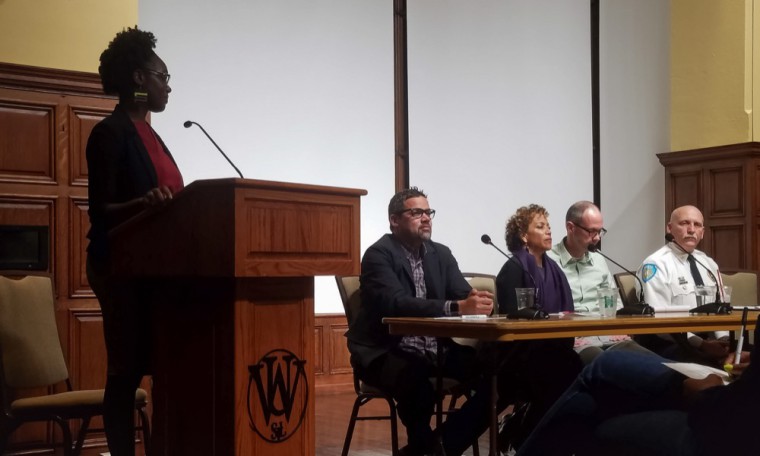
Scene met with Don Strom, Chief of Police of the Washington University Police Department, to discuss the work of the police and the procedure of custody. So for the student who thoughtlessly yells in University City during the wee hours, is involved in light treason or just happen to be in the wrong place at the wrong time, here is a guide to getting arrested.
“The police’s job,” said Strom, “is to make a reasonable determination and gather the facts.” Strom considered several hypothetical scenarios, from underage drinking at W.I.L.D. to fake ID cards. In every case, Strom described the officer’s first action as a process of figuring out what exactly is happening. This decision is often made quickly, but does not always lead to taking a suspect into custody.
Here at Wash. U., for example, Strom asserted that the police issue more referrals to the judicial administrator than they do arrests. More complicated situations may require additional investigation than the officer’s immediate response. If the officer believes a crime has indeed happened, perhaps because of something the suspect says, the officer may decide to arrest the suspect.
Arrest occurs with probable cause, meaning, “a reasonable person has suspicion to believe the suspect has committed a crime.” A failed breathalyzer test would constitute probable cause, as would statements from the suspect like “I’m glad I killed the bastard.” The policeman’s job does not end here, though this is where television begins improvising. Officers on television frequently handcuff the suspects and begin reciting the lines “You have the right to remain silent…”
These rights, according to Strom, are some of the least understood. “What you see on TV is the shortened version, and it may contain a lot of myth,” he emphasized. “For your Miranda rights to apply, the suspect must be in custody and under interrogation for information that will be admissible in court. Some suspects will admit to something in the back of the police car, like ‘I should never have taken that LSD.’ If the officer didn’t ask about it, he’s free to submit that confession to the court.” Confusion about Miranda rights stymie the efforts of many trying to represent themselves in court. The police may collect information about the suspect, a process called booking, once the suspect has been brought to the police station. Information needed in booking includes the suspect’s name, date of birth, Social Security number, address, height, weight and physical characteristics like tattoos. This information is used to correctly identify the suspect, especially if the suspect claims an alias. Since this information will not be submitted to court to determine guilt, questions in booking do not fall under the Miranda rights. “Plenty of folks will claim they never had their Miranda rights read to them before being asked questions. They were never interrogated before Miranda, so their case falls apart,” Strom said.
The other staple of television includes the one phone call. As it turns out, there is no federal law mandating that call. “Some states have providence for contacting a lawyer or family. Mostly, the phone call is a reasonable accommodation to arrange bail or contact a lawyer or family.”
After the interrogation, during which the suspect has the right to remain silent, he or she may be sent to the county jail. There, the officers meet with a prosecutor. They review the material gathered by the police and present it to a judge. The judge then decides whether or not a warrant should be served. If so, the suspect is then served, usually while still in the county jail, and simultaneously notified of his or her bail. If stopped by the police, Strom recommends adopting a candid and open attitude. “Cooperation can go a long way,” Strom said. Those stickers in the library do not offer the best advice, either. “If you run from the police, you’ll probably get caught,” said Strom. “You’re resisting arrest, which is another charge. Plus, you’re trying to outrun technology. We can radio to other officers in the area, or use CCTV, for example.”
Above all, Strom wants students to remember that the police are a part of the same community as everyone else. “We’re all interested in the general safety of everyone, the police are there to enforce it,” he said.
Stay in Touch!
Get the latest and top news from StudentLife delivered to your inbox