Scene
Student recounts evacuation from Egypt
 Courtesy of Pathik Root and Robert Joyce
 A protester carries an Egyptian flag in downtown Alexandria during riots on Jan. 28. Parsa Bastani, a WU junior, witnessed these riots.
Three days earlier, Bastani was on a bus in Alexandria, Egypt listening to gunshots as he and 23 other American college students were transported from one airport to another, long past a state-imposed curfew, to get on a chartered plane out of the country.
While studying at the Middlebury School in the Middle East, which is based in Alexandria, Bastani had found himself in the middle of violent, nation-wide protests against the 30-year rule of Egyptian President Hosni Mubarak.
“The whole week, I just couldn’t process my emotions or what was going on around me. I had an emotional overload,” Bastani said. “Everything just felt so real.”
The protests in Alexandria, which started on Jan. 25, accompanied riots in Cairo, Suez and Ismailia. Bastani said that his classes were canceled beginning that day as over 20,000 Egyptians gathered in the city center to protest Mubarak’s regime.
The protesters’ grievances include various legal and political issues, including police brutality, state-of-emergency laws, lack of free elections and free speech, food-price inflation and low minimum wages.
The Egyptian government cut off Bastani’s phone and Internet that same day.
Three days later, Bastani and his classmates were instructed not to leave their dorm. Bastani and a friend broke the rules and walked to the city center, where police were using tear gas to contain over 10,000 protesters.
 Courtesy of Pathik Root and Robert Joyce
 Protesters in downtown Alexandria, Egypt, rally against the government. The riots, which Wash. U. junior Parsa Bastani witnessed, ousted Egyptian president Hosni Mubarak following violent complaints about legal and political issues.
Bastani and his friend realized that they were in danger and headed back to their dorm. But as it grew dark, they had to run across train tracks and down alleys to avoid being arrested for missing the 6 p.m. curfew.
“People would come running at us in tears telling us, no, go the other way, the government’s coming,” Bastani said. “We didn’t know what to do, we thought maybe we’d have to sleep in a dumpster, we had no idea.”
After hours of wandering the city, the two made it back to their dorm.
The next day, the program’s coordinators told the students to pack their essentials. The dorms were no longer safe, and the students were transported to a different apartment in the city to be evacuated the next day.
Bastani said that neither he nor his fellow students one could sleep that night. From the balcony, he saw army officers kill a group of protesters after they accidentally fired at the military.
On Monday, Bastani and his classmates went into the street to wait for an evacuation team sent in by Middlebury College. After several hours, the evacuation team had not showed up. One of the program’s directors paid an Egyptian bus driver in cash to take the students to the airport.
At the airport, they found that their evacuation had been delayed: The plane, they were told, would come tomorrow.
“People were trying to contact senators, the state department, anyone they knew, just applying pressure and hoping someone would respond,” Bastani said. “This whole time, shots are being fired at the airport, and the State Department hung up on us.”
The problem, Bastani said, is that the United States wasn’t evacuating its citizens from Alexandria—only from Cairo. Bastani watched as Mexican, Canadian and Pakastani citizens got on flights chartered by their respective governments.
The group found a backup flight to Prague, but it arrived at an airport 20 minutes away. One of Bastani’s program directors paid an airport employee in cash to arrange for two buses.
It was on these buses, after curfew with the shades pulled down, that members of Bastani’s group realized they were actually being fired at.
Bastani said the rest was easy: The students got on a plane, arrived in Prague and were put up in a hotel by the U.S. Department of State. From there, he flew to New York, and is now back in St. Louis—his hometown—to figure out the rest of his semester.
Bastani was told that he could complete the semester at Washington University, but thinks that he will return to the Middle East next week to study in Morocco.
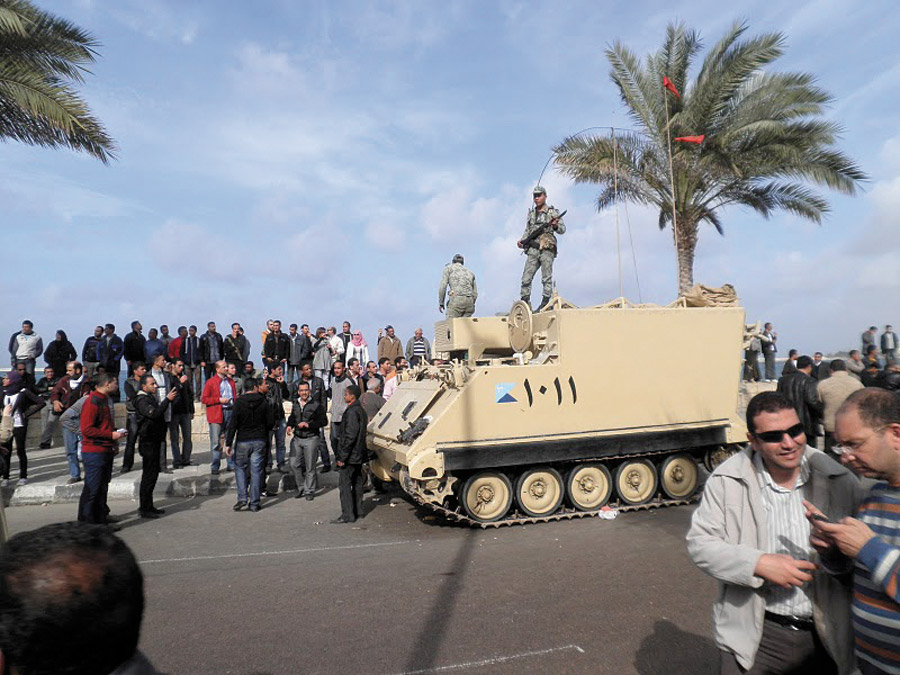 Courtesy of Pathik Root and Robert Joyce
 A soldier from the Egyptian army stands on a tank in downtown Alexandria last Friday. The military was sent in to control the riots that began Jan. 25.
Bastani said that he hopes that the revolution will create change throughout the region.
“People [in Egypt] are fending for their lives,” he said. “They’re so passionate and they’re trying so hard to get the very rights we take for granted here.”
Stay in Touch!
Get the latest and top news from StudentLife delivered to your inbox