Campus Events
Vox editor-in-chief talks election, American political landscape
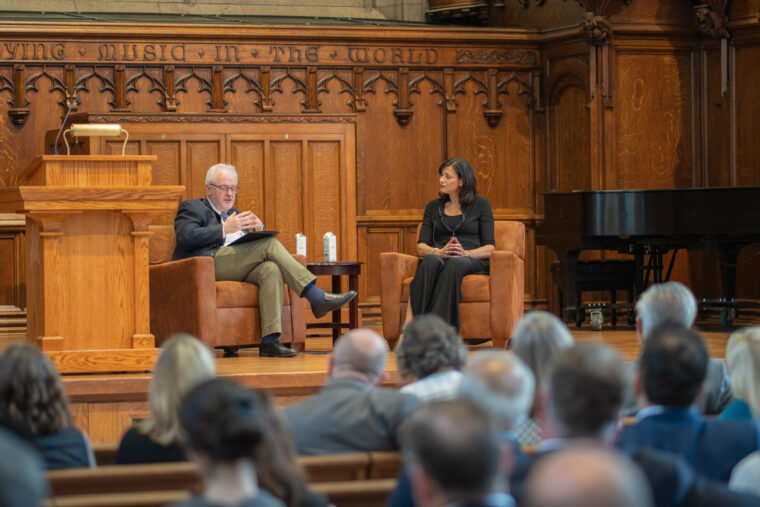
Ezra Klein, journalist, co-founder and editor-in-chief of media organization Vox, shared his thoughts on the upcoming presidential election Tuesday night in Graham Chapel.
Klein’s appearance came just two weeks before the second presidential debate that will be hosted at Washington University Oct. 9. The journalist’s appearance was funded through Student Union’s new Trending Topics series and, at $25,000, was allocated the second largest amount.
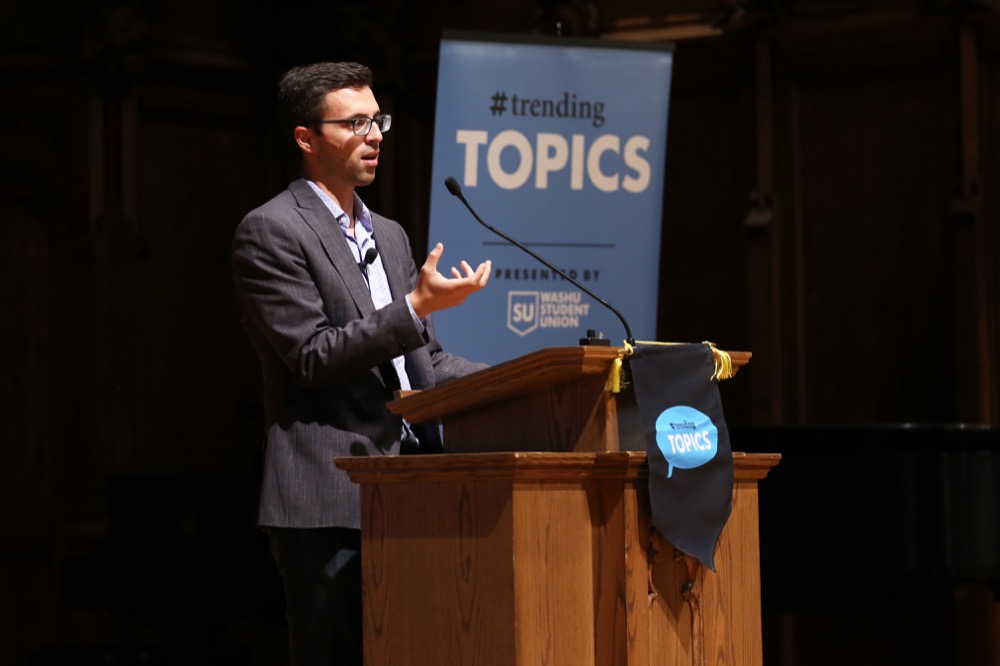
Vox editor-in-chief Ezra Klein speaks in Graham Chapel on Tuesday evening. Vox, a digital news site launched in 2014, helped Klein make GQ’s list of the “50 Most Powerful People in Washington.”
Klein’s insights shed light onto the election as well as the American political system itself. He spoke on a variety of topics including the media’s role in politics, political polarization and the structure of American politics—questioning the foundations of democracy in the United States.
“There’s got to be something between Trump and nothing, and if there’s not, what does that say about America?” Klein said. “When the Republican Party tried to move towards the center on issues like immigration, it angered the voter base so much that it gave them Trump. And almost Cruz.”
He started by discussing a paradox he encounters in his line of work: political media coverage, though intending to convey the thoughts of the American public, can in reality work in reverse by influencing voters’ thoughts prior to and on the election day. Klein stressed the importance of establishing media that convey facts and direct quotes rather than merely opinions. It is these opinions, he proposed, that have led to the increasingly polarized political climate in America today.
Klein took attendees through a mini history lesson: in the early 1900s, the American people wanted more party polarization, hoping voting would be simpler and easier to understand by categorizing candidates into two separate parties. Since Reagan’s presidency, Klein noted, America has become much more politically polarized, and today the nation is seeing a reverse of the circumstances at the beginning of the last century with a lack of moderation in its political candidates.
“Trump is both running as an American exceptionalist and a critic of America,” Klein said.
He suggested that perhaps the American political climate simply isn’t willing or able to return to a state of moderation. His central point was that given the trend line towards party polarization, Americans should look towards political systems like parliamentary republics that are designed to be more capable of handling polarization.
“We need to think much more about what the candidates want to do for the system itself,” Klein said. “We probably have to spend a lot more time about how decision making actually happens, whether the rules of the game are set up well.”
Despite Graham Chapel not being filled to capacity, when the floor was opened for questions following Klein’s speech, a line stretched halfway to the back of the Chapel and some students were not able to ask their questions due to time constraints. Of the questions that were posed, students asked Klein about Trump’s intentions, political moderation and the fate of our political system.
Stay in Touch!
Get the latest and top news from StudentLife delivered to your inbox