News
Doris Kearns Goodwin on what it takes to be president of the United States
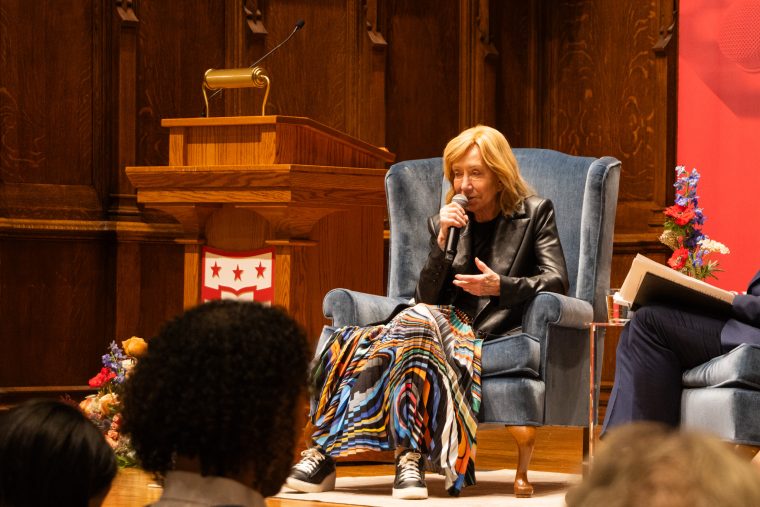
Doris Kearns Goodwin discusses the makings of a U.S. President in Graham Chapel (Hannah Dorval | Staff Photographer)
On Oct. 19, the WashU Assembly series hosted Doris Kearns Goodwin, who shared her belief that the past can give us hope and that quality leadership helps the country persist through challenging times.
Goodwin, a Pulitzer Prize-winning historian and biographer, reflected on leadership that has brought us to this moment. She spoke before a large audience in Graham Chapel on Monday, Oct. 19. She covered the key values she’s identified in transformative U.S. presidents over the course of her research and writing. Goodwin has followed the executive office for 59 years, starting as a White House Fellow for Lyndon B. Johnson’s administration.
Goodwin has led an esteemed career, publishing works detailing the lives of American presidents. One significant publication was “No Ordinary Time: Franklin and Eleanor Roosevelt: The Home Front During World War II,” which won the Pulitzer Prize for History. She has received several other distinguished awards for her works. Goodwin’s expertise expands beyond the pages, as she also plays a role in media. She was previously a frequent guest on the PBS NewsHour show and helped produce documentaries on many historical topics.
Goodwin and Andrew Knight, the executive director of the George and Carol Bauer Leaders Academy, began their conversation on American leaders with, naturally, George Washington. Goodwin emphasized that Washington set the precedent of serving only two terms and was cautious about his role as a president. In her opinion, Washington possessed humility and principles.
“Integrity and firmness is something that you could use today in every policy, certainly in our country,” Goodwin said.
The focus then shifted to Abraham Lincoln, with Goodwin sharing that Lincoln made an effort to appoint political rivals to his cabinet. She writes about this in her biography on Lincoln, Team of Rivals.
“Leaders in any field [need] to be able to have other people that say, ‘You’re wrong,’ and ‘Have you thought about this?’ rather than having people around you who will echo what they see you think is right,” Goodwin said.
Goodwin shared that a foundational moment in Theodore Roosevelt’s life was the adversity he suffered. Roosevelt suffered a great tragedy at the age of 25: his mother and wife passing away on the same day. From that moment, his attitude toward his career changed and he sought a job that would provide a sense of purpose. He worked extensively in civil service and brought together diverse minds over the course of his career.
“I think if we had anybody today, I’d bring back … Teddy Roosevelt, because I think what we need is something that can cross party lines, cross sectional lines, cross class lines, and make us feel like we have something in common with our American citizens,” Goodwin said.
Goodwin and Knight also explored the traits of John F. Kennedy and Johnson, two presidents who served during the Civil Rights Movement. She explained that both made significant contributions to the movement, yet in different ways. Kennedy served an important role in catalyzing the movement. Goodwin was in her 20s during his term and took part in the movement.
“I felt I was bigger than myself. That’s an incredible feeling,” Goodwin said.
By contrast, Johnson served a larger role in the actual implementation of civil rights reforms. Goodwin worked with Johnson for a period of time, helping write his memoir. He ultimately oversaw the passage of the Civil Rights Act and the Voting Rights Act.
Hudson Braue is a first-year student who attended the event. As someone interested in pursuing a degree in history, Braue was curious how Goodwin would frame the historical context of the present moment.
“Throughout the speech, Goodwin seemed confident in the future of the United States, even calm, as she asserted the trends of historical events onto current problems. She inspired confidence in my belief that America will endure for the next 250 years or beyond,” he said.
Near the end of the event, Goodwin reflected on how she believed these distinct figures came to be president.
“I think it’s because they possess a series of traits that make up what a leader is,” Goodwin said.
To her, those traits included a mix of humility, empathy, accountability, communication, and a sense of humor. She also noted that these traits are supported by elements like a period of self discovery, strong mentors, and the ability to ask questions. While this isn’t a formula that voters have to stand by, it is an interesting perspective to consider when choosing future leaders for the country.
Stay in Touch!
Get the latest and top news from StudentLife delivered to your inbox