News
WashU faculty raise concerns over classroom assignments
Alyssa Wang | Contributing Photographer
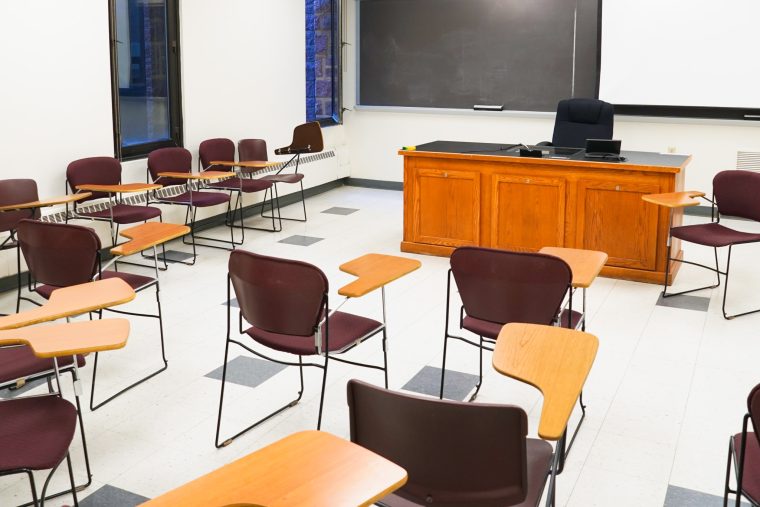
Certain WashU faculty have raised concerns over classroom assignments throughout the past several years, including various scheduling issues and classrooms misaligned with class sizes.
“This semester, my CHEM 4851 lecture meets in Mallinckrodt,” said Senior Lecturer William Spees. “I didn’t even know they had classrooms over there.”
This setting — a chemistry class in an academically ambiguous space — requires Spees to cart demonstration materials across campus multiple times a semester. In lab classes, students themselves have to make the trek down to the labs and back in order to gather the necessary supplies.
Spees reports having been assigned Cupples II for his CHEM 5100 class despite a complete vacancy in Wrighton 301 (a chemistry lecture hall); having no classroom assignment for the start of the fall 2025 semester; and the recent relocation of multiple classes that have had the same room assignment for the past 10 to 20 years.
These issues, however, have been particularly hard on the humanities departments, where classes are rarely larger than 20 students.
Vice Dean of Undergraduate Affairs Erin McGlothlin said, “Humanities faculty are disproportionately affected by these policies because [WashU has] a large number of courses with low enrollment caps and a shorter supply of smaller classroom spaces. The larger courses scheduled in lecture halls are less of an issue than the smaller seminar classes.” The University doesn’t have the resources to completely accommodate these smaller classes, leading to less desirable room assignments for the faculty teaching them.
English Professor Victoria Thomas aligns these classroom assignments, in part, with an attempt by the College of Arts & Sciences to abide by the Classroom Scheduling Standards and Expectations for spring 2026, which state “No more than 65 percent of classes offered by a given unit should be held between 10 a.m and 3 p.m.” This scheduling pushes the remaining 35% of classes into off-peak times, even as, according to Spees, many lecture halls and classrooms sit empty during the 10 a.m.-3 p.m. window.
McGlothlin said the necessity for these measures is what allows for diversity in scheduling.“[The department tries] to distribute classes as evenly as [they] can so that students have as much choice as possible.”
This is what allows for flexibility of student schedules, even if that flexibility puts a strain on the instructors and the spaces they are provided.
Cassie Akins of the Office of the University Registrar wrote in an email to Student Life: “Classrooms are certainly a finite resource on any campus. … We have seen an increased number of classes offered for several years … which puts pressure on our longtime scheduling practices. This means we need to make broader use of all the spaces and times available. We are in ongoing conversation with schools and departments who schedule classes so we can surface these tensions and see where we can improve process and communication.”
“We can’t just conjure up classrooms out of thin air,” McGlothlin said. “It would be great if we could … but we just can’t.”
Stay in Touch!
Get the latest and top news from StudentLife delivered to your inbox