News
‘Ordinary as can be’: Gabe Fleisher on the 2026 midterms
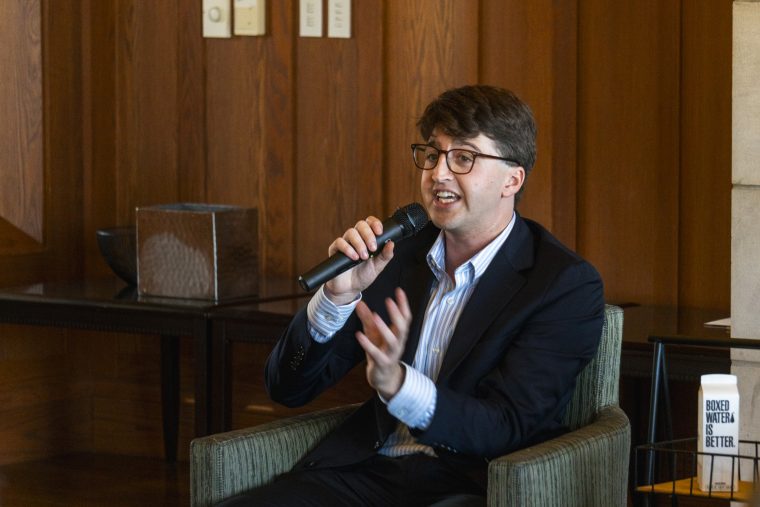
Journalist Gabe Fleisher speaks to WashU community members about the upcoming midterms (Alex Dering | Photo Editor)
The 2026 midterm elections are 17 days away, and candidates around the country are giving their final pitches to voters. On Tuesday, WashU hosted journalist Gabe Fleisher to speak to members of the community about the midterms. He shared that previous elections can tell us what to expect in November.
As with most elections, the 2026 midterms have generated flashy news coverage highlighting topics like contentious races and historic levels of spending. To some voters, this election seems like a historic moment to define a political era. Yet, Fleisher challenged this notion, pointing out that the party of the president has lost House seats in every midterm election except for 1998 and 2002.
“There’s a lot about the 2026 midterms that is fairly ordinary and fairly normal,” Fleisher said. “The fact that the president might be facing losses in the House is as ordinary as can be.”
Fleisher produces the daily political newsletter Wake Up To Politics, which he started at the age of 9. As a St. Louis native, he was profiled for his work by The New York Times and has worked for local news sources. Fleisher now lives in Washington, D.C., and breaks down current events for the 57,000+ subscribers to his newsletter. He spoke with Professor of Political Science Andrew Reeves about the state of the 2026 midterms and what he expects to see. The event was sponsored by the Weidenbaum Center on the Economy, Government, and Public Policy.
Fleisher established that the Democratic Party is favored in the House and that the race for the Senate is competitive.
Fleisher also shared that he will be keeping an eye on Midwestern states, as those will be strong indicators as to how strong projected Democratic gains actually are. In former swing states like Iowa or Ohio, whether strong candidates are able to reclaim these light red states will speak to the competitiveness of the party.
In an interview with Student Life after the event, Fleisher said that he expects that turnout for younger voters in this election will be fairly low.
“Midterm elections tend to attract highly politically engaged voters,” Fleisher said. “Young voters are not highly engaged right now.”
Additionally, he explained that a lot of voters are disillusioned with both parties and may not see their interests reflected. So, a fair share of young voters could sit out this election. Yet, this isn’t to say that young voters aren’t impacted by the current political climate. There’s one big issue on many voters’ minds right now.
“It’s the same one that they cared about in the 2022 midterms and the 2024 elections, and it’s the cost of living,” Fleisher said.
If students are interested in casting their vote in the midterms, it can be overwhelming to know where to begin.
“It sometimes can be exhausting to follow the horse race,” Fleisher said, which is why he recommended focusing on a specific policy that you care about.
Some students may believe that politics isn’t their thing. As Reeves joked, “You might not like the idea of waking up to politics,” referring to the name of Fleisher’s newsletter. However, Fleisher reminded the audience that all the topics we care about are “ultimately downstream of politics [and] political decisions.”
Stay in Touch!
Get the latest and top news from StudentLife delivered to your inbox