News
English professor holds solo demonstration against Iran war
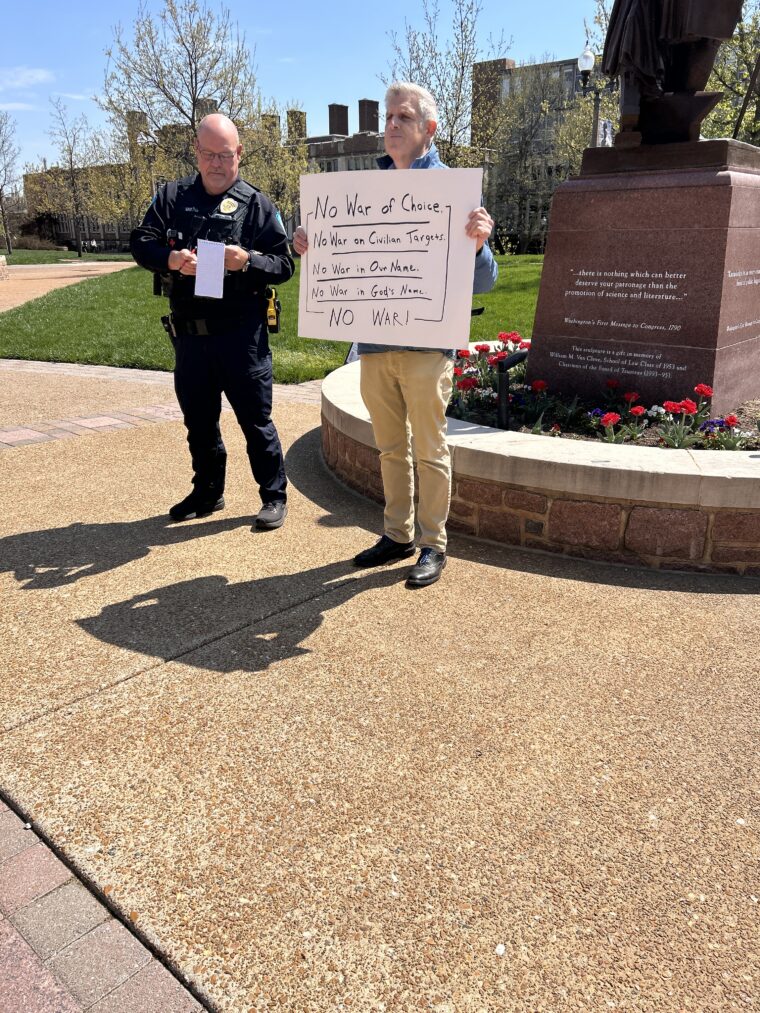
Professor William J. Maxwell demonstrating in front of Olin Library (Lissy Portorreal | Contributing Writer)
Professor William J. Maxwell spoke out against the Iran war outside of Olin Library on April 7. He stood alone in front of the George Washington statue with a sign that read “No war of choice. No war on civilian targets. No war in our name. No war in God’s Name.”
Student Life sat down with Maxwell, professor of English and African American Studies, to discuss his reasons behind the demonstration and what actually happened last Tuesday.
On Sunday morning, President Trump posted on Truth Social, “Tuesday will be Power Plant Day, and Bridge Day, all wrapped up in one, in Iran. There will be nothing like it!!! Open the F—–’ Strait, you crazy bastards, or you’ll be living in Hell.”
Trump’s post prompted Maxwell to take to the statue.
“I had to do something publicly as a form of witness and penance,” Maxwell said.
Maxwell considered his demonstration an important act in higher education.
“I felt that it was important for the University, and particularly the students of the University, to see that some faculty thought that this was crucially important to … teach against,” Maxwell said. “I saw it as an act of teaching.”
Maxwell said that he was shocked that someone felt it necessary to call the Washington University Police Department (WUPD) in response to his demonstration.
“[I am one] old man with a head full of gray hair, standing with a sign that calls for peace; this was somehow thought to potentially be a problem,” Maxwell said. “That’s a sign of where we are as a campus, as a university, and as a society.”
Maxwell later wrote in an email to Student Life that he has currently stopped his demonstrations due to the recently announced ceasefire. He will begin protesting again, however, if the ceasefire falls through.
Maxwell’s demonstration did not explicitly violate WashU guidelines, so while WUPD was called out to the scene, there was no punitive action.
“Once everything was sorted out, the police acted extremely responsibly,” Maxwell said.
Student Life reached out to WUPD for a comment regarding the demonstration. Chief Coonce referred to Vice Chancellor for Marketing and Communications Julie Flory, who commented on behalf of the University.
“At WashU, we fully support free expression within the guidelines and policies that are in place for these activities.”
According to WashU’s policy on demonstrations and protests, “It is the policy of the University to protect the rights of free speech, assembly and expression by making its facilities available for activities related to the exercise of these rights, including peaceful assembly.”
Gregory P. Magarian, professor at the School of Law, found it inexcusable that WUPD was called and arrived on scene.
“I frankly don’t care if it’s a professor or if it’s somebody who came in off the street … [who] can’t do [a demonstration] without getting a police response, then we have no freedom of speech, no freedom of expression at all on this campus,” Magarian said.
Even though Maxwell did not violate the policy, Magarian found the Demonstrations and Disruptions policy overbearing in general.
“The policy on its face, in the abstract, I think it is excessively restrictive,” Magarian said. “I think it reflects a lack of any serious commitment by the University administration to encouraging or even tolerating speech and protest.”
Magarian also found the language in the WashU policy dangerously vague.
“[The policy’s] general tone … fundamentally treats demonstrations as disruptive,” Magarian said. “The language about disruption in the policy seems very broad, and I worry that it’s just too easy to enforce the policy.”
Magarian expressed concern over the principle of freedom of expression on campus, referencing the police response to WashU’s pro-Palestine peaceful protest, which many students found “unnecessarily violent.”
“I’m troubled by the lack of procedural clarity in the policy about restrictions or punishments or consequences for actions that violate the policy,” Magarian said. “We saw this with the Gaza protest. The sanctions that were handed out were essentially arbitrary. The administration just did what it wanted to do.”
Maxwell emphasized the demonstration being an act of necessity, not heroism.
“I don’t consider what I did in any way special or heroic or risk-taking,” Maxwell said. “I want those words in [the article].”
Stay in Touch!
Get the latest and top news from StudentLife delivered to your inbox