News
‘Why now?’: Professor Krister Knapp discusses the nuance of conflict in Iran
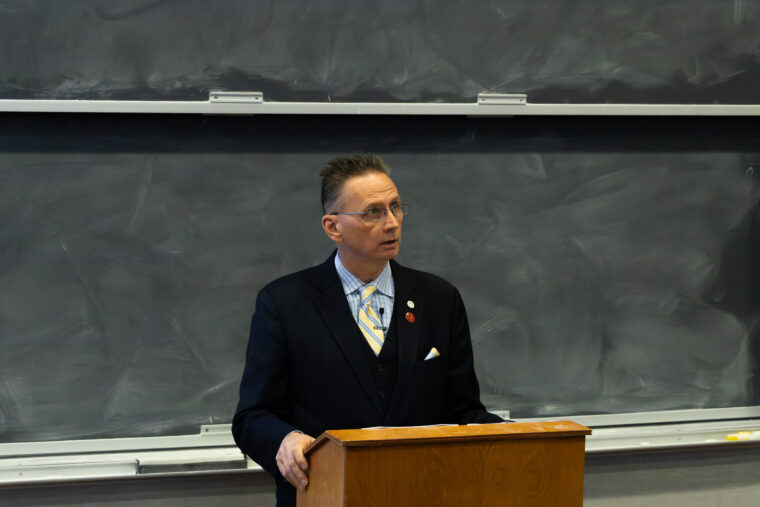
Professor Krister Knapp speaks to community members about the nuances of the conflict in Iran. (Max Silberg | Staff Photographer)
Professor Krister Knapp spoke on the ongoing war in Iran, assessing and explaining both the origins and possible outcomes of the conflict, March 19.
The Busch Hall saw both community members and students alike fill its seats. Attendees stayed well past the end of his prepared talk to ask Knapp, a professor and faculty research fellow in the history department, multiple rounds of questions.
First-year English and history major Elise Hanna attended the lecture after learning about it during her first-year seminar course with Knapp.
“I think he’s very knowledgeable and was excited to hear his take on this monumental event going on in Iran,” Hanna said.
Hanna said that Knapp presents current and historical conflicts in ways that feel accessible, as he provides the whole picture instead of just a snapshot.
“Knapp’s breaking down of the conflict into causes and continuities personally helped me understand the gravity of the situation,” Hanna said.
The war that started on Feb. 28 with Operation Epic Fury has now expanded to a larger Gulf War, with 11 additional countries in the Middle East getting involved. U.S.-Israeli strikes killed Ali Hosseini Khamenei, the reigning Supreme Leader Ayatollah of Iran for the past three decades. Iran, in response to the U.S.-Israeli operation, has traded strikes of its own.
“It is a game of chicken — who will cry ‘uncle’ first,” Knapp said.
A central theme of the talk was, in Knapp’s words, explaining “why now?” Many, including experts from the Brookings Institution, a notable think tank in Washington, D.C., have been trying throughout March to answer the same question Knapp proposed — why now?
To answer this, Knapp explained that the U.S. claimed to attack Iran due to the timeliness of its two strategic goals.
Those goals included reducing Iran’s capabilities as a threat, via mitigating the country’s nuclear, ballistic, and naval capabilities, and dismantling its support of proxy extremist groups. A secondary justification for the attack was in enacting regime change. Knapp explained that despite Iran being a significantly smaller country than the U.S., and not having an army the size of combined U.S. and Israel forces, Operation Epic Fury failed to overturn the Iranian regime, despite striking upon approximately 40 high-ranking Iranian officials.
Knapp’s discussion of the U.S.’s strategic goals, namely the sentiments regarding the power of the Iranian regime, struck a chord with some attendees.
“I mean, I never thought this was likely, but I’d say that Knapp’s argument made me even less optimistic that any kind of internal movement would topple the current Iranian regime,” sophomore Ethan Skolnick said.
Knapp then pivoted away from strategy towards the actualities of the conflict.
Iran is using “asymmetrical warfare to make the costs of the war too high for the U.S. and Israel to continue,” Knapp said.
The asymmetrical warfare to which Knapp is referring describes the contrasts in fighting styles of two militaries whose capabilities are wildly different from each other, resulting in unconventional military tactics. Knapp also presented the history behind the current conflict.
“Over 50 years, many U.S. presidents from both parties have tried carrots and sticks with Iran, but to no avail,” Knapp said. “Trump’s decision to bomb Iran … thus represents not a ratcheting up of existing policy, but rather a distinct break with it.”
In the days of the Cold War, the U.S. and Iran had been allies. The Iran Hostage Crisis under former President Jimmy Carter led to the dissolution of U.S.-Iranian relations. (In the Iran Hostage Crisis, 52 American citizens were held captive for more than a year after being kidnapped from the U.S. embassy in Tehran by militants.)
“A twilight war set in, and it witnessed many destabilizing events that undermined U.S.-Iranian back-channel diplomacy,” Knapp said.
Knapp pointed out that in the past three decades, the U.S. has engaged in three Gulf Wars. After the event, the professor also told Student Life that he perceived the American public as not wanting any more forever wars. News sources such as CBS support Knapp’s point, reporting on increased fear of economic instability and raised gas prices.
Knapp referenced Shakespeare’s “Julius Caesar” and its themes of opportunism, driving home his interpretation of Trump’s reasons for ordering Operation Epic Fury as departing from relational precedent.
“This is a watershed moment in U.S.-Iranian and, dare I say, U.S.-Middle East relations,” Knapp said.
Regarding the plausible consequences of the newfound war, Knapp focused on economic and social reverberations.
A focal point of the conflict is the Strait of Hormuz — and with it, 20% of global natural gas and oil. As not only a finished good sold directly to consumers at the gas pump, these energy sources directly impact economic growth across general economies. Iran is exempting itself from these disruptions, however, letting its own ships through the strait.
“Now that [Iran] knows that they can, this will allow them to wreak havoc with markets at will,” Knapp said.
Knapp said the oil price shocks will worsen inflation and scare investors, possibly leading to an energy crisis. Gas prices are already rising in the U.S., and Knapp said that soon enough, with the continuation of the conflict, $5 for a gallon may look cheap.
“What happens in the Middle East does not stay in the Middle East,” Knapp said multiple times during the lecture.
During the Q&A portion of the evening, audience members inquired about hypothetical scenarios where Iran was armed with nuclear weapons. In response, Knapp returned to the notion that history cycles in patterns.
“Wars are petri dishes for the next war,” Knapp said.
Thursday’s talk was a part of the Crisis & Conflict in Historical Perspective (CCHP) lecture series, which Knapp directs. The next CCHP lecture will be held in the Umrath Lounge on March 30 at 5:30 p.m. American University professor in Foreign Policy & Global Study, James Goldgeier, will be speaking on the causes and consequences of the Russia-Ukraine War.
Nicholas Demba contributed reporting.
Stay in Touch!
Get the latest and top news from StudentLife delivered to your inbox