News
WashU admin launches +AI initiative, encourages discussion on and use of AI
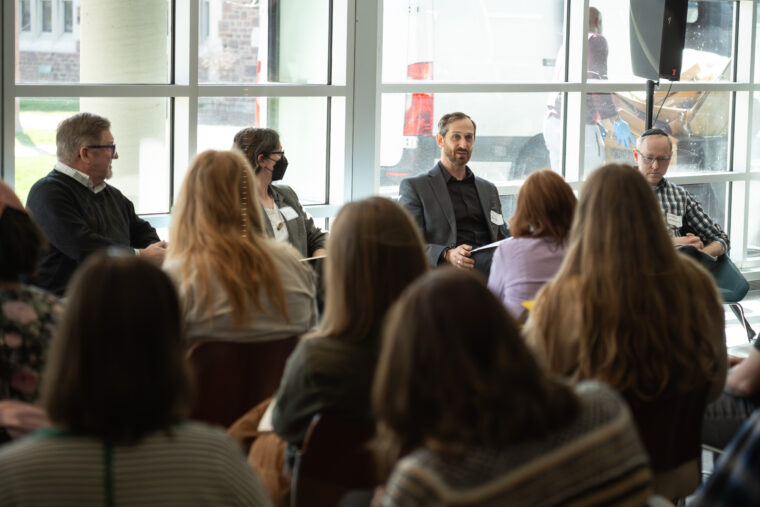
Students, faculty, and staff gathered to discuss various ethical challenges surrounding AI as part of +AI Week. (Bobby Kaplan | Staff Photographer)
This week, WashU is running +AI Perspectives Week, a series of events and workshops focusing on the role of artificial intelligence (AI) at WashU as part of their +AI initiative. The initiative aims to encourage discussion about the role of AI at the University, promote the use of AI to supplement teaching and learning, and familiarize members of the WashU community with how to utilize artificial intelligence tools.
The initiative was created after deliberation with focus groups including administration, faculty, staff, and students. Provost Mark West said that, while the University is not trying to center AI, he and the administration believe the University has a duty to teach students, faculty, and staff how to use developing technologies.
“The goal for us at WashU, whether it’s AI or anything else, is to be able to prepare students and, frankly, faculty too, for the world,” West said. “The idea is [that] we don’t learn AI for AI’s sake, although I’m sure there’s some people who do that. But for most WashU students, it’s going to be sociology plus AI, English plus AI, math plus AI. We’re not trying to make AI the center of an educational experience. The idea is to take the core education, the core educational values that we have now, and see it through the lens of AI.”
This viewpoint that AI has become critical for the University is shared among many members of WashU’s administration. At his State of the University address, Chancellor Andrew D. Martin said preparing students to use AI must become a priority for the University.
“I believe that we need to muster the full force of our institution to address one central challenge: how to ensure that every undergraduate, graduate, and professional student who comes through our doors is able to lead in a society where AI is ubiquitous,” Martin said. “This needs to be our institutional north star with regard to artificial intelligence.”
AI and its relationship with education has become a critical issue for higher education institutions in the past few years. Vice Provost for Educational Initiatives Jennifer Smith said every university is going to struggle with this implementation.
“What does it mean to educate in a world and for a world that is AI enabled?” Smith said. “What are some new things that we need to make sure students are aware of and trained on? How do we safeguard the learning that we want students to have and make sure that AI use is amplifying learning and not undermining learning?”
AI has sparked both concern and excitement over its pedagogical applications for students, faculty, and staff at WashU.
West said that he is excited for AI’s applications to education, but it is important to respect and understand those who are skeptical of it.
“If we’re going to use AI as a pedagogical tool, we’re going to have to train more people and actually respect the skeptics,” West said. “Part of the challenge isn’t just that people are skeptical, it’s that there are some decent reasons to be skeptical. … To me, that just means, let’s ask more questions. Let’s make this an interrogatory exercise and an iterative exercise where we share ideas off of each other, and I think that might feel a little less scary.”
Some of the events in +AI week include the HackWashU AI Build Challenge, a town hall about AI ethics, sessions about the use of tools like NotebookLM for faculty and students, and a speaker series event with Nicholas Thompson, CEO of The Atlantic. These events, according to West and Smith, are meant to encourage discourse and discussion surrounding the role of AI.
One criticism of AI is that utilizing it can lessen the need to learn fundamental skills a college education teaches. According to Smith, creating a balance between the utilization of AI tools along with these fundamental skills falls partially on professors.
“If we live in a world where AI can be used to defeat the purpose of assignments, how do you adapt to teach in ways that build the skills in students that you are trying to build [regardless],” Smith said.
However, not all faculty share the same viewpoint on using AI to teach, Smith said. She warned against faculty members who seek to totally ignore the emergence of AI.
“I’m concerned that there’s some [people with their] head in the sand, just like, ‘I’m just going to forbid it, and I’m going to pretend this isn’t happening, and I’m not going to change anything,’” Smith said. “I don’t think that is serving students or education well, because that is not the reality that we are living in.”
Despite Smith’s disagreement with faculty who refuse to acknowledge the presence of AI in their classrooms, she said it is up to individual professors to decide on their class policies, including ones on academic integrity.
“In the end, faculty have near total autonomy in their classrooms,” Smith said. “If there is a clear statement in a syllabus that certain types of use or any use of AI is a violation of that course’s policy, [and] it is demonstrated that the student did that, they would get a standard violation.”
Acknowledging the potential confusion caused by differing policies, Smith said the Office of the Provost is working on potential levels from which faculty can choose to define the level of AI usage permitted in their class.
A similar issue arose a few years ago in regards to student collaboration on assignments, Smith said. One of the most common academic integrity violations was unauthorized collaboration, and many of those violations were due to confusion regarding specific classes’ policies.
“There should be a standard collaboration policy, but that’s not going to happen because some courses want you working with each other, and some courses don’t, and that’s appropriate for what they’re trying to teach. I feel like AI is the same thing.”
The objectives of an undergraduate education and what appeals to the job market are inherently different, Smith said, but the reality of what employers are looking for does impact how that learning is done.
“If we are training you for fields that use AI, we d*mn well better train you on AI,” she said.
Betsy Sinclair, assistant vice provost for digital transformation and professor of political science, shared that over 1,000 students have completed an AI Literacy module on Canvas, which educates students about responsible AI usage. She said that it is critical that the University continues to listen to students and faculty about AI, since it is impossible to predict what will happen next.
“I think it’s going to be really important that we keep listening to what students need,” Sinclair said. “I think it will be really important that the faculty have leadership here. The reality is that no one really knows what the future is going to hold.”
This article is the first part of a series on artificial intelligence at WashU. If you’re interested in being interviewed about how AI is shaping higher education, reach out to [email protected].
Additional reporting by Riley Herron.
Stay in Touch!
Get the latest and top news from StudentLife delivered to your inbox