News
French ambassador celebrates 250 years of US-France friendship

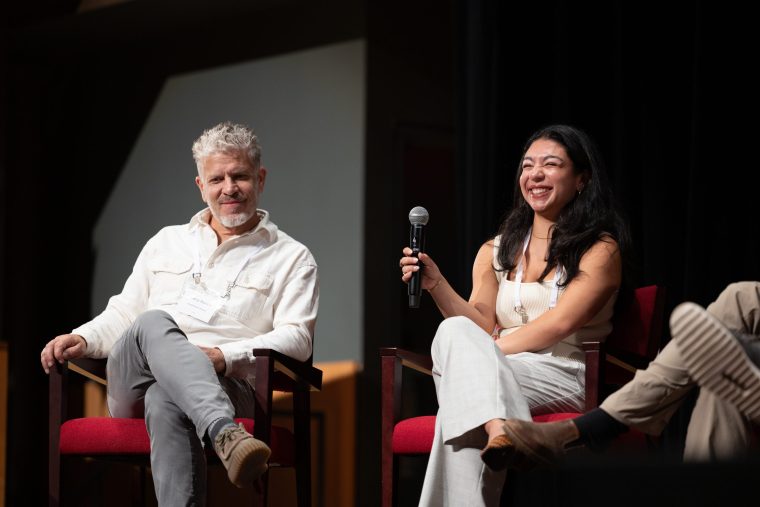
Ambassador of France to the United States Laurent Bili spoke at WashU on Feb. 26. (Charlotte Balla | Staff Photographer)
Two students posed inconspicuously to take a selfie in the midst of a crowded room, hoping to capture photographic evidence of being in the presence of Laurent Bili, the French ambassador to the United States.
Bili spoke at an event that explored the connection between the American Declaration of Independence and the French Declaration of the Rights of Man and of the Citizen on Thursday, Feb. 26. The event was part of a speaker series organized by the French Connexions Center of Excellence and hosted by the department of Romance Languages and Literatures. The series highlights the shared influence between France and the United States on ideas of rights, citizenship, and democracy. The event was also a part of the Gephardt Institute’s Civic Action Weeks, a two-week program offering community and civic engagement opportunities to the WashU community
Bili spoke briefly about St. Louis’ French roots, as well as the 250 years of friendship between France and America, beginning with France’s support for the U.S. during the American Revolution.
“We believe in the power of friendship; we must continue to build bridges and pass on the torch to future generations,” Bili said.
The keynote speaker, Vivian Curran, professor of law at the University of Pittsburgh, discussed ideas of French and American identity in the late 1700s.
“The French had been the first to ask, what is an American? Although [French philosophers] did not agree on an answer, the question continued to hover over them as they confronted the problems of their own identity,” Curran said. “The statement of that [French] identity arose in 1789, with the drafting of the Declaration of the Rights of Man and [of the] Citizen, and the Declaration of Independence truly was a direct influence.”
WashU Professor of International Criminal Law and speaker at the event, Leila Sadat, said that despite this history, she thinks the U.S. has backed away from its historical commitment to human rights.
“We’re still working on pushing forward, and I’m always an optimist, as many of you know, especially my students who are here,” Sadat said, “But I do think it’s paradoxical that a country that was primarily responsible for sparking this idea of human rights [America] has now sort of walked away from it.”
First-year Kat Kluzak was drawn to the event due to the focus on human rights and the opportunity to hear the French ambassador speak.
“I feel like [these events] are a very good reminder not only of the importance of human rights, but also the importance of cultural connection and the differences between cultures and how cross-cultural events help us learn more about each other and our history,” Kluzak said.
Bili told Student Life he was happy to be in St. Louis and that remembering history is important when looking toward the future, especially because today’s political landscape can be complex or overwhelming.
Bili said that the highlight of the event was Curran’s description of a “long love story” between France and the U.S. and the two countries’ shared values.
“The important concept is the fundamental declaration of the values that we share,” he said.
Stay in Touch!
Get the latest and top news from StudentLife delivered to your inbox