News
Patchwork of Hope brings students together for immigrant justice
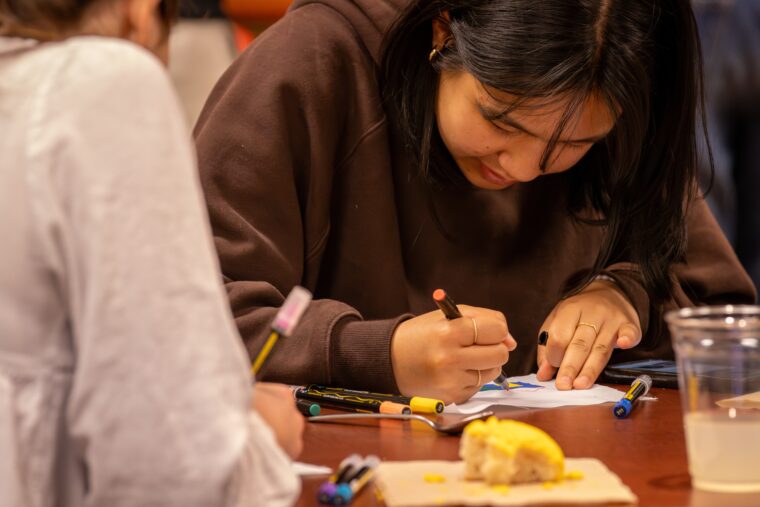
Students decorate and write messages for the Welcome Quilt Project as part of Civic Action Week. (Hannah Dorval | Staff Photographer)
The Gephardt Institute for Civic and Community Engagement collaborated with Response in Action: Students for Immigration Justice (RAISE) to host an event where participants designed quilt squares and wrote positive messages in support of immigrant communities on Feb. 19.
The event, titled “Patchwork of Hope: A Community Quilt-Making Event,” was part of this year’s Civic Action Weeks, a two-week program hosted by the Gephardt Institute offering community and civic engagement opportunities to the WashU community from Feb. 16-27.
“Civic Action Weeks are meant to draw attention to all the different ways that students can get involved in civic life,” Alannah Glickman, the associate director for civic engagement at the Gephardt Institute, said.
RAISE is a WashU student-led organization committed to uplifting immigrant voices. It was founded last semester and centers its work on three pillars: education, advocacy, and action.
The organization partnered with the Welcome Quilt Club for the event, which aimed to use quilt-making as a symbolic and tangible way to unite narratives of support for immigrant communities.
Sophomore Valentina Leon Vasquez, acting president of RAISE, discussed why the group chose quilt-making as the activity.
“The quilt becomes sort of a collective voice, instead of a fear-based narrative. It offers a visible message of care,” she said. “And we thought that bringing this to WashU as an arts-and-crafts event could [help] people reflect.”
Leon Vasquez said the event aimed to counter negative rhetoric surrounding immigration.
“We like to say that there is so much bad going on right now, but there are also very good things that immigrants and that community bring to us,” she said.
During the event, Gale Hall, founder of Welcome Quilt Club and a former early childhood education professor at Fairfield University, spoke with participants over Zoom about how her passion for quilting developed into serving her community.
After she and her husband moved to Arizona, Hall said they heard what she viewed as negative rhetoric about immigration and border patrol from friends and family, including support for increased deportations by the U.S. Immigration and Customs Enforcement. That rhetoric led her to wonder how it could affect children.
“I started to think about all the words of hate and fear that permeated our society that our children might be hearing,” she said. “And I thought, ‘How might I make a difference?’”
Hall said she decided to send letters to her friends containing fabric squares, hoping they would decorate them with positive and uplifting messages for immigrants. She later turned those squares into the first Welcome Quilt Project quilt.
“I told [my friends], ‘I’ll put it into a quilt that I can display in a public place where [immigrants] will see these messages to try and be a counter narrative to all the hate and fear,’” Hall said.
Since the project’s founding, quilts have been sent across the country, from immigration centers in Los Angeles to a child care center in Chicago. In April 2024, the original quilts were featured in an exhibit at the Arizona History Museum. Since then, the exhibit has traveled to cities in Wisconsin and Arizona, with plans for the WashU quilt to join after completion.
At the event, participants selected fabric squares of different sizes and arranged them diagonally across a large backing. Students decorated their squares with messages and designs — including butterflies representing migration and hearts in bright markers.
The messages, including “Welcome home,” and “You are not alone” expressed positivity and solidarity with the immigrant community. Some students wrote messages in Spanish, Mandarin, and Korean.
Sophomore Lily Shay said participating in events like Patchwork of Hope for making a positive impact as a citizen.
“I think it is important to engage [with your community] in any way you can,” Shay said. “It’s part of being a well-rounded citizen.”
For Leon Vasquez, the event also served as a reminder that staying informed about important issues can itself be a form of action.
“A lot of WashU students don’t know what is happening down the street,” she said. “Even educating yourself is doing something instead of doing nothing.”
Stay in Touch!
Get the latest and top news from StudentLife delivered to your inbox