News
AMCS to offer a Native American Studies focus area
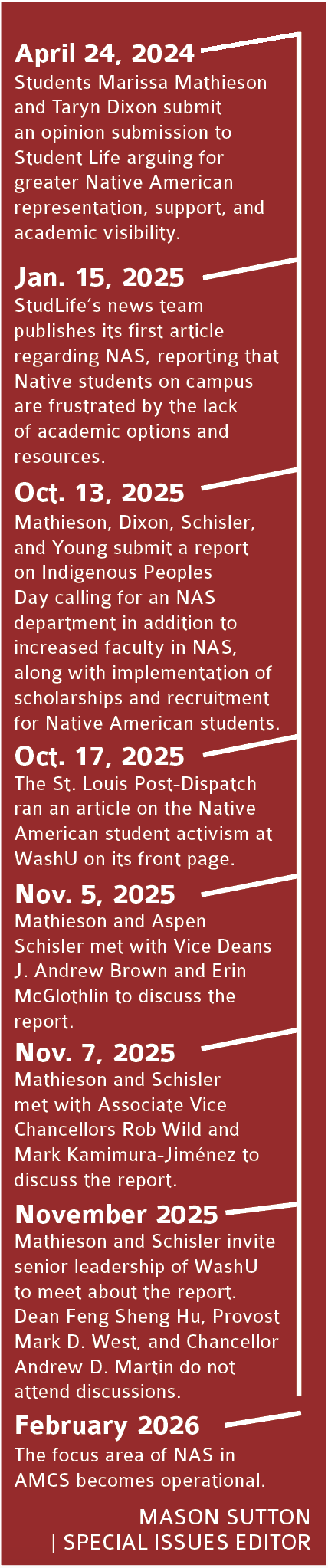
Following continued student advocacy, the American Culture Studies (AMCS) program at WashU has created a “focus area” for Native American Studies.
Noah Cohan, assistant director of AMCS, said that Native American Studies (NAS) will be available as a subject focus area alongside pre-existing focus areas in American Culture Studies (AMCS) such as Race & Ethnicity, Gender & Sexuality, and Ability & the Body. Students will be able to add the focus area to their AMCS major or minor by taking three courses in the field, two of them above the 300-level.
Interim director of the American Culture Studies program, Elaine Peña, said the focus area is operational immediately and will be officially announced on Feb. 20. She said the availability of future aspects of NAS, such as a minor or major, hinges on whether the program can get enough faculty and classes to support a minor or major and if there is sustained student interest in the creation of a minor or major.
“We need instructors,” Peña said. “We need students. It’s going to be a team effort. It’s not just AMCS and the dean’s office doing this from the top down. We need word to spread among students that if this is something that the student body is really interested in, we’re going to need their buy-in as well.”
Senior Marissa Mathieson, Diné student and president of the Washington University Native American Student Alliance (WUNASA), has been an advocate for greater Native visibility since her first year of university. This past fall, Mathieson submitted a detailed report to the administration, alongside co-writers senior Aspen Schisler and alumni Taryn Dixon and Amanda Young, advocating for increased academic options in NAS and greater outreach to prospective Native students.
The report outlined steps to create a NAS department in the College of Arts & Sciences, requests for a cluster hire of faculty with this specialization, and the implementation of a scholarship and recruitment program for Native American students. The report argued that these changes would put WashU on par with peer universities that already have similar programs.
Mathieson said that, even though the upcoming focus area is a good step, she thinks WashU still has room for progress.
“In all practical manners, it is a phenomenal stepping stone,” Mathieson said. “But I think that it is also imperative to know that it is not the last step. It is not the end goal, and I think that WashU still has a ton of progress to make.”
Professor of Sociocultural Anthropology Bret Gustafson said, while he personally views a minor as feasible for the University, the issue is more whether the University will continue developing NAS beyond a minor.
“The bigger question is, will the dean or the University say, ‘Okay, there’s your minor. We gave you something. Stop your activism.’ Whereas the students that I know have a longer-term vision; they would like to create a major, and maybe the major would become something else,” Gustafson said.
Peña explained that the pace of the release of a minor is intended to ensure that any NAS offering is sustainable. She added that progress in academia tends to be slow, and that she does not view the rollout of a potential NAS minor at WashU as particularly delayed.
“The report just came out, right?” Peña said. “It’s something that [we are] not deferring … I think what both the dean’s office and the American Cultural Studies Program want is for us to put this in place in ways that will have longevity. We prefer that we’re doing it methodically, that we’re covering all our bases to make sure that we have money for tomorrow.”
She also added that AMCS is invested in adding more NAS opportunities within the program, but that a focus area is more sustainable at the moment. She said that a minor requires programming and public-facing events that AMCS does not have the infrastructure to support at the moment.
“Even if [expanding NAS options] is going to be a stretch for us in terms of work, in terms of labor, in terms of finances, this is something that we think is very important to the American Culture Studies profile,” Peña said. “So we don’t mind the fact that this is going to stretch us.”
Peña said that students in particular will need to continue advocating so that the dean’s office recognizes NAS as something that students want implemented.
AMCS is one of the few programs or departments at WashU that has an endowment. Though they have an endowment, Peña said that AMCS cannot hire a professor of NAS solely from the endowment.
“It’s very complicated,” Peña wrote in an email to Student Life. “The bottom line is that AMCS needs support beyond its endowments to move forward.”
Sophomore Jenny Barnett grew up on a Yankton Sioux reservation in Wagner, South Dakota, and she went to WashU intending to study Native American Studies through AMCS and apply to the 3-2 program at the Brown School. As an area often understudied even in her own community, Barnett said she was excited to pursue it further and thinks that establishing formal academic visibility would help educate students.
“I’m from a Native American reservation, lived there my whole life,” Barnett said. “Growing up, there is a kind of common sense of Native culture and the history for me, and even there, I thought that we didn’t learn about it enough … Then coming here was just a total shock to me, just how little people knew.”
First-year Alyson Lone Bear is a member of the Hidatsa tribe based in North Dakota. While applying to colleges, Lone Bear was drawn to WashU because of the Kathryn M. Buder Center for American Indian Studies and the potential to eventually pursue a Master’s in Social Work with American Indian and Alaska Native Concentration (AI/AN) through WashU.
However, Lone Bear, who has been drawn to NAS courses as an undergraduate, said she found difficulties when trying to enroll in multiple NAS courses in one semester.
“There were only three options for Native American Studies courses this semester, and two of them were at the same time,” Lone Bear said.
Peña said the AMCS program is in the process of integrating classes from the Buder Center, so they are accessible to undergraduate students. However, she said this process depends on bureaucratic processes, such as whether AMCS can get credit hours for a graduate class offered in the Buder Center to count as a 4000-level class.
Mathieson said that, though she understands the desire for a sustainable program, she is frustrated that the burden of advancing an NAS initiative has fallen on Native students.
“I think that incrementalism puts the burden on a lot of Native Students to keep the momentum up and show interest and prove themselves,” Mathieson said. “I feel a huge burden as a Native woman to carry this movement forward.”
Eman Ghanayem, a former postdoctoral fellow in Indigenous studies in AMCS, said that while on campus, though she found AMCS supportive of her and her research, the lack of enough NAS scholars at WashU made it difficult for her to discuss her research with others.
Additionally, Ghanayem said that the pressure on students to continue to advocate for NAS seems unsustainable for students mentally and logistically, and that faculty should also play a role in advocacy.
“How do you keep the momentum going? I would say [this] falls within the hands of the faculty,” Ghanayem said. “They could always do more. Additionally, I think this is a project that should be embraced by [everyone] outside of AMCS, because it would benefit all WashU students.”
Mathieson said that though she thinks they could be expanded, the existing opportunities she has had at WashU to engage with NAS academically have provided her with mentorship and growth.
“My professors in AMCS, like Dr. Gill or Dr. Eman, have been … the best mentors I will ever encounter in my entire life,” Mathieson said. “They’ve made me feel seen. They have helped me forge my own path. They’ve taught me things about my own culture and identity and about other tribes that I never would have had the opportunity to learn. And they also created a zest in my academic career that I would not have had otherwise.”
Stay in Touch!
Get the latest and top news from StudentLife delivered to your inbox