News
Students call for increase in Native American studies resources, plan to meet with admin
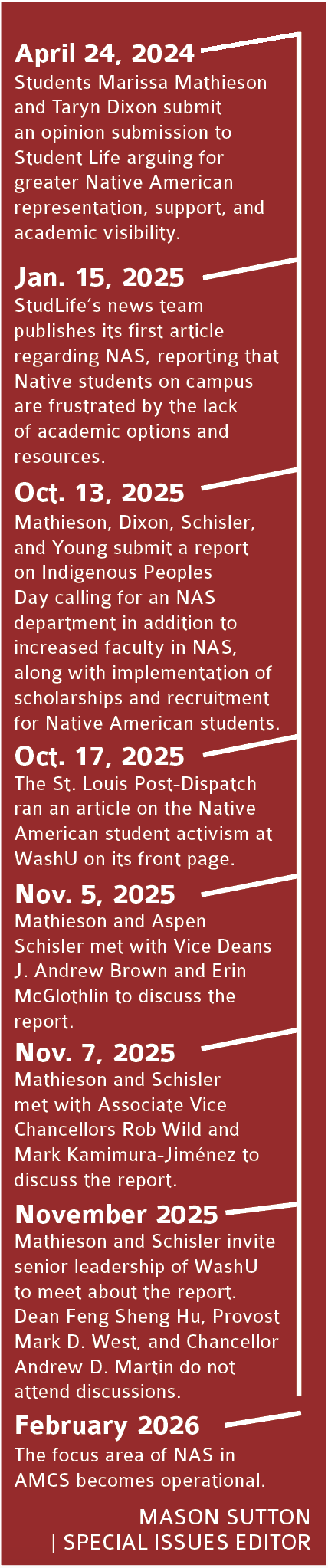
A group of Native American students and alumni submitted a report to the WashU administration calling for increased academic options for Native American studies (NAS) and greater outreach to prospective Native students. WashU has not confirmed whether they will institute these changes, but Vice Dean of Undergraduate Education Erin McGlothlin has confirmed that she will meet with the writers to discuss the possibility.
In addition to calling for the creation of a NAS department in the School of Art & Sciences, the report requests a cluster hire of faculty with specialization in Native and Indigenous studies, and the implementation of a scholarship and recruitment program for native students.
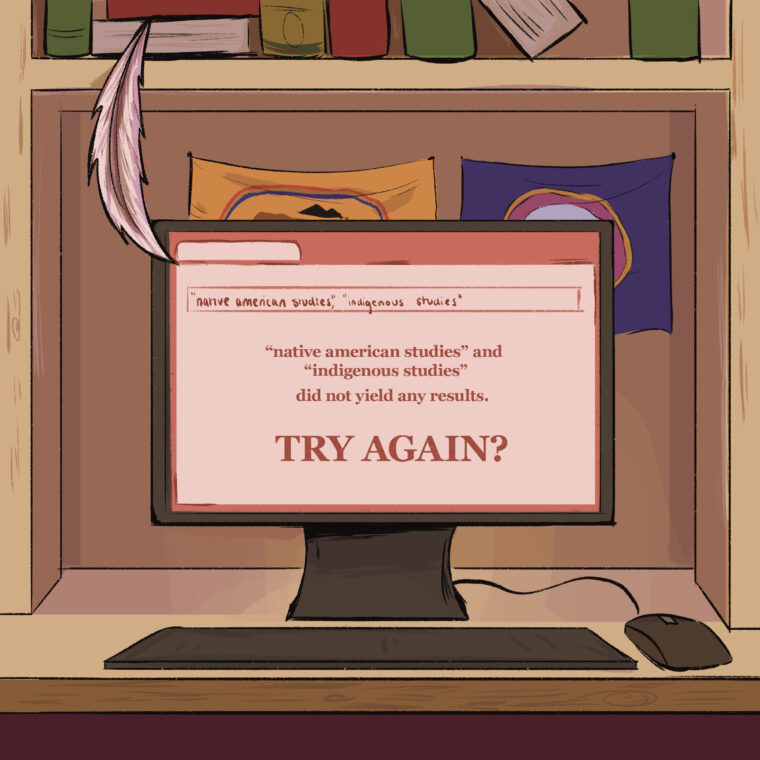
As of this school year, 0.1% of WashU students identified as American Indian. This spring, there will be three NAS classes offered to undergraduates through the College of Arts & Sciences: American Indians and American Empire, Native American Religions and Politics, and Native American Storytelling — Healthy Land Practice.
Seniors Marissa Mathieson and Aspen Schisler, and Taryn Dixon and Amanda Young, class of 2025, started writing the report last fall in their class “Place, Space, and Power: Indigenous St Louis.” Senior Marissa Mathieson, who is Diné and also a founder of WU Native Alliance, said she was motivated to write the report by the lack of opportunities for NAS at WashU.
“The harsh reality is WashU was not doing enough, and is still not doing enough, and that is why we created the report,” Mathieson said. “To tell them how important it is, to tell them that we want it to be seen, and to tell them it is a worthwhile conversation that needs to be had in order to be an institution that claims to care about education.”

Senior Marissa Mathieson, one of the authors of the report and founder of WU Native Alliance (Photo courtesy of Marissa Mathieson)
Dixon, Mathieson, Schisler, and Young worked alongside former postdoc Balraj Gill, former director of the American Culture Studies program Paige McGinley, and director of the Brown School’s Buder Center Pamela Begay to edit and revise the report before sending it to administration on Monday, Oct. 13. Since then, McGlothlin has been in touch with the students who wrote it to schedule meetings.
When asked about the report, Anna “Dr. G” Gonzalez, Vice Chancellor for Student Affairs, emphasized the work the Student Affairs department is doing to celebrate Native American Heritage Month this November in an email to Student Life.
“We are proud to host a range of programs and events — a collaborative effort between staff and students — designed to celebrate and educate about Native American and other Indigenous communities,” Gonzalez wrote. “These campus-wide opportunities are open to all and underscore our unwavering commitment to fostering a deep and lasting sense of belonging for everyone.”
The Brown School’s Buder Center, founded in 1990, specializes in Native American Social Work. According to its mission statement, the center aims to “prepare future American Indian leaders to practice in tribal and urban settings, making significant contributions to the health, wellness and the sustained future of Indian Country.”
The center places an emphasis on recruiting Native students, providing academic support, developing curriculum, and conducting research about Native communities. Even though it is currently inaccessible to undergraduates, the report identifies it as a possible route for collaboration.
“Undergraduate students are unable to enroll in these courses, access Buder scholarships, or participate in the center’s community outreach initiatives. Collaboration between an Arts & Sciences Native American Studies Department and the Kathryn M. Buder Center is likely the fastest and most Native-informed method to create a sustainable NAS program at WashU,” the report reads.
Elaine Peña, the director of the American Culture Studies program, believes the program supports NAS in various ways as well.
“Most prominently, by hiring postdocs in native studies such as Dr. Balraj Gil (who has now gone on to take a prestigious Chancellor’s Fellowship in the University of California system). Our strategic plan also counts on permanently hiring native studies scholars,” Peña wrote in an email to Student Life.
WashU is not the first school to begin considering the implementation of a NAS program. Princeton and Yale just implemented programs last year. Harvard, UPenn, and Northwestern established their programs in the 2010s. Other programs are decades old. In 1966, the University of Minnesota was the first university in the U.S. to start a NAS program. Cornell and Dartmouth soon followed in the early 70s.
Bret Gustafson, a professor of anthropology who has researched energy use in Native communities, sees this report in context with today’s current academic and political climate.
“I see it as fitting into an increasing demand,” Gustafson said. “The big challenge here is that we’re in a political moment where these are precisely the demands that are being targeted by the Trump administration.”
A question surveying support and interest in implementation of a NAS department has been included in Student Union’s yearly survey.
Mathieson shared her hopes for the report going forward.
“I hope the report is seen. I hope people start conversations from it. And I think people should read it honestly,” Mathieson said. “I don’t think it’s just meant for administration. I think this is a broader movement among everyone. This isn’t just me and my co-authors’ movement. This is everyone’s and this isn’t just for Native students, this is for the whole school.”
Stay in Touch!
Get the latest and top news from StudentLife delivered to your inbox