News
Former State Department official Katerina Sedova outlines rising global risks of AI-driven disinformation
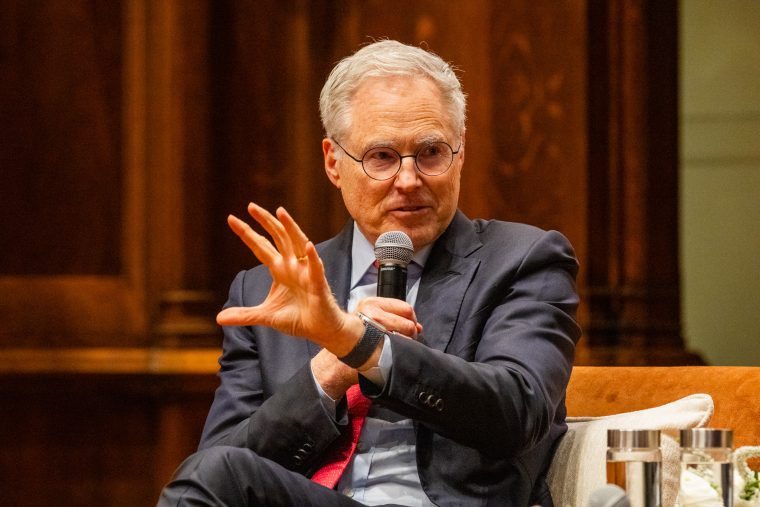
Atlantic Council fellow and former State Department official Katerina Sedova outlined how advances in artificial intelligence (AI) are accelerating the scale, speed, and sophistication of international disinformation during a Nov. 12 event hosted by WashU Law.
Specializing in Ukraine and disinformation, Sedova emphasized that modern disinformation is a systemic threat that exploits fractures within societies.
“Disinformation starts at home because it exploits the target societies,” Sedova said. “It understands them. It tries to exploit the wedges and fissures.”
A central theme of Sedova’s talk was how AI accelerates the production and distribution of disinformation.
“We came to the conclusion that these capabilities could dramatically increase the volume of disinformation, in part, because they help human operators do more with less and do it faster,” Sedova said.
The event featured a concise presentation from Sedova followed by a Q&A moderated by Ryan Durrie, lecturer in law, co-director of the WashU Law AI Collaborative, and policy director for the Cordell Institute — a WashU organization that strives to bring together medicine and law.
Durrie said he hopes that Sedova’s insight offered attendees an insider’s perspective focused on policy, especially as the U.S. struggles to develop cohesive AI regulations.
“We discuss the fact that AI regulation in the U.S. is very inchoate [in class]; it’s not very developed,” Durrie said. “One of the things that [law school students are] going to experience as young attorneys is the change in [its] regulation.”
For Keith Lindsey, a third-year student at WashU Law, Sedova’s talk reflected the very reasons he chose to enter the legal field.
“I came to law school to be part of this conversation. I chose WashU because they’re involved with the Cordell Institute,” Lindsey said. “I can’t imagine a law school that has a better platform for people to learn about legal and societal issues with technology and AI, in particular. So, I’m very pleased.”
Sedova stressed that technological solutions alone cannot counter the spread of disinformation that originates internationally and enters the US. Instead, she called for a coordinated, cross-border monitoring network that serves as an early warning system among U.S. allies and partners.
“The ultimate line of defense is a discerning human at the end of the message,” Sedova said.
Lindsey noted that navigating the intersection of law and technology requires a rare combination of expertise, one he hopes more students will pursue.
“I think that these conversations are really good at pointing out that some of these answers will be technological and some of them will be legal. It’s not all societal stuff,” Lindsey said. “Most of my law school experiences have been me figuring out how the law will give me the tools I need to go and affect change.”
Durrie emphasized that the challenges posed by AI-driven disinformation blur the boundaries of nations, as false content created in one country can rapidly circulate and influence public opinion in another. This then requires a multidisciplinary approach, looking at the intersection of technology and policymaking.
“There [are] going to be different struggles inside any society or inside any legal structure that you have to deal with as you try to figure out if and what we should do about AI and what forms [of harm] AI may be causing,” Durrie said.
For Lindsey, the stakes of this disinformation problem and the general regulation of AI are clear.
“This affects all of us. Please come and be a part of it because we don’t want to leave anyone behind,” Lindsey said. “We get one chance, and let’s do it right.”
Stay in Touch!
Get the latest and top news from StudentLife delivered to your inbox