News
Petition asks for Supreme Court review of discrimination lawsuit involving WashU’s new Provost
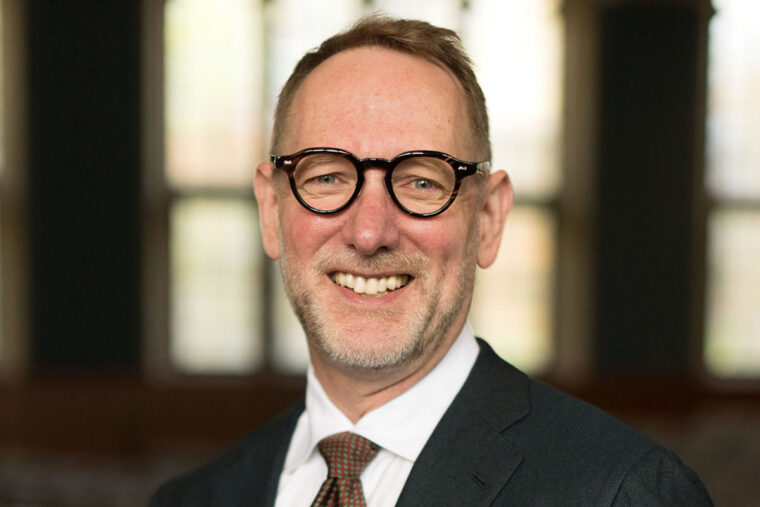
Provost West is at the center of a legal controversy over alleged discrimination and harassment of a professor. (Courtesy of The Source)
A law professor at the University of Michigan filed a petition with the U.S. Supreme Court asking it to review the legal standard applied in her racial and gender discrimination case against the University of Michigan and Mark D. West, WashU’s provost and executive vice chancellor for academic affairs, on Oct. 27. West previously served as the Dean of Law at the University of Michigan from 2013 to 2023 before being appointed as WashU’s provost this June.
Laura Beny, the professor, filed the original lawsuit with the U.S. District Court for the Eastern District of Michigan in 2022. She alleges that West, during his time at Michigan, subjected her to improper and discriminatory disciplinary action, baselessly suggested she might have access to weapons, and sent her emails which she alleges constitute sexual harassment.
The district court found that Beny failed to provide sufficient evidence establishing West did not “honestly believe” in his reasons for taking disciplinary action. As such, the court granted summary judgment with prejudice to West, effectively resolving the case without allowing a jury to consider it and preventing Beny from bringing the same lawsuit again. Beny then appealed the dismissal to the U.S. Court of Appeals for the Sixth Circuit, but the court affirmed the district court’s decision this July.
Now, her petition asks the U.S. Supreme Court to reevaluate the “honest belief doctrine” under which employers are exempted from discrimination trials by demonstrating they “honestly believed” their reasons for disciplining an employee, even when presented evidence suggests discrimination occurred.
Beny’s attorney Amos Jones says the petition raises questions for WashU, where West is currently serving as provost and executive vice chancellor.
“Why was West just made the provost of Washington University in St. Louis amidst this grotesque scandal?” Jones asked in an interview with The Edu Ledger.
West declined to comment on the allegations in the petition and referred Student Life to WashU’s Vice Chancellor for Marketing and Communications Julie Flory.
Flory pointed to the U.S. Court of Appeals for the Sixth Circuit decision from July, which she wrote “clearly indicates that the allegations in this lawsuit were not substantiated.”
Flory did not say whether WashU was aware of the allegations when West was hired.
Chancellor Andrew D. Martin praised West at the time of his appointment in August 2025. He said he had known West for “more than a decade” and had “great trust in his leadership, judgment, and academic credentials.”
Martin also told The Source that there was no search committee to appoint Provost West.
“In our current, fast-moving environment, we knew we needed to take prompt action to recruit the most talented and qualified individual to serve as our next provost. A long, complicated search would have taken our focus away from our mission-focused work. We’re extremely fortunate that Mark was already on our radar, so we could act quickly in bringing him here,” Martin told The Source.
WashU had hired its two previous provosts through a formal search process, conducting a “national search” when it hired Beverly Wendland in 2019 and employing an advisory committee to select Holden Thorp in 2013.
In an email to Student Life, Flory noted that while the University did not appoint a search committee in 2025, West still met with several administrators before being hired.
“Chancellor Martin has a long-standing professional relationship with Provost West and was highly confident that he was the right person for the job. Although there was no formal search committee appointed, Provost West did meet with school deans and an extensive list of University leaders and faculty prior to his appointment,” Flory wrote in an email to Student Life.
Timeline of Beny’s Case
Beny’s dissatisfaction with the Michigan Law School’s diversity practices led to incidents in 2018, when she received her first disciplinary notice after disrupting an academic conference. In the lawsuit, she stated that she was speaking out to challenge “racial and gender institutional inequities that the student [organizers] were perpetuating” by inviting mostly white males to speak at the event.
In 2019, she received a second disciplinary warning after allegedly “verbally abusing” Dean West’s administrative assistant, resulting in a one-year delay of her sabbatical eligibility as a sanction.
In 2021, Beny made “several informal complaints with law school administrators” tracing her grievances with West to a series of email exchanges starting in 2008, which were reported by both courts.
West sent Beny multiple emails between 2008 and 2010, when he served as associate dean, which Beny describes as “insensitive, inappropriate, sexist, and racist.”
Both courts recount details of these emails, including one in which West wrote, “I almost broke [your brother’s] neck just to prove that I could do it” after meeting Beny’s brother at her tenure party. In another, he told her, “I’m going to put [your baby’s] picture on my desk and tell everyone it’s mine.” He also emailed that the law school’s communications office was “all over [his] ass” to get her to do a photo shoot because of her “beauty,” signing off, “Your humble minion, Mark XOXOXO.”
In January 2022, an anonymous student filed a complaint alleging Beny was unprepared and tardy to her Enterprise Organization class. Beny refused to meet with administrators while a complaint she had filed was pending and withdrew from her teaching responsibilities on Feb. 15, 2022, writing to her students that “I am unable to teach at this law school anymore while subjected to arbitrary abuse and retaliation.”
Beny then sent what the appeals court described as “dozens of personal attacks to individual members of the law school faculty,” in which Beny allegedly threatened other faculty members.
West sent a third disciplinary notice to Beny on March 31, 2022, citing her “willful refusal to perform her duties as a tenured professor,” her “retaliation against students in her [Enterprise Organization] class,” and her “continued harassment of colleagues.”
“The concern that you might have access to weapons is a frequent topic of discussion among faculty members,” West wrote in the disciplinary letter.
While there is evidence of Beny calling professors and making threats via emails in the district court’s ruling, no evidence was presented that established Beny had access to weapons.
As part of the sanctions, Beny’s salary was frozen until June 30, 2027, meaning she continues to earn her existing pay but is barred from receiving any raises. She was also prohibited from receiving summer research funding and denied eligibility for sabbaticals. Beny has, as of now, withdrawn from teaching responsibilities at the University of Michigan Law School.
“She has been deprived of at least approximately $200,000 cumulatively [since 2022],” Jones wrote in an email to Student Life.
In her lawsuit, Beny pointed to Mathias Reimann, a white male tenured professor as a comparator. She furnished evidence of his alleged abusive behavior towards his administrative assistant, including pounding her desk, referring to himself as “her master,” calling her an “idiot,” and making inappropriate comments about her weight.
The district court affirmed Beny’s claim and found that Reimann’s “alleged conduct is similarly severe to Beny’s,” but that he “was not similarly disciplined even though officials were aware of his conduct.”
The case has continued with Beny’s lawyers filing a petition with the Supreme Court in late October. They ask the U.S. Supreme Court to reevaluate the “honest belief doctrine” and the erosion of the right to a jury trial, which they claim occurred in the previous rulings.
Beny’s petition is now among the thousands before the U.S. Supreme Court, which will decide in the coming months whether to hear it.
Editor’s Note: This article’s title and first sentence was updated at 4:20 p.m. on Nov. 20 to reflect that the current petition asks the Supreme Court to review the rule applied in the previous cases versus the discrimination and harassment case itself.
Stay in Touch!
Get the latest and top news from StudentLife delivered to your inbox