News
Student Union Treasury to be conservative with funding after Q1 overallocation
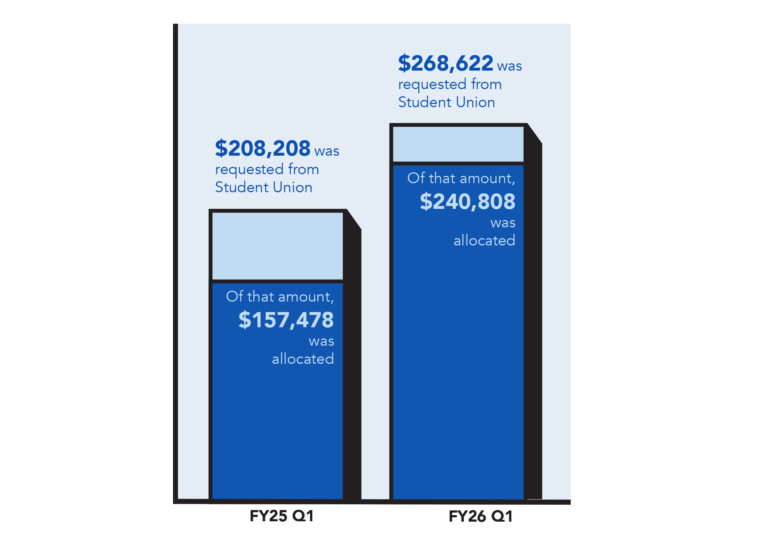
Student Union Treasury has increased the percentage of appeals that it has funded in the first quarter of this fiscal year. (Mason Sutton and Bea Augustine | Designer and Design editor)
Student Union (SU) financial leadership plans to be stricter with giving additional funding in the current 2026 fiscal year’s (FY) quarter 2. The move comes after a 54% increase in appeals funding allocated to student organizations in FY2026 Q1 compared to FY2025 Q1, according to senior and Vice President of Finance, Meris Damjanović. Since then, SU has reduced its funding percentage from 90% in the first quarter to 68.4% for the beginning of the second quarter.
Damjanović attributes some of the increase in funding in the first quarter to a 29% rise in appeals, which could be the by-product of alterations to SU’s former budgeting system that created fiscal uncertainty last year.
“This year we allocated a lot less in the budgets to course-correct for what happened last year,” Damjanović said.

Since Q2 of FY2026 started, SU has decreased the degree it funds appeal requests (Mason Sutton and Bea Augustine | Designer and Design editor)
Before the fiscal year, clubs propose budgets for three events to determine which ones they receive funding for. Throughout the year, a select group of clubs known as Category I clubs can submit appeals for more money, which are reviewed and funded through SU Treasury. This year, SU Treasury was more cautious with the amount of money they afforded clubs for their event budgets. This included minimizing budgeting for events or activities that have an uncertain cost, such as travel.
SU finances appeals based on how important they are for clubs’ missions, and, according to Damjanović, there happened to be a higher number of reasonable appeals requests in the first quarter.
“Groups are getting what they want because what they want is necessary, and it just so happens to be the case that what they want also increases year over year,” Damjanović said.
Senior and Treasury representative Aryan Pradhan said SU Treasury has generally stuck by the same guidelines to fund appeals as they have in past quarters.
“There have been a few appeals where I think we could have made some more cuts, in hindsight,” Pradhan said. “But in general, I think we’ve stuck more to our principles.”
Limited funding from the treasury for the next three quarters will affect three aspects of student organizations: travel, allowed attendance, and high-cost-per-attendee events.
Junior and Speaker of the Treasury Romen Der Manuelian said that SU Treasury wants clubs to consider driving to tournaments within a 500-mile radius of campus instead of flying. He also suggests that clubs limit the number of students traveling to off-campus events to be equitable to other clubs that travel. He illustrated an example below.
“If you have a tournament where you need 11 people on the field and you want to send 25, we might ask you to send 18,” Der Manuelian said.
Lastly, SU wants to cut down on extensive funding for events that fail to bring in large numbers of students. Der Manuelian emphasized the importance of SU spending funds effectively.
Damjanović anticipates some frustration from clubs over new funding limitations.
“I understand that it’s a little upsetting to maybe not get [everything] you’ve requested, but what would be more upsetting is [if] in the spring semester, we have no money [and clubs] can’t do anything,” he said. “This is the kind of balance that you have to strike, and it’s what Treasury is working on right now.”
Some organizations, such as WashU Run Club, are concerned about the impact of Treasury’s approach to funding on their events as their club has doubled in size in the past two years. Since SU’s policy change, Run Club has stated that they will implement a policy of first-come, first-served for race sign-ups.
Run Club president Julia Prata and treasurer Phoenix Jarosz wrote in a joint statement that they understand and agree with the need for SU to allocate funding sparingly, but expressed that they have some hesitancy about what the division of money among clubs of varying sizes would look like in practice.
“Part of Run Club’s mission is to make running accessible and inclusive, and it is frustrating to know that there are clubs that spend about the same amount of money as us on events only to send 10 times less [sic] people to participate in them,” Run Club wrote in the statement.
In the face of new conservative funding policies from SU Treasury, Pradhan said it’s vital for clubs to research options and come prepared for their appeals.
“If you come to the floor, and we see you’ve looked at four different hotel options or four different conferences … and you’ve picked the one that best represents your group’s mission or is the cheapest, that’s something that really reflects well,” he said.
Der Manuelian said that Treasury’s new approach to appeals does not change its mission to allocate funding where it is most needed.
“We have to fund equitably, and we have to make sure we are treating our money as something that student groups want, and they should have access to equitably.”
Editor’s Note: This article was updated at 8:20 a.m. on Nov. 8. to better reflect the position of Run Club on funding allocation.
Stay in Touch!
Get the latest and top news from StudentLife delivered to your inbox