News
Chancellor Martin confirms WashU will not sign Trump’s proposed higher education compact

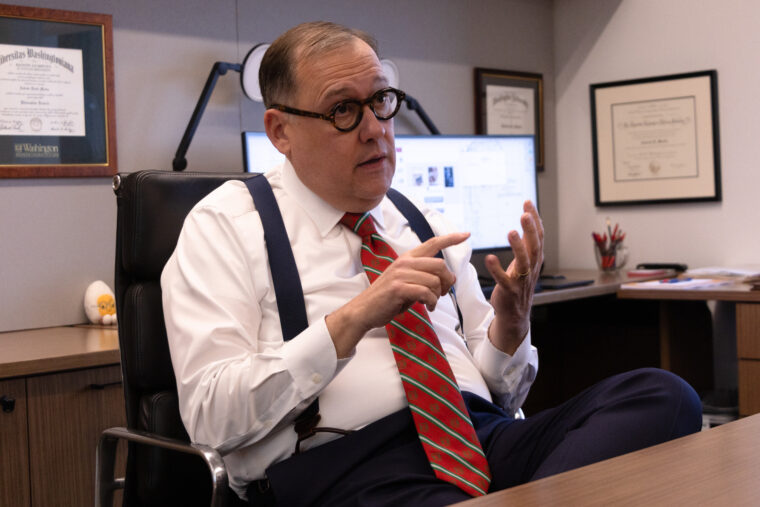
Chancellor Andrew D. Martin informed faculty Wednesday that WashU is not signing the Trump administration’s proposed compact. (Eran Fann | Photo Editor)
WashU Chancellor Andrew D. Martin announced that the University will not sign the Trump administration’s proposed higher education compact. In an email sent to faculty midday Wednesday, Martin wrote that WashU will not sign the compact “or any document that undermines our mission or our core values, perhaps highest among these our commitment to academic freedom, access, free expression, and research integrity.”
Martin’s message was a response to a statement sent by Faculty Senate Council (FSC) leadership after they met with Provost Mark West on Monday. In the statement, FSC leaders called on Martin to reject the compact, citing significant faculty opposition to the proposal.
“We respect Chancellor Martin’s intent to engage in dialogue and recognize the importance of maintaining open and transparent communication with our federal partners,” they wrote Monday. “However, we believe continued ambiguity about WashU’s position risks undermining confidence and clarity within our community.”
In a Tuesday evening faculty meeting College of Arts & Sciences Dean Feng Sheng Hu indicated to faculty that Martin would not sign the compact in its current state per a prior conversation he had with the chancellor.
The compact promised funding advantages to universities who committed to a number of policy changes, including limiting international student enrollment; pledging institutional neutrality; freezing tuition for five years; restricting diversity, equity, and inclusion (DEI) initiatives; and requiring standardized testing for admissions.
WashU was not among the nine schools originally invited at the beginning of October to sign on to the agreement, but Martin participated in a meeting with White House representatives on Friday afternoon to discuss the compact. Martin explained the decision to engage in conversations with the Trump administration, pointing to a need for WashU to advocate for its values by engaging with the process.
“We have chosen to participate in this conversation because we have been invited and with the intention of promoting our mission, values, and independence by having our voice at the table for these potentially consequential conversations,” he wrote in his email to faculty Wednesday.
The FSC wrote in their statement that “no university should strive for or be given preferential treatment.” In response, Martin pointed to Monday’s University-wide email stating that the decision “was not made to advantage ourselves or gain any type of preferential benefit.”
“We firmly believe meaningful progress will best be achieved through open, ongoing dialogue,” Martin wrote in the Monday email. “We appreciate the invitation to participate in this critical conversation and are showing up ready to engage, listen, and work collaboratively toward positive change.”
WashU’s decision not to sign on to the compact comes after a number of student, faculty, and staff organizations publicly denounced the proposal. WashU’s chapter of the American Association of University Professors (AAUP) also released a statement Friday urging WashU to reject the compact, and 19 student organizations called on the University not to sign the compact in a letter posted online Monday.
In his email Wednesday, Martin shared that he appreciated the engagement of faculty and looked forward to continued dialogue, including at an upcoming Faculty Senate meeting this Thursday. He also asked for trust from the University community as the administration navigates complex issues.
“The issues in front of us are complex and extremely challenging, and I ask for your trust that we are acting in the best interest of our university and higher education.”
Stay in Touch!
Get the latest and top news from StudentLife delivered to your inbox