News
Divided on neutrality, trust, and handling Trump: WashU, Vanderbilt chancellors’ disagreements with Princeton and Wesleyan presidents go public

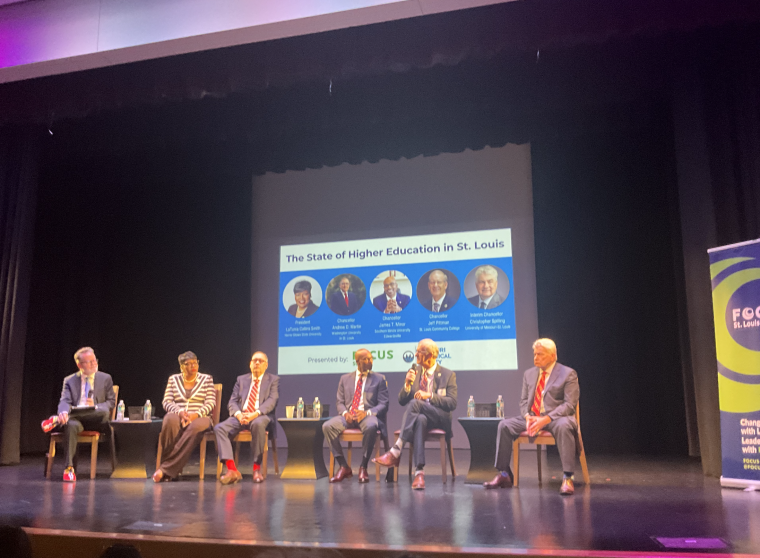
WashU Chancellor Andrew Martin and Vanderbilt Chancellor Daniel Diermeier work together in advocating for institutional neutrality and reform at elite universities. (Bri Nitsberg | Managing Photo Editor; Photo Courtesy of Kellogg Innovation Group)
During an April panel on growing public distrust in higher education hosted by the Association of American Universities (AAU), Christopher Eisgruber — Princeton president and AAU chair — criticized Vanderbilt Chancellor Daniel Diermeier and WashU Chancellor Andrew Martin for their handling of President Trump’s attacks on universities, according to an article published by The Atlantic on Aug. 11.
Eisgruber “all but accused [the chancellors] of carrying water for the Trump administration,” The Atlantic reported. He argued that the two men wrongfully agreed with Trump’s view that American universities are increasingly illiberal and disconnected from mainstream society.
In response to Eisgruber’s accusations, Martin and Diermeier said that the “struggles” of several Ivy League universities were damaging the reputation of American research institutions, per The Atlantic. They also suggested to Eisgruber that other institutions and leaders may be better positioned to represent the country’s top universities.
In his second annual Q&A with WashU’s Student Union on Sept. 2., Martin was prompted by SU senator Saara Engineer to speak on the AAU panel interaction described in The Atlantic. In response, Martin said that the claim that he was “all but carrying water for the Trump administration” and the article’s broader portrayal of university leaders as hostile towards one another were both “ridiculous.”
The AAU panel was not open to the press, so the article in The Atlantic offered one of the first looks into the internal disputes among leaders of elite universities and their differing views on the reforms higher education requires.
Trust in higher education has been declining steadily over the past decade. According to a Gallup Poll, the percent of Americans who have “a great deal” of trust in higher education declined from 57% in 2015 to 36% in 2024, although this improved slightly to 42% in 2025. At the same time, universities have had to contend with attacks and funding cuts from the Trump administration.
Chancellors across the country have taken varied positions on how to respond to these crises.
Wesleyan President Michael Roth and Eisgruber contend that universities should not legitimize what they view as Trump’s politically motivated attacks on higher education. They emphasize instead the importance of safeguarding academic freedom.
Martin and Diermeier argue that certain Ivy League campuses have grown overly ideological and allowed antisemitism to fester. In an Op-Ed in the Chronicle of Higher Education last winter, they attributed declining trust in higher education to the “creeping politicization” of universities.
“Some universities have exacerbated the situation by drifting from their core purposes of education and research to take official positions on political and social issues,” they wrote in the op-ed. “This has led many to see universities as just another ideological combatant in the daily political struggle.”
When contacted by Student Life, Martin, Diermeier, Eisgruber, and Roth, who was also interviewed in The Atlantic, declined to comment further for this article.
Martin and Diermeier told The Chronicle of Higher Education that the only way to regain the public’s trust is to adapt and reform.
“The future of American higher education is at risk and it is important for us to engage across the political spectrum, to listen and understand what the criticisms are, internalize those criticisms, and then work to improve so we can ultimately regain the trust of the American people,” Martin said.
Unlike Roth and Eisgruber, Martin and Diermeier also believe this problem transcends the Trump administration.
“It’s clear that the bipartisan support has eroded,” Martin told The Atlantic. “It’s really misguided to think that what’s happening in higher education is a blip and that we’re going to return to where we were before.”
Conversely, while university leaders like Roth are open to some reforms in the future, they argue that universities should prioritize addressing the more immediate challenges posed by the Trump administration.
“To be worried about [reform] right now seems to me like people in Ukraine worrying about corruption in the mining industry,” Roth told The Atlantic. “It’s the Russians that are the problem.”
In response to accusations that they were caving to Trump, Martin and Diermeier emphasized to The Chronicle of Higher Education that their push for institutional neutrality and university reform began well before the Trump administration took office in January.
A month prior to Trump’s victory in the 2024 election, WashU and Vanderbilt’s boards adopted a joint statement of principles which affirmed a commitment to institutional neutrality and a refusal to advance any particular vision of social change, among other principles.
Eisgruber urges a policy of “institutional restraint,” which involves taking a stand on select issues, while Roth has more strongly criticized the push for institutional neutrality.
“The infatuation with institutional neutrality is just making cowardice into a policy,” Roth told Politico in mid-March. “I’m friends with presidents who genuinely think they’re encouraging free speech by hiding, but I think that the fear is manifesting [in] people just not wanting to talk about policies that they really do oppose.”
Additionally, Martin and Diermeier have taken steps to distance themselves from some other elite institutions. Rather than joining the roughly two dozen universities organized by Eisgruber to lobby against the Trump administration’s proposed endowment tax — ultimately enacted earlier this year — WashU and Vanderbilt chose to lobby separately, according to The Atlantic.
The two chancellors also started Universities for America’s Future, an “invite only group” intended to uphold what Diermeier and Martin view as the purpose of higher education institutions. While some see this as an attempt to create an alternative to the AAU, Diermeier told The Chronicle of Higher Education that the group has no such purpose.
“Universities for America’s Future is just a name, a label that we have for that now. Maybe it’s a movement, maybe it’s a set of discussions, maybe it’s a set of activities that we’re thinking about,” Diermeier said. “The AAU has its purpose. It’s a membership organization. We have no intention of doing anything like that. Nobody has any intention of competing with the AAU.”
Diermeier and Martin said that their intellectually diverse environments have led to increased enrollment interest from prospective students, especially those from the Northeast.
“I can share many anecdotes from families that I met with whose children were admitted to many of the Ivy institutions, and were admitted here, and chose to come to WashU,” Martin said. “I didn’t have those conversations three years ago or five years ago with admitted students.”
According to The Source, WashU received 32,753 applicants for its class of 2028 and 33,283 for its class of 2029, with the latter including 112 more enrolled students than the former. In 2024, for the first time, WashU also offered a mid-year transfer option to students. Many of those transferring to WashU were Jewish students who told Student Life that they faced antisemitism at their previous institutions.
Martin emphasized in his interview with The Chronicle of Higher Education that their disagreements with other university presidents have remained civil and constructive.
“There’s no infighting, there’s no squabbling. There have been many public discussions and public disagreement about what the right approach is for the future,” Martin said. “I think it’s actually great for us to live up to our academic principles and actually have debates about issues that we disagree about.”
Editor’s Note: The article was changed at 4:24 p.m. on Sept. 4 to include information about Martin’s Q&A with Student Union on Sept. 2, during which he commented on The Atlantic article and his AAU panel exchange with Eisgruber.
Stay in Touch!
Get the latest and top news from StudentLife delivered to your inbox