News
Ari Joskowicz discusses Roma and Jewish history at Holocaust Memorial
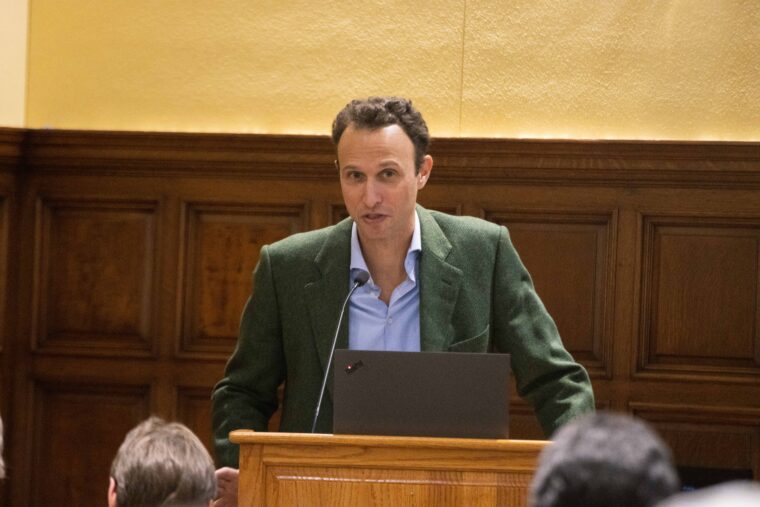
Joskowicz speaks to audience (Jamie Nicholson | Student Life)
Ari Joskowicz, author and Chair of Jewish Studies at Vanderbilt University, reflected on Roma and Jewish history at an event titled “Roma, Jews, and the Holocaust,” the 2023 edition of the annual Holocaust Memorial Lecture in Umrath Lounge, Nov. 15.
Joskowicz discussed the relationship between Roma and Jewish people as victims in the Holocaust and pointed out problems in how their histories are memorialized. He proposed new ways to remember Roma and Jewish histories and how to give Roma people more voice in Holocaust-related conversations.
Joskowicz began the event by describing the Roma population, which includes 10-12 million people. He said that, despite being such a significant population, Roma are often overlooked and misunderstood in government institutions and in academia.
“The largest ethnic minority in Europe usually does not come up in our textbooks,” Joskowicz said.
Joskowicz also said that there are commonly held misconceptions about Roma, including that they are religiously and linguistically homogeneous. He said that Roma practice a variety of religions, including Protestantism, Orthodox Christianity, and Islam.
He also said that, despite popular depictions of Roma as being itinerant, many of them were settled throughout history and are settled today.
Joskowicz’s research and recent book “Rain of Ash: Roma, Jews, and the Holocaust” focus on the connections between Roma and Jewish history. He said that these groups have had many shared experiences historically — most notably, one of being persecuted in the Holocaust.
He said that Roma and Jewish people were often held in the same concentration camps, though sometimes in separate spaces, and often subjected to the same treatment.
However, Joskowicz said he has noticed that conversations attempting to bridge the two groups’ experiences in the Holocaust usually end up comparing struggles rather than making meaningful connections.
“Often when we compare, we end up demeaning both victims,” Joskowicz said.
Joskowicz proposed a more productive method of learning about and talking about Roma and Jewish histories.
“My suggestion is that we pursue a relational method,” Joskowicz said. “We shouldn’t think about comparing fates, but seeing how people actually connected at the time and all the way until today.”
Beyond the way we speak about Roma and Jewish history, Joskowicz said that there are institutional biases that favor memorializing and dispersing knowledge about Jewish history instead of Roma history.
“What it means to study Romani history is that you end up in an institution designed to study and conserve the memory of Jews,” Joskowicz said. “What does it mean when one minority owns so much of the history of another minority?”
He said that prioritizing Jewish history results in Roma people not having enough avenues for sharing or learning about their history in Europe. He uses an institution that records stories of Holocaust survivors as an example of a resource built for Jewish people and not for Roma people.
“They have this slightly bizarre question: ‘What type of Jew are you?’” Joskowicz said. “Are you Reformed, Orthodox, Conservative, or Non-Observant? That’s a bad question for a Roma survivor, and it just shows you how the infrastructure is not built for them. It’s hard for Roma to get recognized.”
Joskowicz said he hopes that his book and lecture are just part of a growing conversation about Roma history in connection with Jewish history.
In the audience was Professor of History Jonathan Judaken, who said that the topic sparks a larger question about how we remember tragedies.
“How does the infrastructure of knowledge production work to create collective memory?” Judaken said. “And therefore, which dead are mourned?”
Sylvia Sukop, a graduate student in German Language and Literature, said she attended the event as well as the smaller book talk about Joskowicz’s book earlier that day.
She said that Joskowicz’s book and lecture can educate people about Roma and Jewish history and also about how we treat victims of tragedies.
“He calls on us to pay attention to the suffering of others,” Sukop said.
Joskowicz said that the basic values of his work, such as building connections between victimized groups, can help people grapple with a range of issues, including antisemitism, racism, and homophobia. More broadly, he said that he hopes his work will make people reflect on how they think about history.
“What I hope my talk and my book can do is be a chance to rethink our responsibilities towards the histories of others,” Joskowicz said.
Stay in Touch!
Get the latest and top news from StudentLife delivered to your inbox