News
David Kertzer, Vatican Historian, speaks about the Pope’s role during World War II
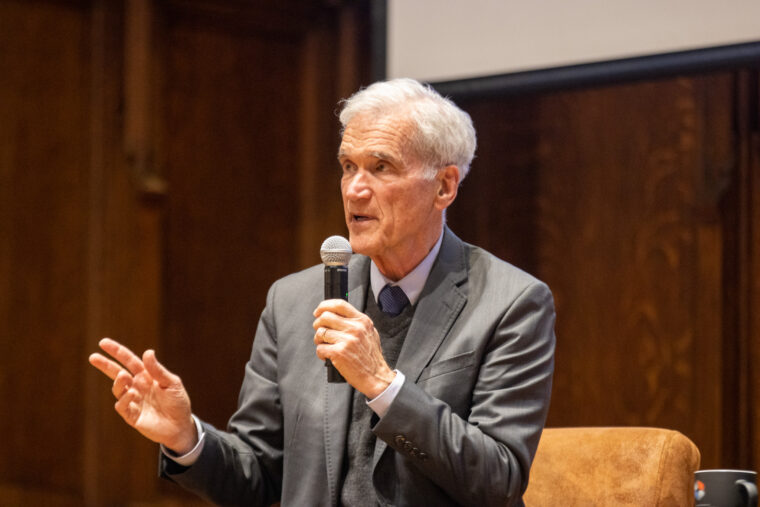
Jamie Nicholson | Student Life
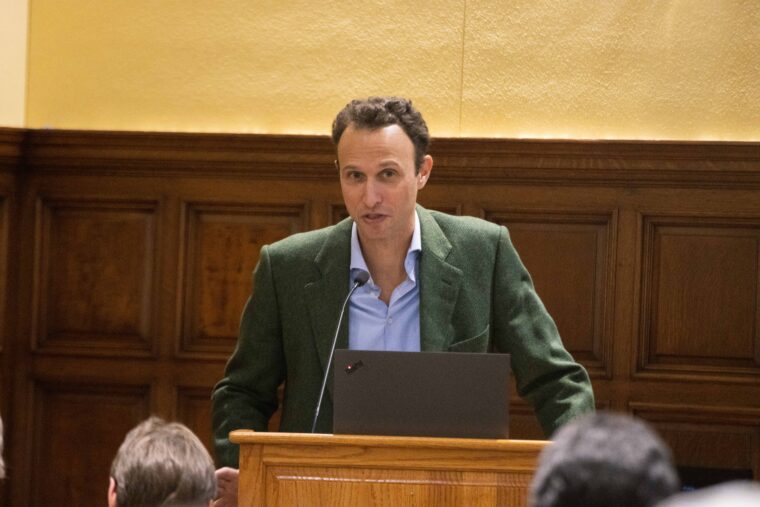
David Kertzer, a prominent professor of Italian and Vatican history, delivered remarks about his new book, “The Pope at War,” which details the behavior of Pope Pius XII during World War II, at an event held by the Danforth Center on Religion and Politics and various community partners, March 27.
“The Pope at War,” the second Pulitzer Prize-winning book by Kertzer, is based on documents released by the Vatican Archives in March of 2020 as part of an effort made by the Catholic Church to be more transparent regarding their history. The newly public archives detail the behavior of Pius and provide context for his decision to not speak out against Adolf Hitler or Benito Mussolini during World War II.
Pius’ lack of action throughout World War II has led some to refer to him as “Hitler’s Pope,” while others want to elevate Pius to sainthood. Kertzer’s book and remarks aim to provide context rooted in Church documents to this conversation.
While speaking with Marie Griffith, the Director of the Center on Religion and Politics, Kertzer explained that his research showed that Pius’ primary goal during the war was maintaining the unity of the Roman Catholic Church.
During his research, Kertzer made the “shocking” discovery that Hitler and Pius communicated with each other before the war and up until the Nazi’s defeat in 1945.
When the Germans initially invaded Poland in 1939, Pius did not speak out.
Kertzer posited that Pius remained neutral during and after the invasion for a variety of reasons, including the fact that Pius was the leader of all Catholics and according to Kertzer, “worried about producing a fracture in the Roman Catholic Church in Germany.”
Halfway through the discussion, Griffith asked Kertzer about the Holocaust, given that it was a central point of contention when examining Pius’s silence about the war.
According to Kertzer, the treatment of the Jews frustrated Pius, who expressed these feelings to a German ambassador present in the Vatican at the time.
During the war, many Jews tried to get baptized because they knew the Nazis were less likely to send a Catholic person to a concentration camp, according to Kertzer.
Teree Farbstein, a local member of the Jewish community, said she doesn’t know what she would have done if she were forced to decide between choosing faith or survival.
“I don’t know what I would do,” Farbstein said. “I can’t judge anyone else in that position.”
Sharon Summers, another Jewish community member, said she would have prioritized survival over allegiance to religion.
“First mitzvah is to health, and what is healthier than surviving,” Summers said. “The individual decision to survive is just that, an individual decision.”
In 1998, Vatican officials released a statement titled “We Remember,” which, according to Kertzer, expressed the position that the church and Christianity generally bore no responsibility for the demonization of the Jews that led to the Holocaust. The statement argued that it was something else, “namely modern antisemitism, which was based on the social, political, economic and racial demonization of the Jews.”
During the reception following the event, Reverend Merek Bozek, a Polish priest who is a quarter Jewish, called the document “an excuse” and “dishonest,” and also stated that this period in history has been completely “white-washed.”
He went on to say that the Catholic Church is still struggling with how it addresses Jewish history, and he expressed frustration at the fact that “it is 2023 and [the Catholic Church] is still trying to find a way to say ‘mea culpa.’ They don’t know how to say ‘we messed up.’”
Reverend Alan Young, who works with the Christian group Companions of Dorothy the Worker, said, “We must need to know the depth, the totality of what is being repented for before extending forgiveness,” and said that repentance and forgiveness are linked.
In an interview with Student Life after the event, Kertzer discussed how recognizing the intersection of religion and violence is critically important for understanding conflict taking place today.
“It’s the archbishop who is the head of the Russian [Orthodox] Church who is calling on all good Christians [to fight in the conflict with Ukraine],” Kertzer said. “That kind of misuse of religion is…another one of the lessons that I think [is] very apt today.”
Stay in Touch!
Get the latest and top news from StudentLife delivered to your inbox