News
University hosts the opening of the Holocaust exhibition Lest We Forget
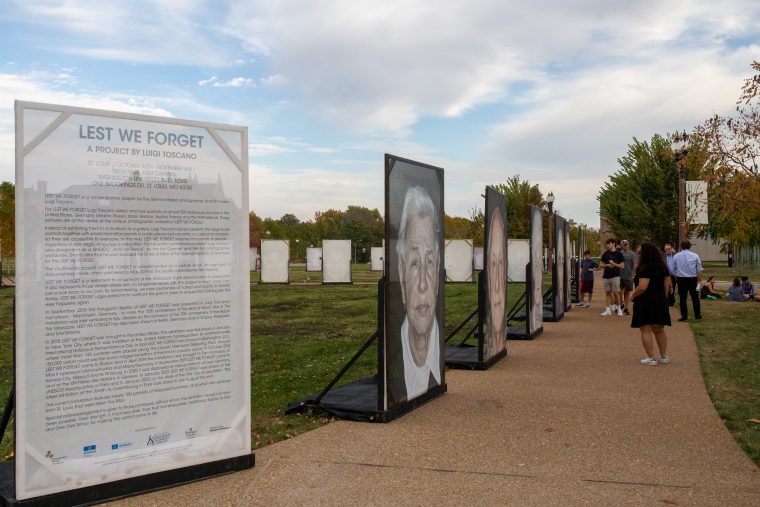
Photo by Scarlett Patton
The Sam Fox Art School and the Kemper Art Museum jointly hosted the opening of the Holocaust memorial exhibition “Lest We Forget” by Italian-German photographer Luigi Toscano, Oct. 20. Presenting photographic portraits of survivors, the opening featured special remarks from the artist himself, the organizers and sponsors of the event, and one of the survivors portrayed in the collection.
Many who attended the event were Holocaust survivors, a number of whom appear in Toscano’s works. Participants dressed solemnly to pay tribute to those whose lives were taken away. Classical music accompanied the entering of the audience as they extended embraces and handshakes amongst themselves.
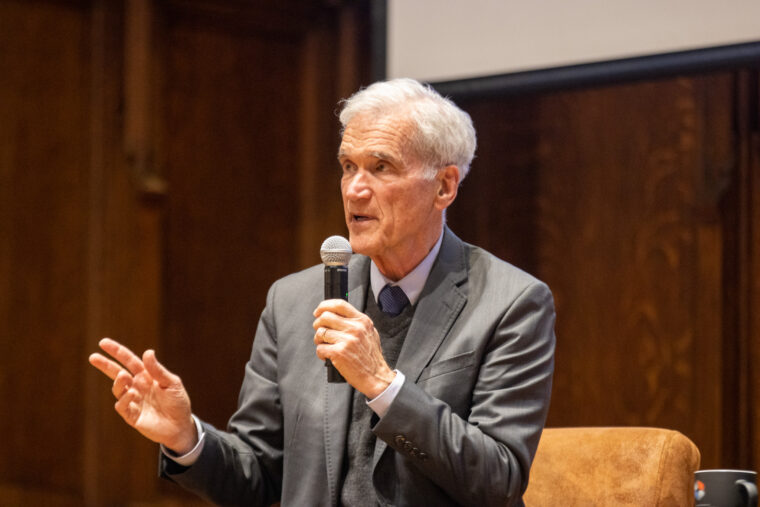
Erin McGlothlin, professor of German and Jewish studies, began the opening of the exhibit by discussing the numerous faculty members and students who are refugees and survivors of the Holocaust, as well as the University’s extensive research and representation of Holocaust history in academia.
“[The University] has a long and distinguished history of serving as an intellectual haven for refugees from Nazi Germany and for survivors of the Holocaust,” she said.
McGlothlin recognized the permanent trauma that Nazi Germany inflicted on the Jewish population and civilization.
“They are the millions of unseen or no longer existent photographs of parents, grandparents, siblings, aunts, uncles, cousins, indeed, entire families, all of whom perished in the Holocaust,” she said.
“These multitudinous virtual images float invisibly in the air around the concrete photographs of the survivors as ambient reminders of the cataclysmic destruction of an entire culture and the great loss of millions of individual human lives,” McGlothlin said.
Luigi Toscano incorporates new photographs of survivors living in different cities into this Lest We Forget collection as he travels. 12 new photographs of survivors living in the Saint Louis metropolitan area joined the collection, which has been displayed in headquarters of the United Nations in New York and Genève, as well as many other cities across Europe and the United States.
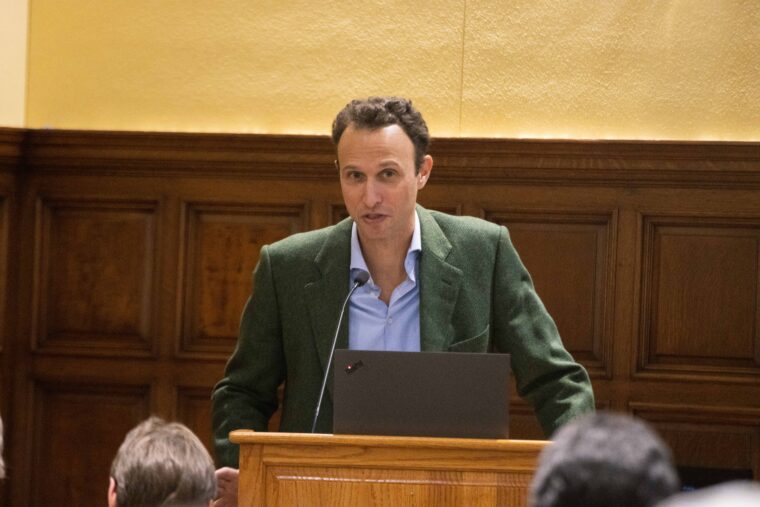
The key organizer and sponsor of the event, Dee Dee Simon, co-founder of local nonprofit organization Conversation Builds Character that focuses on understanding history and human dynamics for a better future, mentioned her own experience of how this exhibition spoke to her.
In addition to extending gratitude to the survivors for being here, as they are “the unspoken words that speak the loudest,” she also applauded the legislative efforts that mandate the education of Holocaust history to high school students in the state of Missouri, starting from the 2026–2027 school year.
Simon introduced Toscano as a “self-taught photographer and filmmaker,” whose passion for photography “was born out of the necessity to record and share his ideas.” Toscano’s portraits are often presented in public spaces accessible to everyone, so that “the portraits gain an uninhibited entry point into the everyday lives and consciousness of people passing by, independent of origin, age or education.”
Luigi Toscano was awarded the Order of Merit of the Federal Republic of Germany, the highest tribute that can be paid to individuals for services to their nation.
In response to those who question the purpose of his project, Toscano said, “My answer is that I would like to stand up against antisemitism, racism, and any kind of hate crime, and when I met the first survivor, he said to me, ‘Luigi, if we forget the past, we are doomed to repeat it.’”
One of the survivors at the venue, Rachel Miller, gave an account of her own story of persecution, loss, emigration, and hope.
“It is not easy to speak about your entire family being murdered, and it still hurts and frightens me and makes me very emotional at times,” she said.
Miller endured separation from her entire family, who were mercilessly murdered by the regime, from her motherland, as an immigrant to the United States, and from her Jewish identity, as she had no choice but to rename herself “Christine” to avoid systemic persecution.
“It is never easy. I never want anyone to feel sorry for me. I want them to listen and learn from my testimony. I never forget and I keep speaking,” she said. “It is my hope that we will continue to tell the stories, and I will continue to speak as long as I knew.”
Chancellor Andrew Martin spoke of the “alarming rise of hate in our society today,” manifested by forums and political movements worldwide that still espouse the “dangerous stereotypes and falsehoods” with regards to the Jewish population.
“Hatred and bigotry can only thrive in the vacuum of ignorance,” he said. “And ignorance can only be countered by confronting, reckoning, and learning from the past.”
Stay in Touch!
Get the latest and top news from StudentLife delivered to your inbox