Staff Columnists
A new moderation for our generation
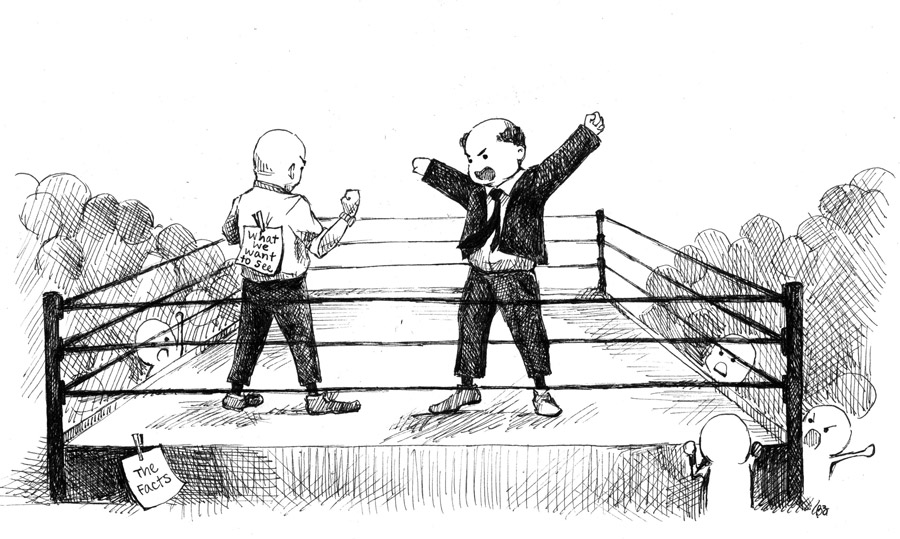
Talbott advocated a stronger sense of moderate discourse, with an emphasis on facts over rhetoric. He recommended that we demand a higher sense of responsibility from our news media, which have devolved into talking heads hurling spittle and spite at one another. The truth has become secondary to entertainment, and while the masses might not have found politics particularly appealing in the past, they can certainly find it entertaining with today’s cocktails of spin and anger.
In a world that values fabrication over fact and rhetoric over reality, research and dialogue have indeed been pushed aside, deemed irrelevant and, in some cases, elitist. It’s difficult to imagine where moderation fits into this scheme. As the consumers of this so-called news, we deserve better than having to endure unmitigated, inexplicable anger pouring from our radios, streaming from our televisions, flooding from our computers.
My point of contention is the model used by Talbott to illustrate a better age of moderation. In his speech, Talbott used measured examples from the 1950s and 1960s to illustrate his point, looking to the gently color-tinted pages that, to him, did not signify consensus politics. But what Talbott missed, in my mind, is that the 1950s and 1960s were also a time of political and social repression. And in part, it is avoidance of the facts of this era—which sparked a generation of nationwide discontent—that has both plagued and been perpetuated in the current government. Members of the baby boomer generation, many of whom now hold the most powerful seats, have seen the ascent of polarized politics in the last 40 years. They don’t want to go back to being stifled by consensus. They also don’t have to.
As students, we stand on the threshold of a new era of moderation. It is up to us to redefine what moderation encompasses, even with the overwhelmingly unforeseeable future of the Internet and new media. It doesn’t mean the repression of ideas outside the norm or caving in to societal pressures. It does, however, mean promoting civil discourse, for the millions who share their voices and ideas across the world every day. We have all experienced the thrill of enlightening conversation—the kind that challenges and provokes thought, the rhetoric of arguments that actually lead us to actually reconsider our perspectives and redefine our positions. We’ve seen it around seminar tables in classrooms and huddled around steaming cups of coffee in Whispers. It does exist here at Wash. U., and it’s up to us to bring the spirit of real, factual and civil discussion to the world we will soon inhabit—a world that is real and more in need of our fresh perspective than ever.
Stay in Touch!
Get the latest and top news from StudentLife delivered to your inbox