op-ed Submission
Op-ed submission: Wash. U.’s normalization of violent foreign policy
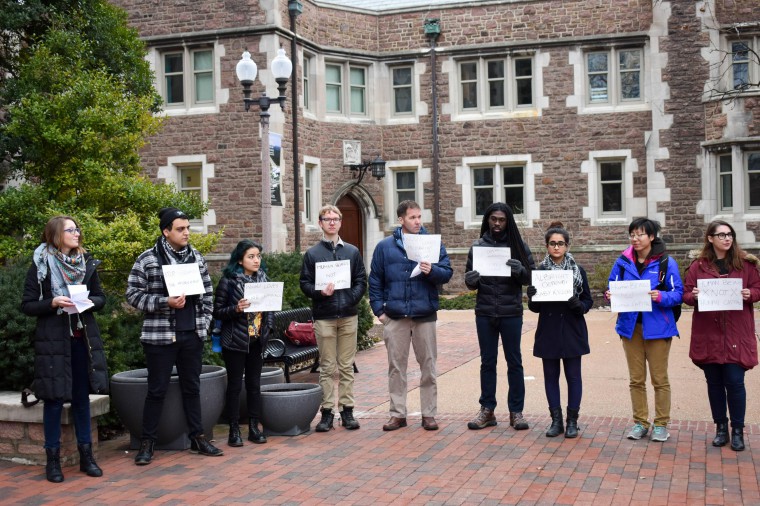 Courtesy of Chelsea Birchmier
Students and a professor protest a talk by former former Secretary of State Madeleine Albright and former National Security Advisor Stephen Hadley outside Graham Chapel.
This Wednesday, on Feb. 8, Washington University and the Pulitzer Center on Crisis Reporting hosted former Secretary of State and U.N. ambassador Madeleine Albright and former National Security Advisor Stephen Hadley in Graham Chapel to discuss “A New Approach to the Middle East,” and the Atlantic Council’s Middle East Strategy Task Force, which Albright and Hadley co-chair. According to the Pulitzer Center event page, the task force is “a two-year initiative aimed at forging new policy solutions that harness the resources and human capital of the Middle East region itself as a solution to state failure, civil wars, and extremist violence.”
These speakers are war criminals who carry violent and bloody legacies. In 1990, Albright and the Clinton administration advocated for harsh economic sanctions against Iraq that resulted in the deaths of 576,000 Iraqi children. When asked in an interview, Albright responded that the deaths of half a million Iraqi children as a result of U.N. sanctions was “a hard choice. But…the price was worth it.” Albright was also behind the 1999 bombing of Serbia, which killed thousands of civilians and destroyed hundreds of schools, libraries and hospitals. When Serbian activists protested her war crimes, she called them “Disgusting Serbs” and shouted at them to leave.
Hadley is responsible for falsely accusing Iraq of buying uranium from Niger, a primary justification the Bush administration provided for the invasion of Iraq in 2003. Hadley is tightly connected to the weapons industry, and he has served on the board of arms manufacturer Raytheon since 2009. He is also connected to oil giant ExxonMobil and guided Trump to nominate ExxonMobil CEO Rex Tillerson as secretary of state.
We condemn Wash. U.’s choice to offer a platform to Albright, Hadley and the Middle East Strategy Task Force, particularly given Chancellor Wrighton’s recent statement declaring a commitment to “the safety, well-being and academic success of all of our students, faculty and staff,” in light of the travel ban. Awarding honorary degrees to war criminals like Albright does not make international students and faculty feel safe, nor does referring to human beings as “human capital.” Language of “harnessing” conjures up dehumanizing images of people as cattle and emphasizes dollar signs over human life. Saying that the Middle East is full of failed states does not uphold Wrighton’s ideal of a “global community of scholars”; moreover, we cannot discuss civil wars and collapsed infrastructures without acknowledging the role of U.S. imperialism in helping to create such conditions. Inviting people to campus who have histories of human rights violations abroad does not make Wash. U. a welcoming space to “students, scholars, faculty and staff from all around the world.”
Unfortunately, Wrighton also puts capital over people when he makes statements on CNN that lament the executive order as a hindrance to a “stronger, more vibrant U.S. Economy” and not as a policy that will violently tear people—not just University students, faculty and scholars—from their homes, their lives and their families. And even while condemning the executive order, Wrighton asserts the need to “maintain national security,” a phrase that is fraught with xenophobic undertones alluding to a desire to protect the U.S. from a dangerous “other.” The language used by Wrighton mirrors that of Albright, Hadley and their task force, and we must hold our University leadership to higher standards.
Importantly, these issues are not separate from Trump’s anti-immigrant, anti-Muslim, anti-black and anti-brown stances. If the claims to oppose Trump’s travel ban (which it should), then it must also oppose the policies and the people that create refugee crises in the first place. In our activism, we must challenge ourselves not only to oppose Trump but to oppose policies that U.S. foreign policy have been building up for decades; what good does it do for Albright to register herself in the Muslim registry while simultaneously advocating for the bombing of Muslim children?
The Student Life editorial board, Wash. U. MSA and other Wash. U. students, have spoken out against the travel ban and urged Wrighton to offer more than lip service to immigrants. We too call upon Wrighton and Wash. U. leaders to do more. Now is the time for Wrighton to offer tangible support to black and brown international students (as did the University of Michigan) by explicitly refusing to comply with the executive order, collaborate with ICE officials or release the immigration status of its students.
We also call upon Wrighton and University leaders to stop hosting people like Albright and Hadley who, from sanctions to drone strikes, are complicit in economic and military violence abroad. We call upon Wash. U. faculty to stand on the right side of history and join protest picket lines like Professor Bret Gustafson did today. We call upon allies to resist the normalization of a racially and religiously violent event like this because we too are complicit in this violence when we make space for war hawks. If Wash. U. wishes to politically engage with Middle East policy, they should use their incredible institutional prestige to bring in real scholars of international repute, like Mahmood Mamdani, instead of political hacks.
Finally, we call upon our fellow students to be vocal in our opposition to partnerships with people and organizations that have committed heinous crimes in the U.S. and abroad. We must challenge our University and hold Wash. U. leadership accountable when it hosts war criminals on our campus. We must ask ourselves: can Wash. U. really say it cares about international students and immigrants when it does not take concrete action to stand for their rights in the U.S. and against the destruction of their homes, friends and families abroad?
Stay in Touch!
Get the latest and top news from StudentLife delivered to your inbox