Forum
After a month and a half, WashU still offers no explanation of U.S. Secretary of Education visit
Holle Ritter | Staff Ilustrator
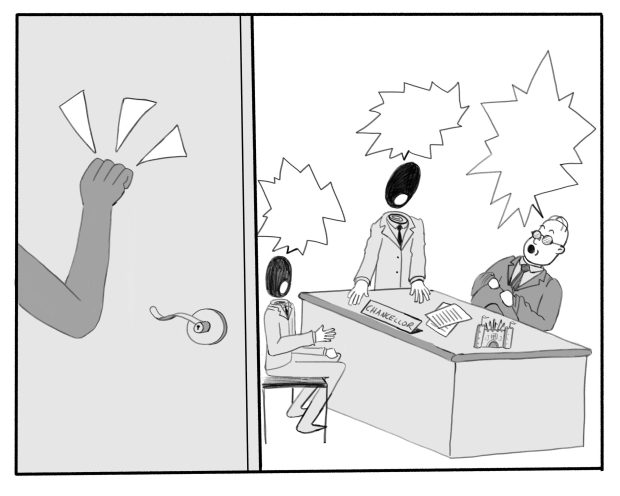
It has now been about a month and a half since U.S. Secretary of Education Linda McMahon’s visit, and University administration has yet to speak on what the meeting entailed. As a student of WashU, I take issue with our administrators’ continued lack of transparency.
In a panel held with other St. Louis education leaders, Chancellor Andrew D. Martin said, “We engage and meet with everyone, and we advocate for our interests, sometimes publicly, most of the time privately. … I can tell you that there are many members of the Washington University community who do not think that is the right thing to do.”
My frustration with Martin, Vice Chancellor for Student Success Anna “Dr. G” Gonzalez, and other members of University administration has stemmed from our seemingly different standards of public and private. As a student, I understand that some matters must be discussed in private. But I became suspicious when, at the same panel, Martin revealed that the McMahon visit was scheduled about a week in advance. Martin would have had time to inform the College of Arts & Sciences that he would not be able to attend their panel, but he chose to keep the entire happening of this meeting private.
The only communication that the chancellor seems to prioritize is the conversations he has with federal officials. “We’re happy to sit down and talk to you,” Martin recounted. “We are an educational institution nonetheless, and you are the Secretary of Education.” He has made numerous trips to Washington, D.C., to advocate for WashU after the Trump administration’s attacks on higher education. Seeing as Martin’s academic background is in political science, it makes sense as to why his priority lies here. I have no issue with Martin going to D.C. As the spokesperson for the school, it makes sense why he would choose to. It doesn’t surprise me that he’s made a practice of speaking with U.S. officials since before the Trump administration. My frustration comes with the fact that the WashU administration is alarmingly secretive about anything discussed in these meetings and their outcomes.
There was a time when WashU’s chancellor was more communicative with their community. Former Chancellor Mark S. Wrighton was known for his emails that he would send out to WashU students and faculty after notable events. As Student Life editor Emily Schienvar wrote in 2016, “We’ve come to expect it: something tragic happens—a shooting, a natural disaster—and an email pops up in the inboxes of students and faculty all across Washington University ‘on behalf of Chancellor Mark S. Wrighton.’” But he would also be critiqued for how general these emails would be. Since students complain when you speak and complain when you don’t speak, it would seem to chancellors that they just can’t win.
It’s not about speaking to students and faculty at any given moment; it’s about making statements that count. It’s also about having the policies to back up what you’re saying.
A question Gonzalez recently asked at a Student Union session on Sept. 29 has lingered with me: “What are students doing in order to prevent sexual assault?” In a climate where we are currently grappling with the Cornell 7 case and sexual violence on college campuses, a statement like this is out of touch without explicit information as to how university leaders will pull their weight in sexual assault prevention. The chancellor’s administration has a tendency to either ignore those asking for accountability or to place it on others, those of whom usually have less influence. Martin’s administration has exhibited this pattern consistently. For example, following the humanities report decision, they are asking faculty to consolidate their own departments instead of making the cuts themselves.
The solution for people’s frustration isn’t to go deeper into seclusion. It’s to answer the questions that you can. I also don’t want for people to become fine with all of this because they think that administration won’t change or because they way that they’re acting is normal. It’s okay to ask more questions. It’s okay to ask more of our administrators.
Stay in Touch!
Get the latest and top news from StudentLife delivered to your inbox