Forum
Boulevards, Backroads, and the Uneven Paths to Success: How WashU’s neutrality allows recruiting budgets to shape student ambitions and opportunity
Marceline Lee | Illustration Editor
I am from a mid-sized central Illinois town and a working-class family. We lived in a neighborhood where few had collegiate aspirations, and many of my friends and neighbors opted for blue-collar careers instead. The consequences of economic scarcity were readily apparent, and having seen the impact of these consequences firsthand, I knew I wanted my career to benefit communities like mine.
I found like-minded people during my undergraduate education at Illinois State University (ISU). My peers wanted to find careers that would allow them to make positive impacts on the world. They sought positions in the government, nonprofit organizations, and public schools, and many of them achieved their aspirations. Some did not, but at a state school like ISU, it is understood that there are certain limitations on career opportunities.
WashU, by contrast, has the reputation, resources, and influence to offer something more. When I got to campus, I expected the coffee chats, employer receptions, and networking events to expose students to new possibilities and empower them to pursue their ambitions — wherever those ambitions lead them. But while those resources do introduce students to some new possibilities, disparities in employer visibility disproportionately elevate some career paths, shaping which possibilities students see as accessible. And when WashU allows employers to purchase greater visibility, public-service employers — many of which face resource limitations — risk being overshadowed. In this environment, employers’ financial capacity limits what careers students perceive as accessible rather than the breadth of their own ambitions.
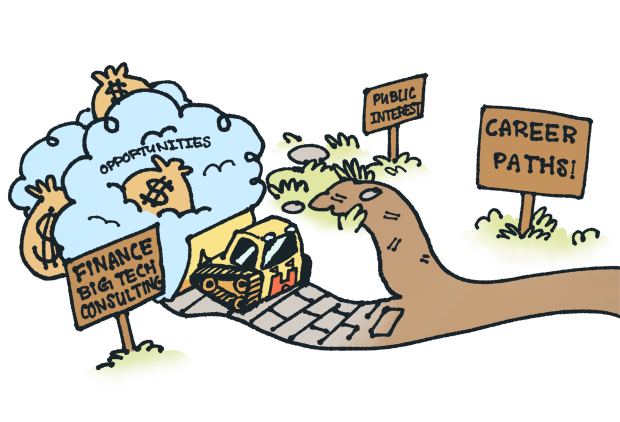
This is called career funneling: the process by which campus structures, student culture, and corporate recruiting cycles channel students toward a narrow range of career paths by shifting students’ perceptions of success and accessibility.
By altering how students define success, universities steer students away from pursuing their once-aspired careers and toward careers more prominently promoted on campus. And when accessibility of public-service careers is limited, the substance of choice begins to erode. The result can still appear to be a free choice, but how free is your choice when your alternative is a career path with fewer recruiters, fewer events, fewer institutional connections, and fewer visible opportunities?
This is not because some employers recruit more aggressively or more strongly desire to employ WashU grads. Public-service-oriented employers and major corporations enter the recruiting process with stark differences in their available resources, and WashU’s institutional neutrality allows for those disparities to translate into limitations for students. Asymmetrical resources push public-interest recruiters into the corners of career fairs and the outskirts of campus, while corporate employers with more resources can maintain a constant presence in students’ lives.
I am not advocating for WashU to restrict on-campus corporate recruiting. I am advocating for WashU to provide students with more opportunities by reducing the gaps between corporate and public-service recruiting. Treating employers with dramatically unequal resources as though they enter campus on equal footing does not produce balance; it allows existing disparities to reproduce themselves, limiting student opportunity along the way.
These structures were not built on bad intentions. WashU overwhelmingly wants its students to succeed, and its career resources are intended to support that success. But success is a subjective concept, and students are best positioned to determine what success means for them — not a corporate recruiter or a career advisor. Students may arrive on campus uncertain of what their definition of success is, but the University’s responsibility is to guide students in discovering that for themselves — not determine it for them. By remaining neutral in a recruiting environment that is anything but neutral, WashU risks allowing financial disparities between employers to influence how students define success. That concern becomes particularly salient when 88% of the top employers at WashU are finance, Big Tech, or consulting firms, while zero are public-interest employers. In this context, neutrality begins to look much less like balance.
But it doesn’t have to be like this. On-campus career funneling results from policy decisions that we can have a part in. This is why I joined Class Action, a national student organization urging elite universities to use their resources and influence to serve the public, rather than merely preserve their own prestige. We’ve done the research, and we’ve identified the pitfalls. Now it is up to all of us to voice our concerns to the university and call on our administrators to change
We’re asking WashU to support students’ aspirations to pursue public service by increasing the summer internship fund, which is one of the lowest summer internship funds of peer institutions we reviewed. We’re asking WashU to expand public-service employers’ presence on campus. We’re asking WashU to make career exploration a part of every student’s educational journey. And we’re asking WashU to adjust and leverage corporate recruiting fees to divert additional funding toward expanding public-service opportunities.
These are the changes we are asking WashU to make, and we are inviting students, faculty, and staff to join us by signing our open letter.
I am very proud to attend WashU, and I believe deeply in what this University can be. That is why these shortcomings matter so much. WashU has the influence and capacity to shape which aspirations students see as realistic; it should not leave that power to disparities in recruiting resources. Students come to WashU with ideas and dreams about the lives they want to lead, the problems they want to solve, and the impact they want to create. WashU should make these ambitions easier to pursue, not easier to abandon.
Stay in Touch!
Get the latest and top news from StudentLife delivered to your inbox