Forum
From conservatism to semi-liberalism: WashU through the eyes of a Miamian
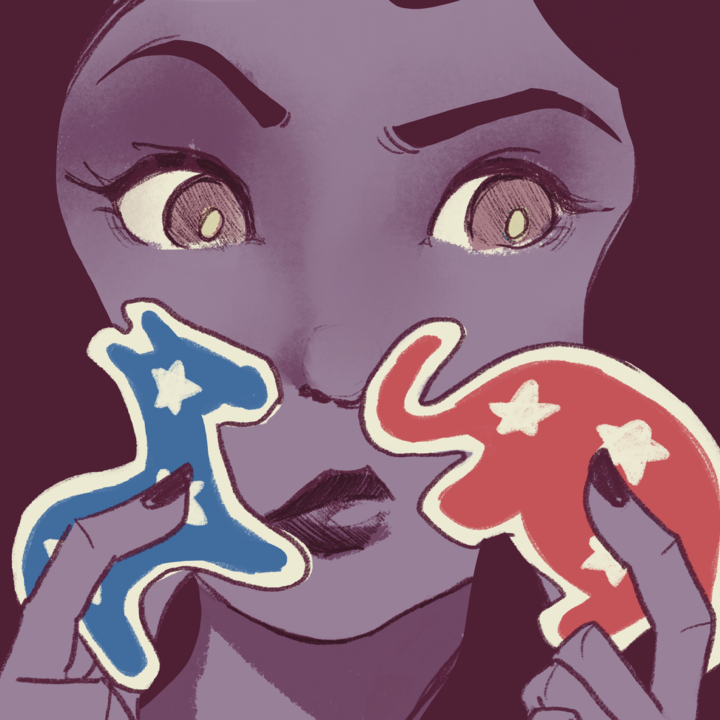
Olivery Ni | Contributing Illustrator
“I know Florida is red, but I thought Miami would be blue,” my roommate said, after I told her I was still adjusting to WashU’s political climate four weeks into my first year.
As someone who grew up surrounded by conservatism, WashU is the most liberal institution I have stepped foot in. I am sure that anyone who grew up in a conservative environment would be inclined to agree.
In the state of Florida, under a near constant wave of heat and rain, resides my hometown, Miami. Political conversations often start with cafecito y pastelitos de guayaba (coffee and guava pastries), the kind of fuel that keeps conversations going long after plates have been emptied. At every family dinner, once the dominoes are tucked away and the cafecito cups are refilled, political conversations start to fill the room again. I hear the same words repeated over and over with the same intensity: “We came here to escape communism — don’t forget that.”
Surrounded by heads adorned in red MAGA hats and horror stories of Cuban totalitarianism, I grew up thinking that conservatism was the only acceptable perspective — a mindset deeply rooted in Miami’s Cuban American community. In fact, a 2020 Pew Research Center survey found that Cuban Americans remain among the most reliably Republican-leaning Latino groups in the U.S., a reality that mirrors the conversations at home. It is almost unthinkable that some people divert from the conservative majority, and those who do (even if they are slightly left-leaning) are deemed communists.
It wasn’t until late middle school that I started to question the beliefs I grew up with. Being an Orthodox Christian taught me to love my neighbor and seek justice for the oppressed — values that often clashed with the political ideas I heard around me. That realization sparked my interest in law, leading me to work with my local representative on immigration issues and help immigrants navigate an unfair system. Once I began speaking out about my evolving views, my family often dismissed my opinions at the dinner table, branding me as one of the many “brainwashed by liberal propaganda.”
When I first arrived at WashU, I felt out of place, but over time I’ve realized the discomfort was productive. I began to listen with curiosity in my political science classes and late-night dorm conversations. Some evenings, I have casual conversations on abortion and gun rights, hearing different perspectives from the ones I grew up with. On others, I attend discussion-based events sharing these perspectives, such as one where a panel argued for DEI in higher learning institutions like WashU. With over 450 student organizations — including bipartisan and issue-based groups like College Democrats, College Republicans, and the Washington University Political Review — WashU encourages open debate across ideologies.
This exposure hasn’t turned me fully liberal, but it has taught me the value of nuance. I still hold onto the lessons I grew up with — the importance of personal responsibility, hard work, and freedom of choice — but I’ve learned those values can coexist with empathy and collective care. I now support policies often associated with the left: a stronger social safety net to protect vulnerable communities, sensible environmental regulations to safeguard our planet, and immigration reforms that treat newcomers with dignity and humanity.
Today, I describe myself as “independent, left-leaning.” I’ve always resisted aligning with a single party and I used to feel the need to defend that stance, as if neutrality made me naïve or indecisive. However, that middle ground isn’t about indecision; it is about choosing to engage issue by issue, and being guided by compassion, evidence, and practicality.
Now, as I walk across campus, the memory of cafecito reminds me that every person’s perspective is rooted in a story that deserves to be heard. Stepping outside my ideological bubble has changed me. At WashU, I have been pushed to challenge my assumptions, with my Miami roots keeping me grounded in my family’s story of exile and struggle. Combining both is what has made me who I am today.
To students arriving at WashU, or leaving it for homes with different political environments, my advice is simple: Lean into the discomfort of listening. The hard conversations we avoid are often the ones that teach us the most. Political identity isn’t a fixed label we must carry; it is a reflection of many communities and experiences that shape us.
Stay in Touch!
Get the latest and top news from StudentLife delivered to your inbox